George Russell refused to second-guess himself after a late-race lock-up against his own teammate turned a potential Las Vegas Grand Prix win into a ninth-place finish. The Mercedes driver made clear he would rather chase glory and fail than settle for a safe podium in one of the most chaotic races of the 2026 season.
The moment that defined the night came on lap 48 of 50. Running third behind race leader Max Verstappen and teammate Kimi Antonelli, Russell launched an aggressive move on the inside at Turn 5. Antonelli had no overtake mode remaining. Russell locked the brakes, slid into the barriers, reversed back onto the circuit, and recovered only as far as ninth. Verstappen went on to win a race featuring dozens of lead changes in a relentless slipstream battle under the Las Vegas lights.
RUSSELL EXPLAINS WHY THE RISK WAS NON-NEGOTIABLE
Russell’s post-race comments left little room for ambiguity. He needed second place heading into the final laps if he was going to have any realistic chance of beating Verstappen to the line. Sitting behind his teammate would have left him poorly positioned for the decisive drag race down the Strip.
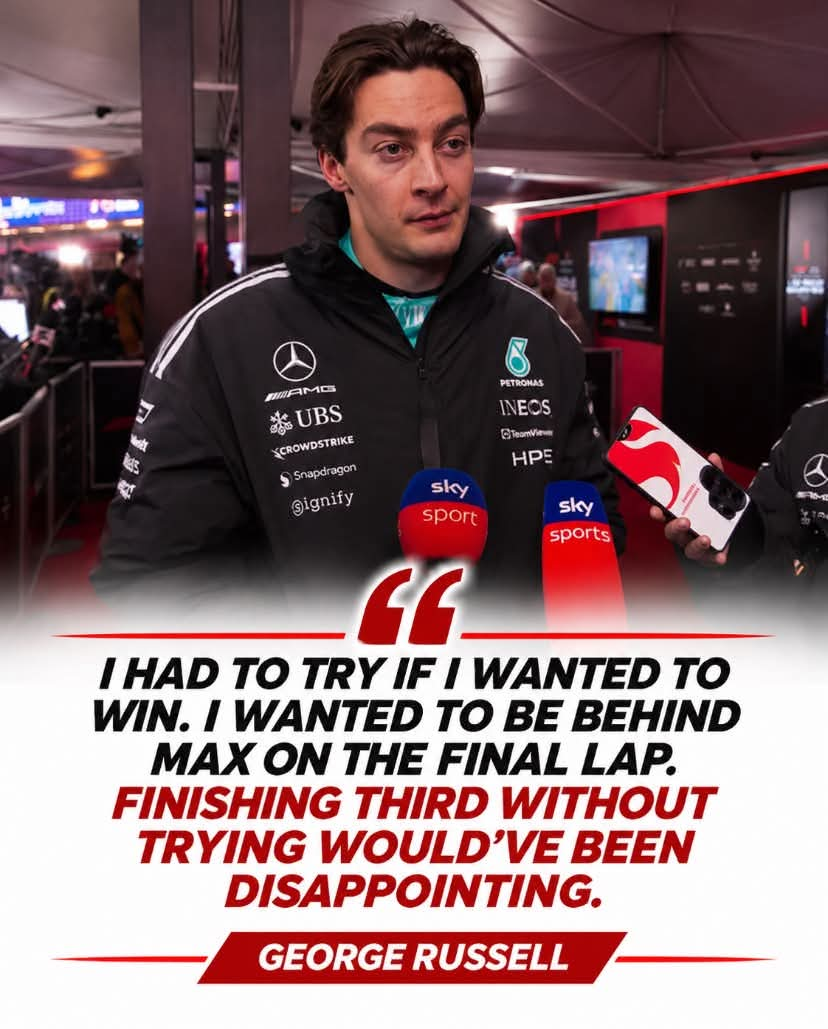
“I knew if I wanted to win the race I needed to be in second going into the last couple of laps,” Russell said. “Kimi didn’t have the overtake mode, and I just went for a high-risk move and paid the price, but I don’t regret it. Of course I’m disappointed with it, but I could have been conservative and I would have finished in third.”
That stance is pure racing driver logic. In a race where energy deployment and track position swung wildly from one lap to the next, finishing third without having thrown a proper punch at the win would have felt emptier than a ninth-place recovery. Russell has never been the type to bank points and smile for the cameras when a victory is still mathematically possible.
HOW THE LAS VEGAS RACE TURNED INTO A SLIPSTREAM SHOOTOUT
The 2026 Las Vegas Grand Prix was never going to be a conventional grand prix. The long straights and relatively low downforce package turned the event into a high-speed game of cat-and-mouse. Drivers repeatedly overtook into the final corners only to be re-passed on the next straight. Lead changes piled up. Energy management became as important as pure pace.
Russell spent large parts of the race trading the lead with Verstappen. He felt strong on deployment and believed he had the tools to make a move stick late. The problem was the middle sector. Pushing hard for the tow left him vulnerable, forcing strategic adjustments mid-race. By the time the final three laps arrived, he found himself behind Antonelli and running out of options.
The young Italian, already crowned 2026 world champion, was doing his job by holding second. Russell’s decision to attack his own teammate was therefore both logical and messy. Team orders rarely apply cleanly when both cars are still fighting for the win and the championship picture remains fluid for everyone else.
WHAT THE MISTAKE MEANS FOR RUSSELL AND THE CHAMPIONSHIP FIGHT
The points loss was significant. Russell dropped to fourth in the drivers’ standings, level on points with Lando Norris and a few points behind Lewis Hamilton. Verstappen’s victory strengthened his grip on second place overall. Russell’s podium drought also stretched to six races, an unwelcome statistic for a driver who has regularly shown race-winning pace this season.
For Mercedes the result was mixed. Antonelli brought home solid points in fourth, but the team watched a potential one-two fight dissolve into a solitary mid-pack recovery for their more experienced driver. The internal dynamic between the established British star and the newly crowned Italian champion will be worth watching as the season winds down. Russell’s willingness to attack his teammate so late shows he still sees himself as the primary challenger inside the garage when the opportunity arises.
THE BROADER LESSON FROM A HIGH-STAKES ERROR
Formula 1 rewards calculated aggression more often than pure caution, especially on street circuits where overtaking windows are narrow and the consequences of hesitation are immediate. Russell’s crash was expensive, but it also reinforced his identity as a driver who will go for the win when the chance appears. Fans and teams notice that quality. It is the same mindset that has produced memorable wins and near-misses throughout his career.
Verstappen, never one to miss a moment of psychological warfare, later described the incident with characteristic bluntness after earlier weekend tension between the two. The Dutchman celebrated the result while Russell absorbed the cost of ambition. That contrast between the two drivers has defined several of their recent battles.
Looking ahead, the final races of 2026 will test whether Russell can convert similar late-race opportunities into results rather than barriers. The car has the pace. The driver has the intent. The question is whether the execution can match the courage when the stakes are highest.
Russell walked away from Las Vegas without a podium and without self-pity. In a sport that often punishes hesitation more than mistakes, that attitude may prove more valuable than the two points he actually scored. The next time the opportunity appears, few will be surprised if he takes the risk again.