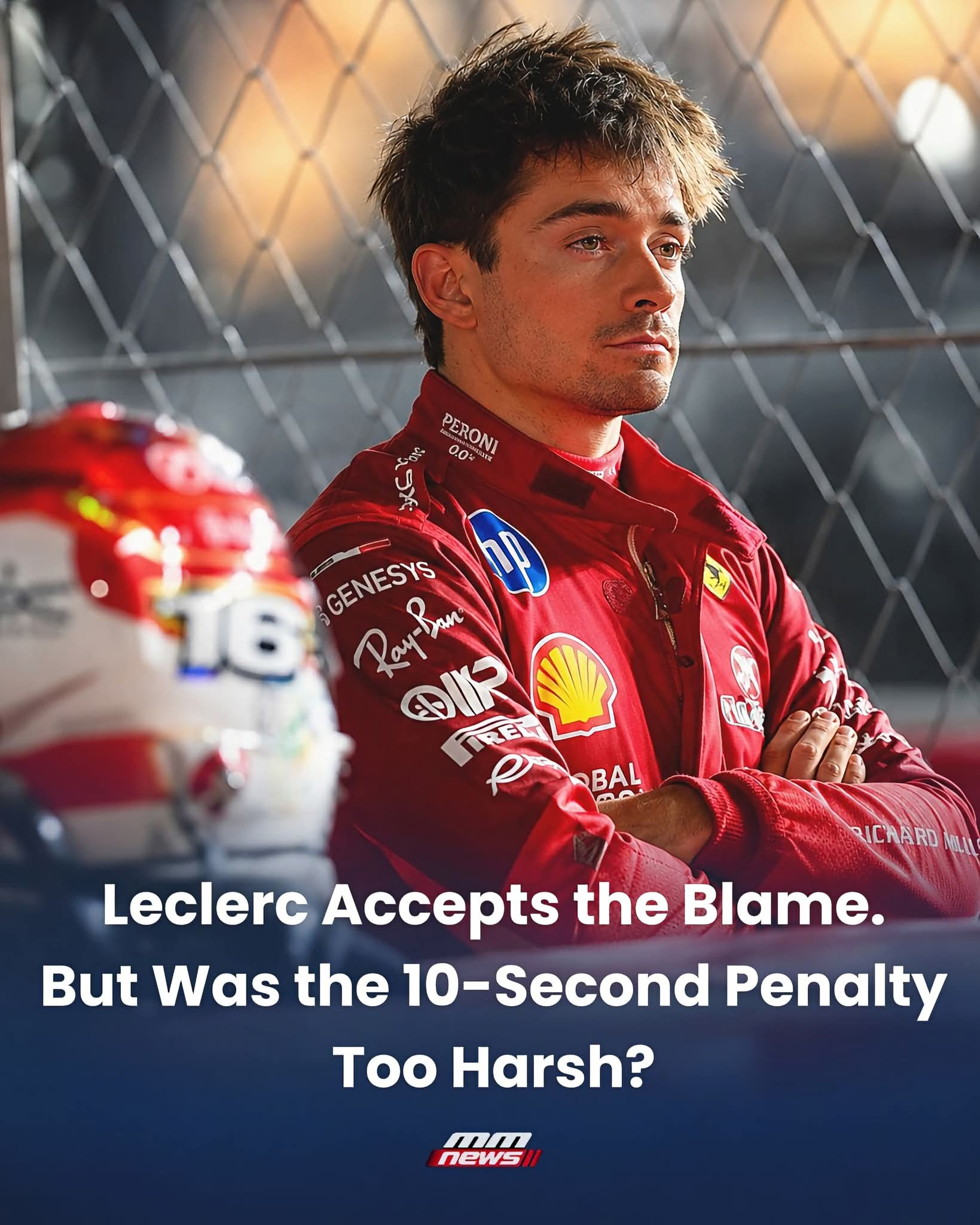
Charles Leclerc has admitted that he made a mistake during his collision with Lewis Hamilton at the Las Vegas Grand Prix, but the Ferrari driver has questioned whether the resulting 10-second time penalty was as fair as the stewards believed.
What should have been another opportunity for Ferrari to collect valuable championship points instead turned into a frustrating evening, with both drivers losing out following an incident that has raised fresh questions about the team’s internal racing dynamics.
Leclerc’s attempt to overtake his teammate at Turn 7 ended in contact, triggering an investigation by the stewards and another difficult moment in what has become an increasingly complicated relationship between Ferrari’s two star drivers.
Although Leclerc accepted responsibility for the incident, his explanation revealed that he still believed there was enough room to complete the manoeuvre.
For Ferrari, however, the biggest concern may not be the penalty itself. It is the growing frequency of costly incidents involving its own drivers.
WHAT HAPPENED BETWEEN CHARLES LECLERC AND LEWIS HAMILTON?
The incident unfolded at Turn 7 during the Las Vegas Grand Prix when Leclerc attempted to overtake Hamilton.
The Monegasque driver saw an opportunity to make a move on his teammate, but the manoeuvre ended with the two Ferrari cars making contact.
The stewards investigated the incident and ultimately placed full responsibility on Leclerc.
Their assessment was that the Ferrari driver had not established the necessary right to the corner, meaning he was not entitled to expect Hamilton to leave sufficient space for the attempted overtake.
As a result, Leclerc received a 10-second time penalty.
While the decision settled the official question of responsibility, it did not completely eliminate the debate surrounding the severity of the punishment.
Leclerc acknowledged that he had made an error, but his comments suggested that he genuinely believed the available space was sufficient to attempt the move.
That distinction is important. A driver can accept responsibility for a collision while still questioning whether the punishment adequately reflects the circumstances.
HOW THE 10-SECOND PENALTY DESTROYED LECLERC’S RACE
The consequences were particularly painful for Leclerc because the penalty significantly affected his final classification.
He eventually dropped from sixth position to tenth, losing four places in the final result.
Hamilton, meanwhile, managed to recover and finish seventh.
The difference between their finishing positions made the incident even more frustrating for Ferrari.
Instead of having both drivers contribute valuable points, the team found itself dealing with another disappointing afternoon involving its own machinery.
For Leclerc, the result was especially damaging because penalties of this nature can erase the progress made through careful tyre management, race strategy and overtaking.
Formula 1 is a sport where small margins frequently determine the difference between a successful weekend and a disappointing one.
A 10-second penalty can be particularly expensive when the field is closely packed, as it was in Las Vegas.
The incident also raises questions about how Ferrari’s drivers should approach wheel-to-wheel battles when racing each other.
WAS THE 10-SECOND PENALTY FAIR?
Leclerc’s punishment has naturally created room for debate among Formula 1 fans.
From the stewards’ perspective, the central issue was whether Leclerc had established the right to the corner before attempting the overtake.
Under Formula 1’s racing guidelines, drivers are expected to demonstrate sufficient overlap and control before claiming space during an overtaking manoeuvre.
Simply placing a car alongside a rival does not automatically guarantee the right to the racing line.
If the attacking driver has not established the necessary position, responsibility for avoiding contact can fall on the driver attempting the move.
That appears to have been the foundation of the stewards’ decision.
However, Leclerc’s perspective highlights another important element of modern Formula 1 racing: the difference between what a driver sees from the cockpit and what race officials determine from multiple camera angles.
Drivers make decisions at extremely high speeds, often with limited visibility and only fractions of a second to react.
That does not excuse mistakes, but it helps explain why drivers sometimes disagree with the severity of penalties even after accepting responsibility.
In my view, the stewards’ decision can be defended if the evidence clearly showed that Leclerc had not earned the right to the corner. Nevertheless, the broader discussion about consistency in penalty decisions remains important.
The key question should always be whether similar incidents receive similar punishments, regardless of which drivers or teams are involved.
FRED VASSEUR FACES ANOTHER FERRARI HEADACHE
Perhaps the most worrying development for Ferrari is that this is not an isolated incident.
The collision between Leclerc and Hamilton comes after their previous on-track clash during the Mexican Grand Prix.
Having two highly competitive drivers is normally an advantage for a team, but that advantage can quickly disappear when internal battles begin costing valuable championship points.
Ferrari team principal Fred Vasseur was clearly unhappy with the latest incident.
His frustration is understandable.
Ferrari invests enormous resources in giving both drivers competitive machinery, and the team’s primary objective is to maximise its results.
When teammates collide, the consequences extend beyond the drivers involved.
Engineers must assess potential damage, strategists must reconsider their race plans, and management must determine whether changes are necessary to prevent another occurrence.
Vasseur now faces the difficult task of maintaining competitive freedom while ensuring that both drivers understand their responsibilities when fighting each other.
He cannot simply ask Leclerc and Hamilton to stop racing aggressively. Both are elite competitors who expect opportunities to fight for strong results.
However, Ferrari must establish clearer expectations about acceptable risks during internal battles.
LEWIS HAMILTON AND CHARLES LECLERC: IS FERRARI’S DRIVER PARTNERSHIP BECOMING A PROBLEM?
The partnership between Hamilton and Leclerc was always going to attract enormous attention.
Hamilton arrived at Ferrari with an extraordinary record, multiple world championships and years of experience competing at the highest level.
Leclerc, meanwhile, has established himself as Ferrari’s long-term star and one of the most naturally talented drivers on the grid.
Putting two ambitious drivers in the same garage creates enormous potential, but it also introduces a complicated management challenge.
Both drivers want to demonstrate their speed, establish themselves as the team’s leading competitor and maximise their opportunities.
That competitive instinct is essential in Formula 1.
However, there is a difference between healthy competition and unnecessary risks that damage the team’s overall performance.
The Mexican Grand Prix incident had already highlighted the possibility of tension between the two Ferrari drivers.
The Las Vegas collision has now strengthened concerns that Ferrari could be entering a difficult period if the situation is not addressed.
Importantly, two incidents do not automatically mean there is a serious personal disagreement between Hamilton and Leclerc.
Their relationship should not be judged entirely through racing incidents.
Nevertheless, repeated contact on track can create frustration, particularly when one driver believes the other has compromised an important result.
Ferrari needs both drivers working towards the same objective rather than allowing individual battles to become bigger than the team’s ambitions.
WHY THIS INCIDENT MATTERS FOR FERRARI’S CHAMPIONSHIP AMBITIONS
Every point matters in Formula 1, particularly when the competition between constructors is tight.
Ferrari cannot afford to repeatedly sacrifice valuable results because of avoidable incidents between its own drivers.
The consequences of the Las Vegas collision go beyond Leclerc’s individual finishing position.
The team lost the opportunity to secure a stronger combined result, while the incident also placed additional pressure on its management structure.
There is another important consideration: team confidence.
When drivers begin questioning whether their teammates will leave enough space during wheel-to-wheel battles, trust can gradually become an issue.
That can influence how aggressively they race each other in future events.
Ferrari must avoid reaching a situation where both drivers become overly cautious around one another or, conversely, begin taking unnecessary risks to establish superiority.
Neither outcome would benefit the team.
The strongest Formula 1 partnerships are built on competition supported by clear boundaries.
Ferrari needs to find that balance quickly.
WHAT HAPPENS NEXT BETWEEN HAMILTON AND LECLERC?
The next challenge for Ferrari will be preventing the Las Vegas incident from becoming a recurring storyline.
Vasseur will likely want a detailed discussion with both drivers about what happened and how similar situations should be handled in future races.
That does not necessarily mean Ferrari will introduce strict team orders.
Instead, the priority should be establishing clear racing expectations.
Both drivers must understand that they are free to compete, but they also have a responsibility to protect the team’s interests.
For Leclerc, the incident provides another reminder that aggressive overtaking attempts must be carefully calculated, particularly when racing a teammate.
For Hamilton, the priority will be ensuring that he can compete fairly without becoming involved in unnecessary internal battles.
The bigger question is whether Ferrari can turn this latest disappointment into a learning experience.
If the team responds properly, the incident could strengthen its internal racing procedures.
If it fails to address the problem, however, future collisions could become increasingly damaging.
FINAL VERDICT: FERRARI MUST SOLVE ITS INTERNAL PROBLEM BEFORE IT COSTS MORE POINTS
Charles Leclerc has accepted that he made a mistake in his collision with Lewis Hamilton, but his doubts about the 10-second penalty show that he still believes the situation was not entirely straightforward.
The stewards have delivered their verdict, and Ferrari must now concentrate on the bigger picture.
The most concerning aspect of the Las Vegas incident is not simply that two teammates collided. It is that Ferrari has experienced another costly moment involving the same drivers shortly after their previous clash in Mexico.
Hamilton and Leclerc are both capable of delivering exceptional performances, and Ferrari needs their combined talent to compete at the highest level.
However, talent alone will not guarantee success if internal competition repeatedly compromises the team’s results.
Fred Vasseur now has an important management challenge: allowing both drivers to race freely while ensuring that their battles do not become Ferrari’s biggest weakness.
The 10-second penalty may have ended Leclerc’s hopes of a stronger Las Vegas result, but Ferrari’s real test will be making sure this incident does not become a pattern.
What do you think? Was Charles Leclerc’s 10-second penalty justified, or were the stewards too harsh? And should Ferrari introduce stricter rules for Hamilton and Leclerc when they race each other?