In Formula 1, raw speed is essential, but speed alone does not guarantee greatness. The ability to read a race, anticipate an opponent’s next move, manage pressure and make the right decisions at critical moments can be just as important as outright pace.
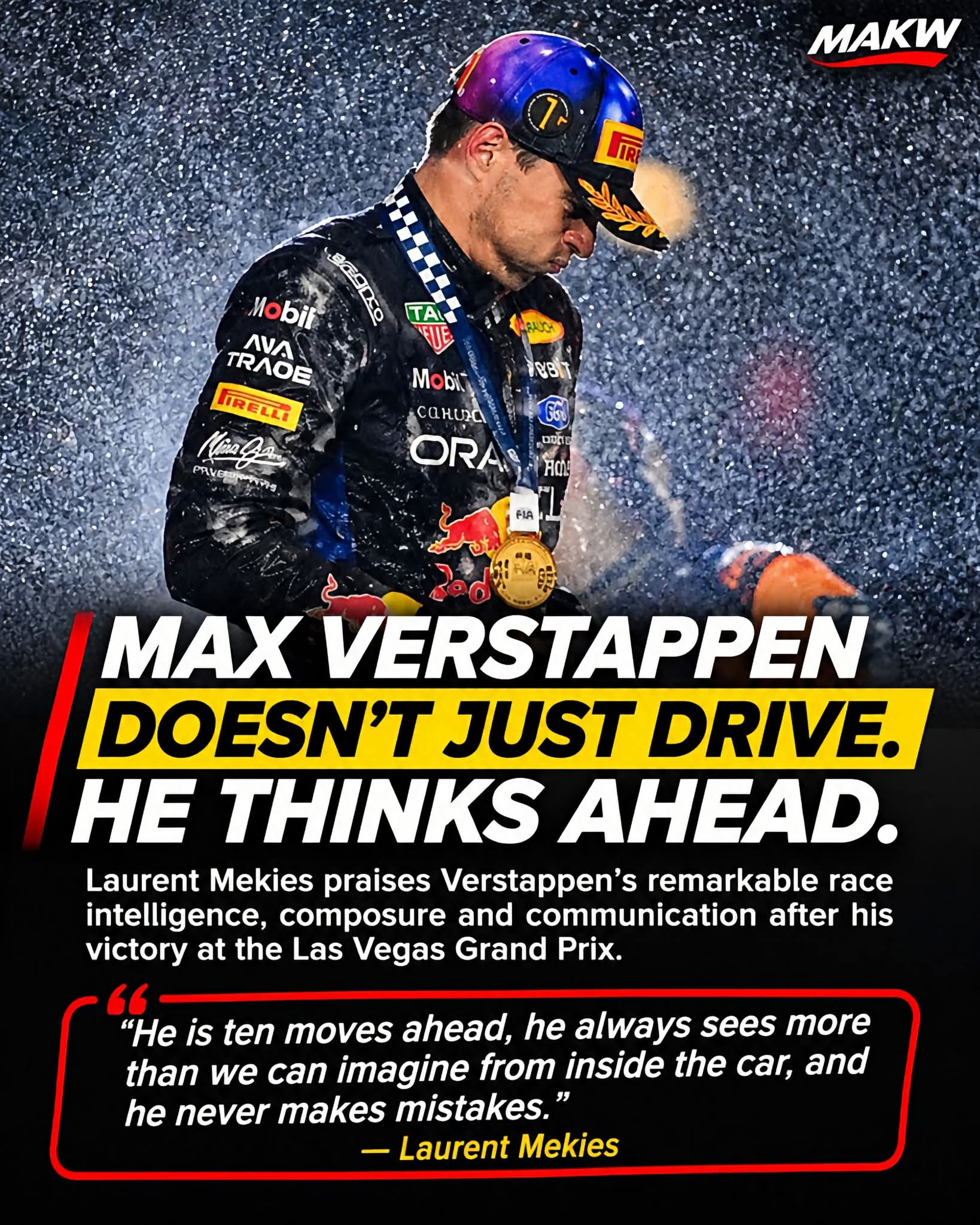
For Max Verstappen, these qualities appear to come naturally. The four-time world champion has repeatedly demonstrated that his understanding of racing goes far beyond simply driving a car quickly. According to Red Bull team principal Laurent Mekies, Verstappen possesses a remarkable ability to think several steps ahead, making him an exceptionally intelligent competitor.
Mekies’ praise highlights an important part of Verstappen’s success: his ability to process complicated situations at incredible speed while maintaining composure and communicating effectively with his engineering team.
But is this race intelligence what separates a great Formula 1 driver from a truly exceptional one?
LAURENT MEKIES IDENTIFIES WHAT MAKES VERSTAPPEN SPECIAL
Laurent Mekies has praised Verstappen’s racing intelligence, composure and communication, highlighting characteristics that make the Dutchman such a formidable presence on the Formula 1 grid.
While many drivers concentrate on responding to what is happening immediately in front of them, Verstappen often appears to anticipate how an entire racing situation will develop.
Whether he is managing tyre degradation, defending a position, planning an overtaking manoeuvre or adjusting his approach to changing conditions, his decisions frequently reflect an understanding of the bigger picture.
This ability is particularly valuable in modern Formula 1, where races involve complicated strategic calculations involving tyre compounds, pit-stop windows, energy management and constantly changing track conditions.
A driver who understands these elements can make a significant difference to a team’s overall performance.
WHY THINKING AHEAD IS A MAJOR ADVANTAGE IN FORMULA 1
Formula 1 is not simply a competition between the fastest cars and the most talented drivers. It is also a mental battle.
Every race presents situations that require drivers to make decisions within fractions of a second. A defensive move can influence tyre temperatures, an aggressive overtake can compromise the next corner, and an early pit stop can completely change the strategic direction of a race.
Verstappen’s ability to anticipate these situations gives him an important advantage.
Instead of focusing exclusively on winning the immediate battle, he often appears to consider what that battle means for the following corners, the next stint and ultimately the chequered flag.
This is one reason why his racecraft has attracted so much attention.
The difference between reacting and anticipating can be enormous. A driver who reacts to an opponent’s move may already be at a disadvantage. A driver who predicts that move can position himself to control the situation before it develops.
COMPOSURE UNDER PRESSURE: ANOTHER VERSTAPPEN STRENGTH
Another important quality highlighted by Mekies is Verstappen’s composure.
Formula 1 drivers operate in an environment where enormous pressure comes from multiple directions. They must satisfy team expectations, manage championship ambitions, respond to competitors and deal with the consequences of mistakes.
Remaining calm during difficult moments is therefore a valuable competitive advantage.
Verstappen has demonstrated throughout his career that he can maintain concentration during complicated races, including situations involving changing weather, safety cars and intense wheel-to-wheel battles.
This does not mean he never gets frustrated. His radio communications have occasionally revealed his emotions, particularly when he disagrees with a decision or encounters an unexpected problem.
However, the important distinction is his ability to refocus on the competitive task.
At the highest level of motorsport, controlling emotions while making technically complicated decisions can be just as important as physical preparation.
COMMUNICATION WITH RED BULL IS A CRUCIAL PART OF HIS SUCCESS
Verstappen’s relationship with his engineering team is another important element of his racing intelligence.
A Formula 1 driver cannot succeed through individual talent alone. The information exchanged between the cockpit and the pit wall plays a major role in determining race strategy and car performance.
Drivers must communicate tyre behaviour, balance problems, changing grip levels and the condition of their machinery.
Verstappen’s ability to provide feedback while simultaneously managing the demands of racing helps Red Bull understand what is happening on track.
Good communication also allows engineers to make better-informed strategic decisions.
This relationship becomes particularly important when races do not follow the expected script. A sudden change in weather, an unexpected safety car or an opponent adopting an alternative strategy can force teams to reconsider their plans immediately.
Having a driver who understands the strategic picture makes those decisions easier.
IS RACE INTELLIGENCE WHAT SEPARATES GREAT DRIVERS FROM EXCEPTIONAL CHAMPIONS?
There is a strong argument that it is.
Formula 1 has featured numerous drivers with extraordinary natural speed. However, becoming a multiple world champion requires more than consistently setting the fastest lap times.
Exceptional drivers understand how to maximise opportunities, minimise unnecessary risks and recognise when patience is more valuable than aggression.
They also understand that not every battle needs to be won immediately.
Verstappen’s development over the years has demonstrated the importance of combining natural speed with improved judgement and strategic awareness.
His early career was characterised by fearless overtaking and an aggressive driving style. As his experience increased, he developed into a more complete competitor capable of controlling races and managing different challenges.
That evolution is an important part of his legacy.
WHAT THIS MEANS FOR RED BULL’S FUTURE
For Red Bull, having a driver with Verstappen’s combination of speed, intelligence and communication is an enormous advantage.
Car performance can fluctuate between seasons, and technical regulations can dramatically change the competitive order. However, a driver’s ability to extract maximum performance from whatever machinery is available remains valuable.
Verstappen’s race intelligence could become even more important whenever Red Bull faces periods of technical difficulty or increased competition.
A driver who understands how to manage an imperfect car can sometimes achieve results that appear impossible based on outright performance.
It also places greater importance on the team’s ability to provide him with a competitive package.
Red Bull knows that having an exceptional driver is only one part of the championship equation. Engineering, strategy, reliability and operational execution must all work together.
THE VERDICT: VERSTAPPEN’S BIGGEST ADVANTAGE MAY NOT BE HIS SPEED
Laurent Mekies’ comments offer an interesting perspective on what makes Max Verstappen such a difficult competitor to beat.
His speed is obvious, his racecraft is widely recognised, and his achievements have already established him among Formula 1’s leading drivers.
However, his ability to anticipate situations, remain composed and communicate effectively could be among his most valuable qualities.
In modern Formula 1, where the smallest decisions can determine the outcome of a race, intelligence is a competitive weapon.
My view is that Verstappen’s greatest strength is not simply that he can drive faster than many of his rivals. It is that he often understands what needs to happen before the decisive moment arrives.
That is the difference between being a fast driver and being a complete racing competitor.
And as Formula 1 continues to evolve, this ability to think several steps ahead could remain one of the biggest reasons Verstappen is so difficult to defeat.
DO YOU AGREE WITH LAURENT MEKIES? IS MAX VERSTAPPEN’S RACE INTELLIGENCE THE QUALITY THAT SEPARATES HIM FROM OTHER FORMULA 1 DRIVERS, OR IS HIS NATURAL SPEED STILL HIS GREATEST WEAPON?