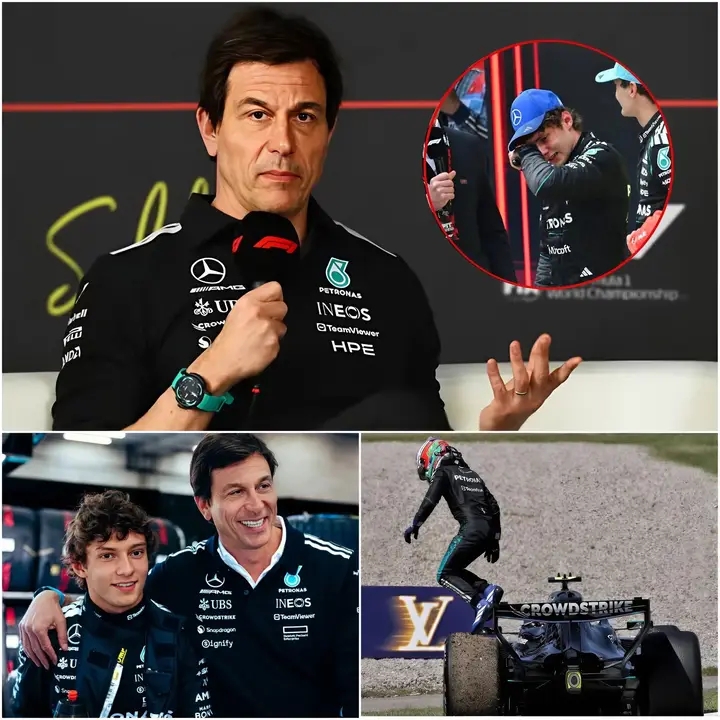
Formula 1 is often described as the ultimate team sport disguised as an individual competition. Nowhere was that reality more evident than during Kimi Antonelli’s frustrating weekend at the 2026 Spanish Grand Prix, where a promising performance ultimately ended in disappointment.
While many observers initially questioned whether the young Mercedes driver had simply lacked the pace to challenge for a stronger result at Circuit de Barcelona-Catalunya, Mercedes Team Principal Toto Wolff has made it clear that the story was far more complicated.
According to Wolff, Antonelli’s difficult afternoon was not the consequence of driver error or lack of speed. Instead, reliability issues within the Mercedes package prevented the Italian rookie from converting potential into points and reinforced a growing concern inside the Brackley-based team.
ANTONELLI SHOWED THE SPEED MERCEDES WANTED TO SEE
Coming into Barcelona, expectations surrounding Antonelli were high.
The Italian teenager has rapidly established himself as one of the standout stories of the 2026 Formula 1 season. Despite stepping into one of the most demanding seats on the grid, he has displayed maturity, consistency, and flashes of exceptional racecraft that have justified Mercedes’ decision to place its future in his hands.
Barcelona appeared to offer another opportunity to strengthen his growing reputation.
Throughout the weekend, Antonelli demonstrated competitive pace and looked capable of fighting among the leading group. His confidence behind the wheel continued to grow, and there were signs that another strong result could be within reach.
However, Formula 1 can be brutally unforgiving.
A race that began with promise slowly unraveled as technical concerns emerged, leaving Antonelli unable to achieve the finishing position both he and the team believed was possible.
TOTO WOLFF REFUSES TO BLAME HIS YOUNG DRIVER
One of the most significant aspects of Wolff’s post-race comments was his willingness to shield Antonelli from criticism.
In Formula 1, young drivers often face intense scrutiny when results fail to match expectations. Yet Wolff immediately moved to clarify that the problem did not originate behind the steering wheel.
Instead, the Mercedes boss openly accepted responsibility on behalf of the team.
That response speaks volumes about how highly Mercedes rates Antonelli.
The team understands that driver confidence is a valuable asset, particularly for a rookie learning the complexities of Formula 1. By publicly taking responsibility for the setback, Wolff reinforced the message that Mercedes remains fully committed to Antonelli’s long-term development.
It is a strategy that mirrors how Mercedes previously managed the growth of young talents throughout its modern era.
RELIABILITY IS BECOMING A SERIOUS CONCERN FOR MERCEDES
While Antonelli’s result may be disappointing, the bigger issue for Mercedes could be what it reveals about the car itself.
Reliability has traditionally been one of the team’s greatest strengths. During its dominant championship years, Mercedes built a reputation for combining speed with remarkable dependability.
That reputation is now being tested.
Technical failures are particularly damaging in the modern Formula 1 landscape because the margins between teams have become incredibly small. Losing points due to reliability problems can quickly derail championship ambitions, especially when rivals are consistently maximizing their opportunities.
Every retirement, every power unit concern, and every technical setback represents more than a single race result—it impacts momentum, confidence, and potentially the entire season.
For Wolff, solving these issues may now be just as important as finding additional performance.
WHY BARCELONA WAS A CRUCIAL TEST
The Spanish Grand Prix has long been considered one of Formula 1’s most revealing events.
Circuit de Barcelona-Catalunya demands a complete package. Cars need aerodynamic efficiency, strong tire management, balanced handling, and dependable mechanical performance.
Weaknesses are often exposed.
Because of that, Mercedes engineers will likely spend considerable time studying the data collected from Antonelli’s car.
Barcelona’s layout provides valuable insight into a team’s overall competitiveness, making any reliability concerns discovered there particularly significant.
If the problems were isolated incidents, Mercedes can recover quickly.
If they represent a deeper engineering challenge, however, the team may face a more complicated battle as the championship progresses.
ANTONELLI’S DEVELOPMENT REMAINS ON TRACK
The encouraging news for Mercedes is that Barcelona changes very little regarding Antonelli’s future prospects.
The young Italian continues to exceed expectations in many areas.
His adaptability has impressed engineers, his feedback has been praised internally, and his ability to handle pressure has demonstrated maturity beyond his years.
Importantly, setbacks like Barcelona are part of every successful driver’s journey.
Even Formula 1 legends endured difficult races early in their careers. What often separates great drivers from good ones is how they respond when circumstances work against them.
Antonelli now has another opportunity to learn valuable lessons about resilience, technical understanding, and race management.
Those experiences could prove invaluable as he continues his evolution into a potential future championship contender.
THE GEORGE RUSSELL COMPARISON WILL REMAIN IMPORTANT
Another fascinating subplot at Mercedes is the internal benchmark provided by George Russell.
Russell remains one of the grid’s most complete drivers and serves as an ideal reference point for Antonelli’s development.
Every qualifying session, race stint, and strategic decision provides direct evidence of how quickly the Italian is progressing.
Thus far, Antonelli has shown enough pace to suggest he belongs at this level.
The challenge now is maintaining consistency while continuing to narrow the gap to an experienced teammate who understands every aspect of Formula 1 competition.
Healthy competition between the pair could ultimately accelerate Mercedes’ return to the front.
WHAT THIS MEANS FOR THE 2026 CHAMPIONSHIP
The consequences of Barcelona extend beyond a single disappointing afternoon.
Mercedes remains locked in a fiercely competitive battle where every point matters.
Reliability issues can be especially costly because they create opportunities for rival teams to gain ground without necessarily having superior pace.
If Mercedes wants to challenge consistently for victories, podiums, and potentially championship honors, the team cannot afford repeated technical failures.
The pressure is therefore shifting from the drivers to the engineering department.
Finding solutions quickly will determine whether Mercedes can maintain its position among Formula 1’s leading contenders throughout the second half of the season.
CAN MERCEDES FIX THE PROBLEM BEFORE THE NEXT RACE?
History suggests that few teams respond to adversity better than Mercedes.
The organization has repeatedly demonstrated its ability to identify weaknesses, implement solutions, and recover from setbacks.
That experience should provide optimism.
Engineers will now analyze every piece of telemetry from Barcelona, searching for the root cause of the issues that compromised Antonelli’s race.
The next Grand Prix will provide an immediate indication of whether those efforts have been successful.
If reliability improves, Antonelli could quickly return to fighting for the results his pace deserves.
If problems persist, Mercedes may face difficult questions about its ability to sustain a championship challenge.
THE BIGGER PICTURE FOR KIMI ANTONELLI
Barcelona may ultimately be remembered as nothing more than a frustrating chapter in an otherwise promising rookie campaign.
The most important takeaway from the weekend is that Mercedes continues to believe strongly in its young star.
Wolff’s comments made it clear that Antonelli remains central to the team’s future plans, and there is no indication that confidence inside the garage has diminished.
In fact, the opposite may be true.
The willingness of Mercedes leadership to publicly accept responsibility demonstrates how highly they value their newest talent.
As the season continues, Antonelli’s combination of speed, determination, and growing experience suggests that stronger results are likely just around the corner.
CONCLUSION
Toto Wolff’s explanation following the Spanish Grand Prix provides important context behind Kimi Antonelli’s disappointing result. The issue was not a lack of talent, pace, or preparation from the young Italian. Instead, reliability shortcomings within the Mercedes package prevented him from capitalizing on what could have been another impressive performance.
For Mercedes, the challenge now is clear: eliminate the technical weaknesses that are costing valuable points. For Antonelli, the objective remains unchanged—continue learning, keep developing, and remain ready to seize opportunities when they arise.
If Mercedes can solve its reliability concerns, Barcelona may ultimately be viewed not as a setback, but as a turning point that strengthened both the team and one of Formula 1’s brightest young stars.