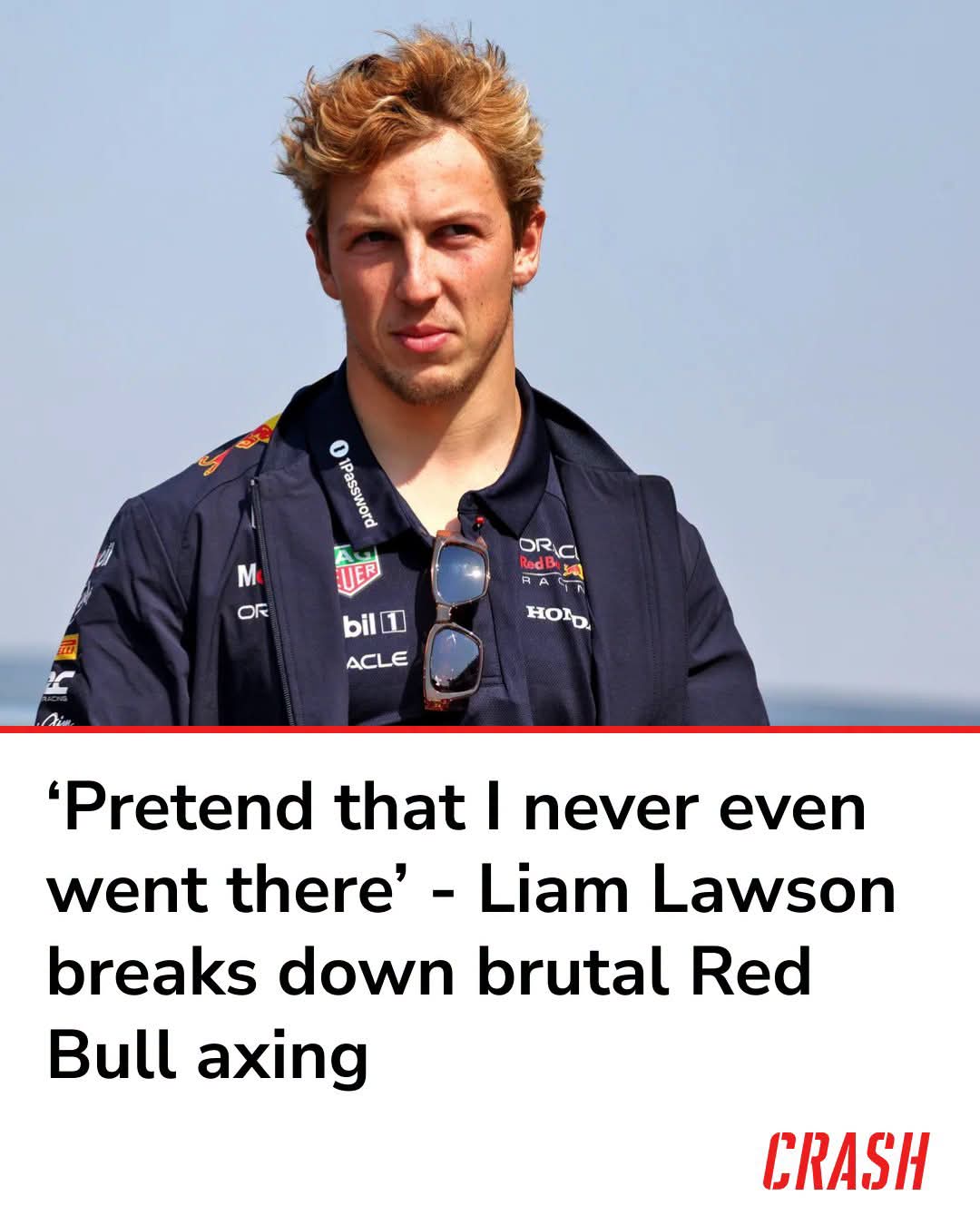
Liam Lawson has delivered one of the most revealing accounts yet of life inside Red Bull’s unforgiving Formula 1 system, admitting that his brief promotion to the senior team became such a painful experience that he eventually tried to erase it from his mind altogether.
The New Zealander’s comments have reignited debate about Red Bull’s approach to driver management after he was dropped just two races into the 2025 season. While Red Bull has built a reputation for discovering and developing elite talent, Lawson’s story highlights the immense pressure that comes with stepping into one of the most demanding seats in motorsport. More than a year later, the emotional scars from that experience still appear fresh.
As Formula 1 heads deeper into the 2026 campaign, Lawson’s reflections offer a fascinating look behind the scenes of a decision that continues to divide opinion across the paddock.
THE RED BULL DREAM THAT QUICKLY UNRAVELED
When Red Bull selected Lawson to partner Max Verstappen for 2025, many viewed it as the natural next step in the young driver’s career. The team believed he possessed the speed, maturity, and mental strength needed to thrive alongside one of Formula 1’s greatest talents.
Instead, the opportunity quickly turned into a nightmare.
A difficult opening weekend in Australia was compounded by a challenging Sprint format event in China, where Lawson had little experience and limited preparation. Mistakes followed, confidence suffered, and results failed to materialize. Within weeks, the dream promotion had become one of the shortest-lived tenures in recent Formula 1 history.
Looking back, Lawson believes circumstances played a significant role. Limited track time, technical issues, and unfamiliar circuits combined to create a perfect storm that prevented him from showing his true potential.
THE CAR PROBLEMS THAT COMPLICATED EVERYTHING
One of the most revealing aspects of Lawson’s account was his description of Red Bull’s struggles with the car itself during that period.
According to the New Zealander, dissatisfaction with the car was not limited to his side of the garage. Even Verstappen was reportedly unhappy with the balance and handling characteristics. In response, Red Bull attempted an aggressive setup experiment during the Chinese Grand Prix weekend, radically changing the car in search of answers.
Such drastic adjustments are rarely made during a race weekend unless a team feels it has little to lose.
For Lawson, the gamble represented an attempt to find a direction that could make the car more manageable. However, the experiment also created additional variables at a time when he was already struggling to adapt. In hindsight, it raises questions about whether enough context was considered when evaluating his performances.
WHY LAWSON STILL FEELS THE DECISION WAS HARSH
Perhaps the most striking part of Lawson’s comments was his belief that he was judged too quickly.
Formula 1 is unquestionably a results-driven sport, but many observers felt two races were insufficient to accurately assess a driver’s capabilities. Lawson argues that being evaluated on two unfamiliar circuits, while simultaneously trying to adapt to one of the grid’s most challenging cars, was an impossible task.
His frustration appears rooted not only in the demotion itself but in how the decision unfolded. After participating in simulator work and discussions aimed at improving the team’s direction, he received news that his time at Red Bull was already over.
The experience left him feeling disconnected from the decision-making process and reinforced his belief that the verdict had been reached before he was given a fair opportunity to recover.
WHAT THIS SAYS ABOUT RED BULL’S DRIVER PROGRAMME
Red Bull’s junior system has produced world champions, race winners, and some of Formula 1’s biggest stars. However, Lawson’s story adds to a growing list of drivers who have struggled under the immense expectations placed upon them.
The challenge facing Red Bull is unique. Any teammate of Verstappen is inevitably compared against one of the fastest drivers in Formula 1 history. That benchmark can make even highly talented drivers appear less competitive than they truly are.
Recent years have shown that success in the second Red Bull seat requires more than raw speed. Drivers must quickly adapt to a demanding car philosophy, withstand relentless scrutiny, and deliver immediate results. Lawson’s experience suggests that even promising talents can find that combination difficult to achieve.
As Red Bull continues evaluating its future driver lineup, the team may eventually face questions about whether its development pathway allows enough time for drivers to fully establish themselves.
WHY THIS STORY STILL MATTERS IN 2026
Lawson’s comments are about more than revisiting old wounds. They serve as a reminder of how quickly careers can change in Formula 1 and how crucial timing can be in determining a driver’s trajectory.
Since returning to Racing Bulls, Lawson has focused on rebuilding confidence and proving he belongs on the grid. Every strong performance strengthens his case for future opportunities, whether within the Red Bull family or elsewhere.
For Red Bull, the situation remains equally significant. The team continues searching for long-term stability alongside Verstappen, and Lawson’s experience will inevitably be referenced whenever future driver decisions are debated.
WHAT HAPPENS NEXT FOR LAWSON?
The encouraging aspect of Lawson’s story is that his Formula 1 career remains far from over.
Many drivers have experienced setbacks before eventually finding success, and Lawson possesses the talent needed to rebuild his reputation. His honesty regarding the Red Bull episode may even help him move forward, turning a painful chapter into a valuable learning experience.
As Formula 1 enters a new era of regulations and shifting competitive dynamics, opportunities can emerge quickly. If Lawson continues delivering strong performances, the narrative surrounding his brief Red Bull stint could eventually change from a career-defining failure to a temporary obstacle on the road to greater success.
For now, however, his remarks provide a rare and fascinating insight into the human side of Formula 1—where confidence, preparation, and trust can be just as important as raw speed.