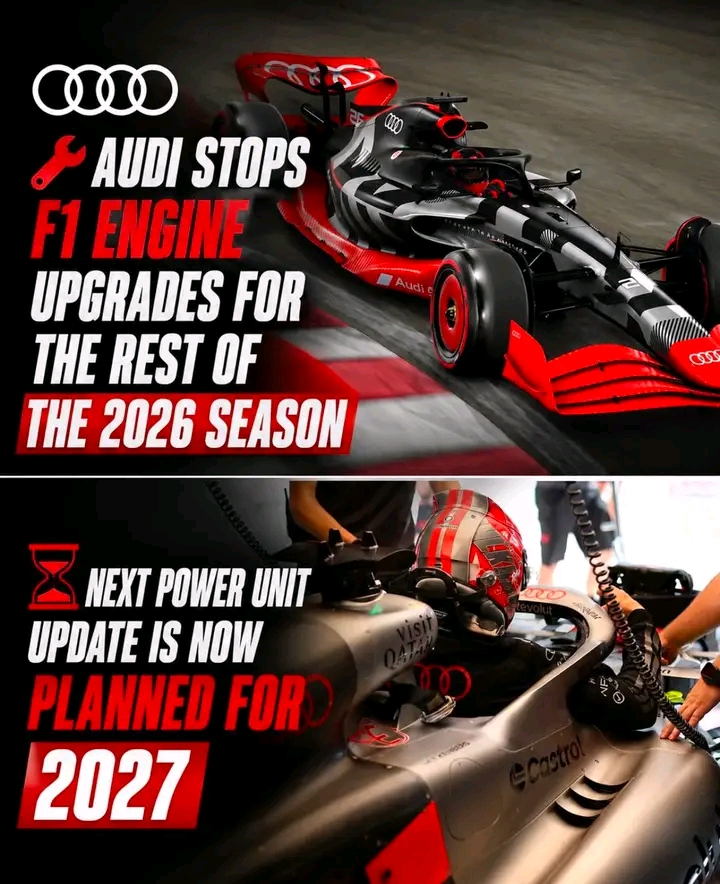
Audi has confirmed that it will not introduce another major Formula 1 power unit upgrade before the end of the 2026 season, choosing instead to focus its resources on the bigger development push planned for 2027.
The decision, revealed by Audi racing director Allan McNish, highlights the difficult balancing act facing teams under Formula 1’s cost cap. While Audi’s first season as a full works operation has shown encouraging signs of progress, the German manufacturer believes that spending too aggressively on short-term improvements could limit its ability to compete effectively in future seasons.
Audi inherited the Sauber operation for the 2026 campaign and entered the new regulations era with its own power unit project. The transition has been challenging, with the team struggling to consistently challenge for points during the opening stages of the season. However, a power unit update introduced at the Barcelona Grand Prix appears to have delivered meaningful improvements, particularly in terms of driveability.
The upgrade has since been followed by a noticeable improvement in Audi’s results, giving the team reasons to be optimistic despite its decision to hold off on another major engine development this year.
BARCELONA UPGRADE GIVES AUDI A MUCH-NEEDED BOOST
Audi’s first significant power unit adjustment of the season arrived at the Barcelona Grand Prix. According to Nico Hulkenberg, the primary benefit was improved driveability, an area that had previously been identified as one of the weaknesses of the R26 package.
In Formula 1, outright horsepower is only one part of the performance equation. How smoothly and predictably the power unit delivers its power can have a major influence on a driver’s confidence, particularly when accelerating out of slow corners or managing traction.
For Audi, improving this characteristic appears to have helped its drivers extract more from the overall package.
The results have been encouraging. Audi has scored points in the last three rounds, with Gabriel Bortoleto contributing eight points and Hulkenberg adding two. That recent run has allowed the team to move ahead of Williams and climb to eighth in the constructors’ championship.
Although eighth place may not represent Audi’s ultimate ambition, the progress is significant for a manufacturer competing in its first season under a completely new works structure.
WHY AUDI IS WAITING UNTIL 2027
McNish made it clear that Audi’s next major power unit development will not arrive during the remainder of the 2026 campaign.
Asked when the next powertrain upgrade would be introduced, McNish simply responded that it would come “next year.”
The explanation is closely connected to the financial restrictions imposed by Formula 1’s budget cap. Teams must carefully decide how and when to allocate their limited resources between chassis development, aerodynamic upgrades and power unit improvements.
Audi’s decision reflects a long-term strategy rather than a lack of ambition.
McNish explained that teams cannot spend their entire development budget at once because doing so would leave them without the resources needed to respond to rivals later in the season or in future campaigns.
That philosophy is particularly important for Audi. Unlike an established front-running team with years of experience developing its current power unit, Audi is effectively building a new competitive foundation in Formula 1.
The manufacturer therefore has to think beyond simply improving its position in the 2026 constructors’ championship.
AUDI’S LONG-TERM PLAN COULD BE MORE IMPORTANT THAN 2026
Audi’s decision to prioritize 2027 could ultimately prove to be one of the most important strategic choices of its early Formula 1 project.
The team has already introduced an initial update under the ADUO framework, described by McNish as a relatively small adaptation that was brought in early and delivered positive results.
However, the more substantial development work has been reserved for 2027.
That could indicate that Audi sees the 2026 season as a foundation-building year. The team can use the current campaign to understand its power unit, gather data, improve operational efficiency and develop its drivers while preparing a more competitive package for the following season.
For a manufacturer entering Formula 1 with long-term ambitions, that approach makes sense.
The danger, however, is that the team could fall too far behind its competitors if the current power unit limitations remain visible throughout the season. Formula 1 is an intensely competitive environment, and even a small performance deficit can have a major impact on qualifying position and race strategy.
Audi must therefore ensure that its decision to wait for 2027 does not turn 2026 into a wasted opportunity.
HULKENBERG AND BORTOLETO FACE DIFFERENT CHALLENGES
The decision also creates an interesting situation for Audi’s driver lineup.
Nico Hulkenberg brings considerable Formula 1 experience and has already demonstrated his ability to deliver strong performances when the machinery allows him to fight competitively. His two points from the recent run of results may not fully reflect his contribution to Audi’s progress.
Gabriel Bortoleto, meanwhile, represents an important part of Audi’s future. His eight points during the team’s recent improvement suggest that he is adapting well to the demands of Formula 1 and taking advantage of opportunities when they appear.
For both drivers, the remainder of 2026 could become a season of maximizing results rather than expecting constant technical breakthroughs.
Without another major power unit upgrade, Audi will likely need to focus heavily on extracting performance from its chassis, improving race execution and making strategic gains. Qualifying performance, pit-stop efficiency, tyre management and reliability could become just as important as raw engine performance.
THE CONSTRUCTORS’ CHAMPIONSHIP BATTLE COULD BECOME AUDI’S MAIN TARGET
Audi’s move ahead of Williams into eighth place demonstrates how quickly the midfield order can change.
The team may not be in contention for victories or podiums, but its battle in the lower half of the constructors’ standings remains important. Every championship position carries financial and reputational value, while finishing higher can provide evidence that the team’s development program is moving in the right direction.
Williams will be determined to respond, while other midfield teams could also enter the fight as the season progresses.
This means Audi cannot afford to become passive simply because its next major power unit upgrade is scheduled for 2027.
Instead, the team will need to maximize every available area of performance. If its power unit remains stable and reliable, the focus could shift toward aerodynamic efficiency and track-specific optimization.
Circuits that reward strong traction or low-speed performance may present opportunities, while tracks that place greater emphasis on outright power could expose the limitations of the current package.
WHAT THIS MEANS FOR AUDI’S 2027 F1 AMBITIONS
The real significance of Audi’s announcement may not be what happens during the remainder of 2026, but what the team can achieve once its larger power unit development arrives.
The 2027 campaign could represent a major test of whether Audi’s long-term strategy has worked.
By delaying its bigger upgrades, the manufacturer is effectively betting that patience and careful resource management will produce a stronger overall package. The goal will be to combine a more competitive power unit with the lessons learned from its first season as a full works team.
That could give Audi a much clearer opportunity to challenge the established midfield order.
However, expectations will inevitably rise. Once a manufacturer announces that its major developments are being saved for the following season, fans and rivals will closely monitor whether those upgrades deliver the performance gains promised by the strategy.
A power unit alone will not transform Audi into a championship contender. The team will also need to develop its chassis, improve its aerodynamic department and build a stronger operational structure.
AUDI’S DECISION SHOWS HOW HARD IT IS TO BUILD A NEW F1 TEAM
Audi’s situation is a reminder that success in modern Formula 1 cannot be achieved overnight.
The 2026 regulations have created a new competitive environment, and every manufacturer is attempting to maximize its interpretation of the rules. Audi has the additional challenge of establishing itself as a works operation while simultaneously developing its own power unit and integrating that technology with the former Sauber team.
That is an enormous undertaking.
The early struggles were therefore not entirely unexpected, but the recent points-scoring run suggests that the team is beginning to find a more competitive baseline.
The Barcelona upgrade may not have been revolutionary, but its impact demonstrates how even relatively small technical changes can make a meaningful difference when a team is operating close to the midfield.
OUR VERDICT ON AUDI’S 2026 STRATEGY
Audi’s decision to avoid another major power unit upgrade this season is a calculated risk.
In the short term, it could limit the team’s ability to climb significantly higher in the constructors’ championship. Rivals will continue developing their cars, and Audi may find itself fighting with one hand tied behind its back if its power unit falls further behind.
But the long-term argument is compelling.
A controlled development strategy gives Audi the opportunity to preserve resources for a more substantial 2027 package. The manufacturer can spend the remainder of 2026 learning from its first season, improving the chassis and building a stronger foundation around Hulkenberg and Bortoleto.
If the 2027 power unit delivers the expected step forward, Audi could emerge as a much more serious midfield force.
The key question is whether the team can maintain its current momentum without another major engine upgrade. If Audi continues scoring points and stays ahead of Williams, the strategy will look increasingly justified. If its rivals pull away, however, pressure will grow on the project.
For now, Audi appears to be playing the long game. The 2026 season may be about survival, learning and incremental progress, while 2027 is shaping up as the year when the German manufacturer’s true Formula 1 ambitions will begin to receive a much clearer test.
FINAL THOUGHTS
Audi’s decision to postpone its next major Formula 1 power unit upgrade until 2027 underlines the financial and technical realities of competing under the modern budget cap.
The Barcelona update has already helped improve the team’s performance, with Bortoleto and Hulkenberg contributing to a three-race points-scoring run that moved Audi ahead of Williams in the constructors’ standings.
Now, the challenge is to build on that momentum without relying on another major engine development in 2026.
If Audi can continue extracting points from its existing package while carefully preparing its larger 2027 upgrade, the strategy could ultimately accelerate its long-term progress. But if the midfield battle becomes increasingly competitive, the manufacturer may discover that waiting for the future comes with a significant price in the present.
Either way, Audi’s first Formula 1 season is becoming an important chapter in the manufacturer’s wider motorsport project, and the decisions made now could have consequences that extend well beyond the 2026 championship.