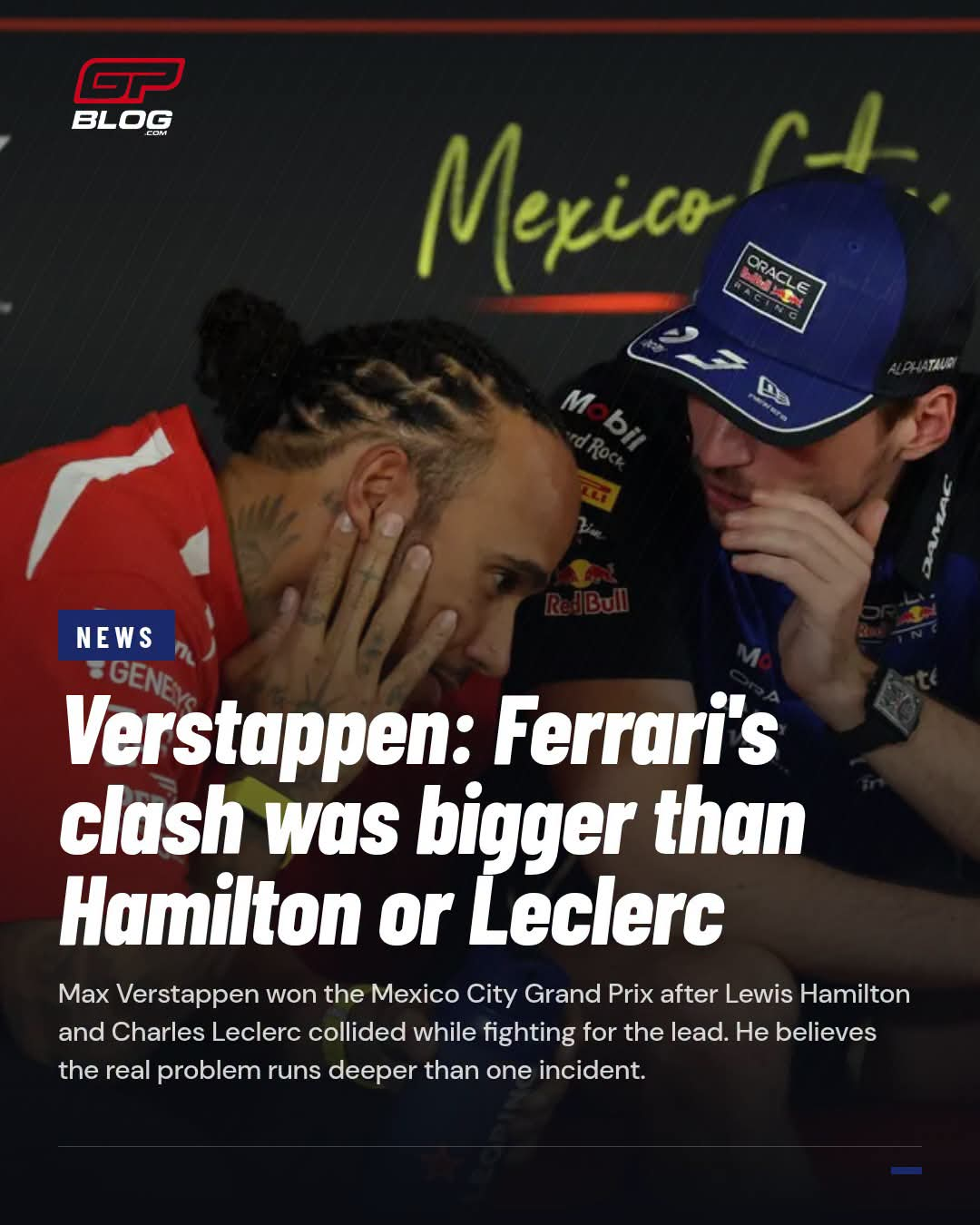
Max Verstappen does not need gifts. Yet in Mexico City he accepted one gratefully. Starting fifth after a grid penalty, the four-time champion sliced through the chaos of the opening lap, seized second when Ferrari’s two stars collided in ambition, and never looked back. By the time the chequered flag fell he had beaten Lewis Hamilton by just 0.799 seconds, claimed his third victory of 2026, and secured his sixth win at the Autódromo Hermanos Rodríguez. Behind him, Kimi Antonelli completed a historic podium and became Formula 1’s youngest world champion.
Verstappen’s post-race verdict was characteristically blunt. Ferrari, he said, made it a little bit difficult for themselves. Two number-one drivers fighting each other created the opening he needed, and he took it.
THE OPENING-LAP MELTDOWN THAT CHANGED EVERYTHING
Hamilton started from pole, his first for Ferrari. Leclerc sat third. Verstappen, demoted one place for a practice clash with Liam Lawson, began fifth. The lights went out and the Ferraris immediately went to war. Leclerc attacked around the outside into Turn 4. Both cars ran wide. Leclerc cut the chicane and emerged in the lead. Hamilton lost momentum. Verstappen, already up to third after a strong start, slipped past the seven-time champion into second.
Leclerc kept the position. The stewards later handed him a five-second time penalty for leaving the track and gaining a lasting advantage. Hamilton’s radio messages made his frustration clear. Verstappen’s engineer was already calculating the undercut.
Red Bull timed the pit stop perfectly. Verstappen followed Leclerc in on the same lap. While the Ferrari served its penalty, the Red Bull emerged ahead. From that moment the race belonged to Verstappen. A red flag for Valtteri Bottas’s heavy crash and a late safety car only reset the order without changing the hierarchy. Hamilton hounded the Red Bull in the final stint, never more than a second behind, but could not find a way past on the long run to Turn 1.
WHY VERSTAPPEN’S ANALYSIS CUT DEEP
“I do think they made it a little bit difficult for themselves, fighting each other, and that’s why I could capitalise on that,” Verstappen said. “I mean, I’ll take it, right? I always try to go for every opportunity and today I saw the opportunity.”
The observation goes beyond one race. Ferrari currently fields two drivers who both believe they are the primary contender. Hamilton arrived with seven titles and the weight of history. Leclerc has been the team’s long-term project and still carries the expectation of delivering Ferrari’s first drivers’ championship since 2007. Neither is wired to yield. The result in Mexico was predictable: pure racing that cost the team a victory it should have controlled.
This is not the first time the pair have cost each other points. It is, however, the clearest example of how their equal status becomes a liability when the car is fast enough to win. Team orders are harder to enforce when both drivers have legitimate claims on the number-one role. The Mexico incident will force Ferrari’s leadership to confront that reality before the remaining races.
ANTONELLI’S CORONATION AND THE SHIFTING POWER BALANCE
While the Ferrari drama unfolded, Andrea Kimi Antonelli quietly did what champions do. The 20-year-old Mercedes driver finished third, needed only a modest result to seal the title, and delivered a podium under pressure. He becomes the youngest world champion in Formula 1 history, beating Sebastian Vettel’s previous record, and the first Italian to claim the crown since Alberto Ascari in 1953.
The podium scene was striking: Verstappen, Hamilton and Antonelli, twelve world titles between them, the new generation standing on the shoulders of the old. Antonelli’s calm maturity throughout the season has been the story of 2026. Mexico simply made it official.
Verstappen’s win moved him into second in the championship, ahead of Hamilton. With four rounds remaining the title is decided, but the fight for runner-up and the constructors’ battle remain live. Red Bull’s late-season form has been strong. Ferrari’s internal friction is now an open talking point.
WHAT THIS MEANS FOR THE TEAMS AND THE SPORT
For Red Bull the result is pure reinforcement. Strategy, pit execution and Verstappen’s opportunistic racecraft delivered a win that looked unlikely after qualifying. The team continues to extract maximum results even when the car is not the outright favourite on pure pace.
For Ferrari the questions are more uncomfortable. The car was competitive enough to start from pole and finish first and second on pure merit. Instead the team left Mexico with second and fourth. The psychological cost of repeated teammate battles may prove more damaging than the points lost on any single Sunday. Sponsors, fans and the board will notice.
For the championship the Mexico result crystallises a transitional season. Antonelli’s title arrives earlier than many expected. Verstappen remains the standard by which others are measured. Hamilton continues to show the hunger that has defined his career even as the clock ticks. Leclerc faces the difficult task of proving he can still lead a team that now contains a seven-time champion who refuses to accept second status.
LOOKING AHEAD: BRAZIL AND BEYOND
The paddock now heads to São Paulo. Verstappen will arrive with momentum and the knowledge that Ferrari’s internal dynamics remain unresolved. Hamilton and Leclerc will face another weekend of managing expectations and each other. Antonelli can race with the freedom that comes from having the title already secured.
Mexico was not simply a race Verstappen won. It was a demonstration of how quickly opportunity appears when rivals turn on each other, and how ruthlessly the very best drivers exploit it. Ferrari’s fight became Verstappen’s reward. The question for the remainder of 2026 is whether the Scuderia can stop offering the same gift again.