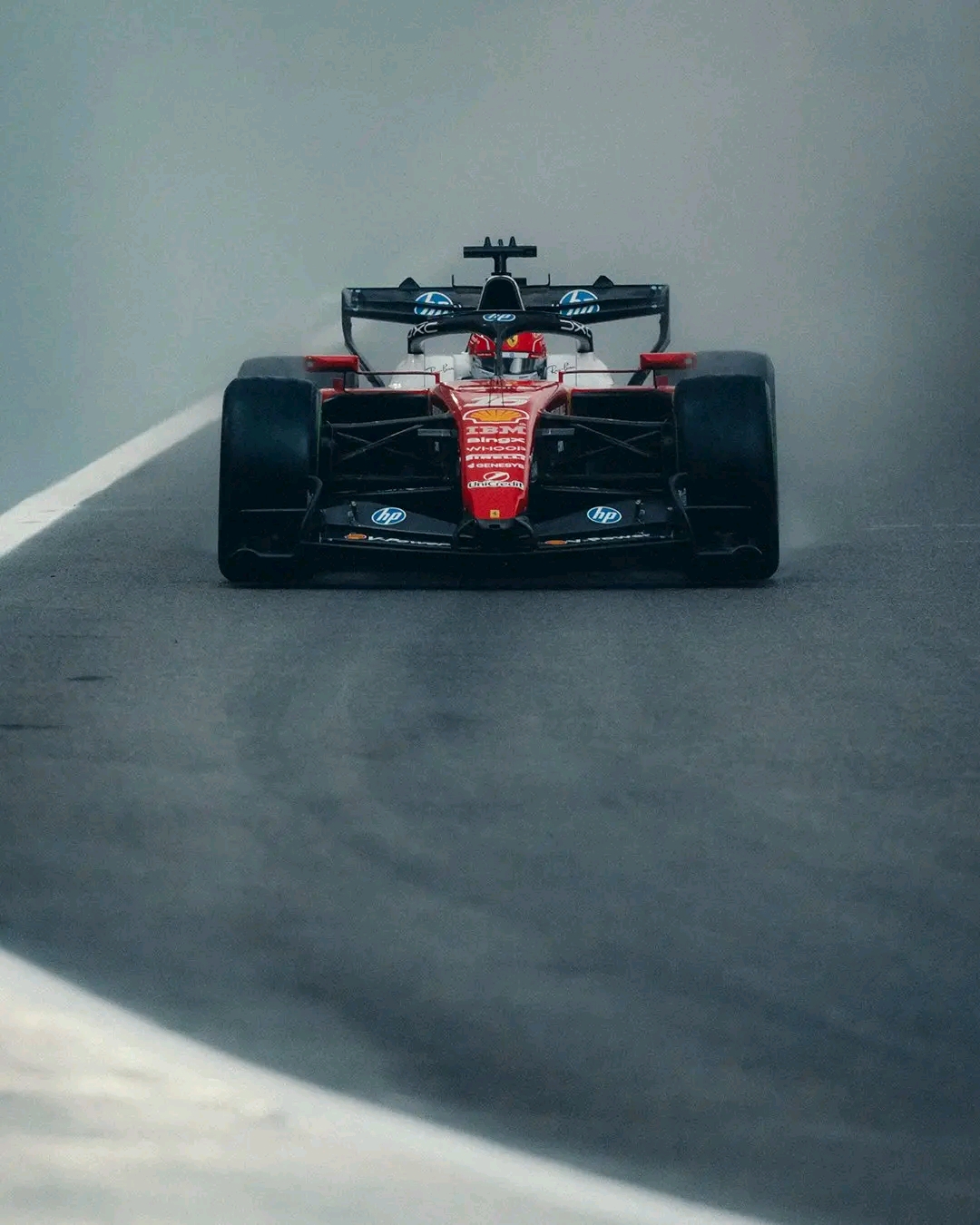
🚨| Leclerc Frustrated by Ferrari’s Wet Weather Performance…🚨 CHARLES LECLERC FRUSTRATED BY FERRARI’S WET-WEATHER PERFORMANCE AFTER BRAZILIAN GP STRUGGLES! 🇧🇷🌧️
Charles Leclerc has expressed serious frustration with Ferrari’s performance in wet-weather conditions following a difficult Brazilian Grand Prix, describing the team’s car as a “complete disaster” to drive in the rain. The Monegasque driver endured a challenging afternoon at Interlagos, where a lack of grip, tyre-temperature problems and limited opportunities to overtake prevented him from achieving the result he had hoped for.
The Ferrari driver made it clear that the team’s problems were not simply related to strategy or race execution. Instead, he believes the car itself was extremely difficult to control, particularly during the opening stint when the track conditions made tyre preparation even more important.
For a team with Ferrari’s ambitions, Leclerc’s comments will undoubtedly raise questions about its ability to compete consistently when the weather becomes unpredictable.
A Difficult Afternoon for Leclerc at Interlagos
Leclerc entered the Brazilian Grand Prix hoping to recover from a disappointing starting position. A grid penalty forced him to begin the race from 13th, immediately placing additional pressure on the Ferrari driver.
Starting further down the field meant that Leclerc needed an excellent getaway and a competitive car to fight his way towards the points positions. However, the wet conditions made that challenge considerably more complicated.
While Lewis Hamilton managed to make significant progress during the opening stages, Leclerc struggled to find confidence behind the wheel.
The difference between the two Ferrari drivers was particularly noticeable during the first stint. Hamilton appeared to have a much stronger start, while Leclerc found himself fighting for grip and struggling to make progress.
After the race, Leclerc admitted that Ferrari’s execution was acceptable, but the car’s pace was nowhere near where it needed to be.
“The execution was okay, but the pace in the first stint was horrendous. Particularly at the start, we had so much struggle getting those tyres up to temperature, it’s unbelievable.”
His explanation highlighted one of Ferrari’s biggest problems throughout the race: getting the tyres into the correct operating window.
In wet-weather Formula 1 racing, tyre temperature is extremely important. Drivers need sufficient grip to accelerate, brake and attack corners without losing control. When tyres fail to reach their ideal temperature, the car can become extremely difficult to manage.
That was exactly the situation Leclerc believed he experienced.
“It Was Just Like Driving on Ice”
Perhaps the most striking part of Leclerc’s post-race assessment was his description of the Ferrari.
The Monegasque did not attempt to hide his disappointment, explaining that driving the car in those conditions felt almost impossible.
“It’s just undrivable. Lewis definitely found a way because he had an incredible start, but for me, it was just like driving on ice.”
Those comments provide a clear indication of how uncomfortable Leclerc felt during the opening stages.
The comparison with Hamilton also makes the situation particularly interesting. Although both drivers were competing with the same Ferrari machinery, their experiences were noticeably different.
Hamilton managed to find opportunities and make progress, while Leclerc struggled to generate the necessary grip.
Ferrari will now need to understand why the two drivers experienced such different levels of performance.
Differences in driving style, tyre preparation, setup and individual race circumstances could all have contributed to the situation.
However, Leclerc’s comments suggest that the problem goes beyond one difficult race.
Second Stint Offers Some Encouragement
Although the opening stint was extremely disappointing, Leclerc revealed that his performance improved considerably once he switched to the soft tyres.
The Ferrari driver began finding more pace and felt considerably more comfortable with the car.
Unfortunately, his recovery was limited by traffic.
“Later on, I had the pace but we had very little free air, and we also lost a lot of time in the straights.”
Being stuck behind other cars made it difficult for Leclerc to demonstrate his true speed.
In Formula 1, clean air can make a significant difference to performance. Following another car closely can disturb aerodynamic airflow, affect tyre performance and make it harder to attack.
For Leclerc, the lack of free air meant that even when the Ferrari began performing better, he could not fully take advantage of the improvement.
He further explained that the second stint was considerably stronger than the first.
“The first stint was very poor, the second stint on the soft was actually pretty good. But not much free air.”
Despite the difficulties, Leclerc remained patient and continued working towards a better result.
His recovery eventually brought him to seventh place at the chequered flag, although a subsequent five-second penalty for a collision with Liam Lawson dropped him to eighth.
Ferrari’s Wet-Weather Problems Raise Serious Questions
Leclerc’s frustration goes beyond the final classification.
The Ferrari driver believes the team needs to understand why its performance becomes so unpredictable whenever it encounters wet conditions.
He suggested that the team sometimes finds itself competitive in the rain, while on other occasions the car becomes extremely difficult to drive.
“There is so much to learn. For qualifying, there are things we can learn from and do better.”
His comments indicate that Ferrari must examine its preparation before both qualifying and races.
Wet-weather performance is one of the most important aspects of modern Formula 1. Teams cannot control the weather, but they must be capable of adapting their setups, tyre strategies and driving approaches when conditions change.
A team that struggles to find consistency in the rain risks losing valuable opportunities throughout a season.
Leclerc was particularly critical of Ferrari’s unpredictability.
“For [the race], and still in qualifying, I felt like we are going into the rain and it’s like a coin flip.”
He explained that the team sometimes gets things right, but on other occasions finds itself struggling without a clear explanation.
“Maybe we end up on the right side of things, or we end up on the wrong side. It’s just a complete disaster to drive. We’ve got a lot of work to do on that side.”
That is arguably the biggest concern emerging from his assessment.
Ferrari needs a predictable car that allows its drivers to understand what they can expect when conditions change. Confidence is particularly important in wet races, where even a small mistake can result in a crash or a significant loss of positions.
Hamilton’s Performance Adds Another Talking Point
Hamilton’s ability to make progress during the same race will naturally attract attention.
The seven-time world champion demonstrated that Ferrari could still produce encouraging moments despite the difficult conditions.
However, Leclerc’s experience was considerably less positive.
The contrast between the two drivers should provide Ferrari with valuable information during its post-race analysis.
Understanding how Hamilton managed to generate better performance could help the team identify areas where Leclerc struggled.
It would also be important to examine whether the difference came from tyre temperatures, car balance, setup or simply the circumstances each driver encountered.
There is no doubt that Ferrari needs both drivers performing consistently if it wants to maximise its results.
Leclerc Sends a Clear Message to Ferrari
Ultimately, the Brazilian Grand Prix was another frustrating experience for Leclerc.
Although he managed to recover from 13th on the grid and initially finish seventh, the subsequent penalty dropped him to eighth.
More importantly, his comments have highlighted a weakness that Ferrari cannot afford to ignore.
The team must improve its understanding of wet-weather tyre preparation, car balance and overall performance if it wants to avoid similar difficulties in future races.
Leclerc has made his feelings clear. He believes Ferrari has plenty of work to do, and the team’s engineers will need to study the problems carefully.
For the Scuderia, the challenge is now turning that frustration into meaningful improvements.
Ferrari may have the speed in certain conditions, but until it can deliver consistent performance in the rain, serious questions will remain.
And after describing the car as undrivable and comparing the experience to driving on ice, Leclerc has certainly given Ferrari plenty to think about. 🔴🏎️
#F1 #Formula1 #CharlesLeclerc #Ferrari #BrazilianGP #ScuderiaFerrari #LewisHamilton