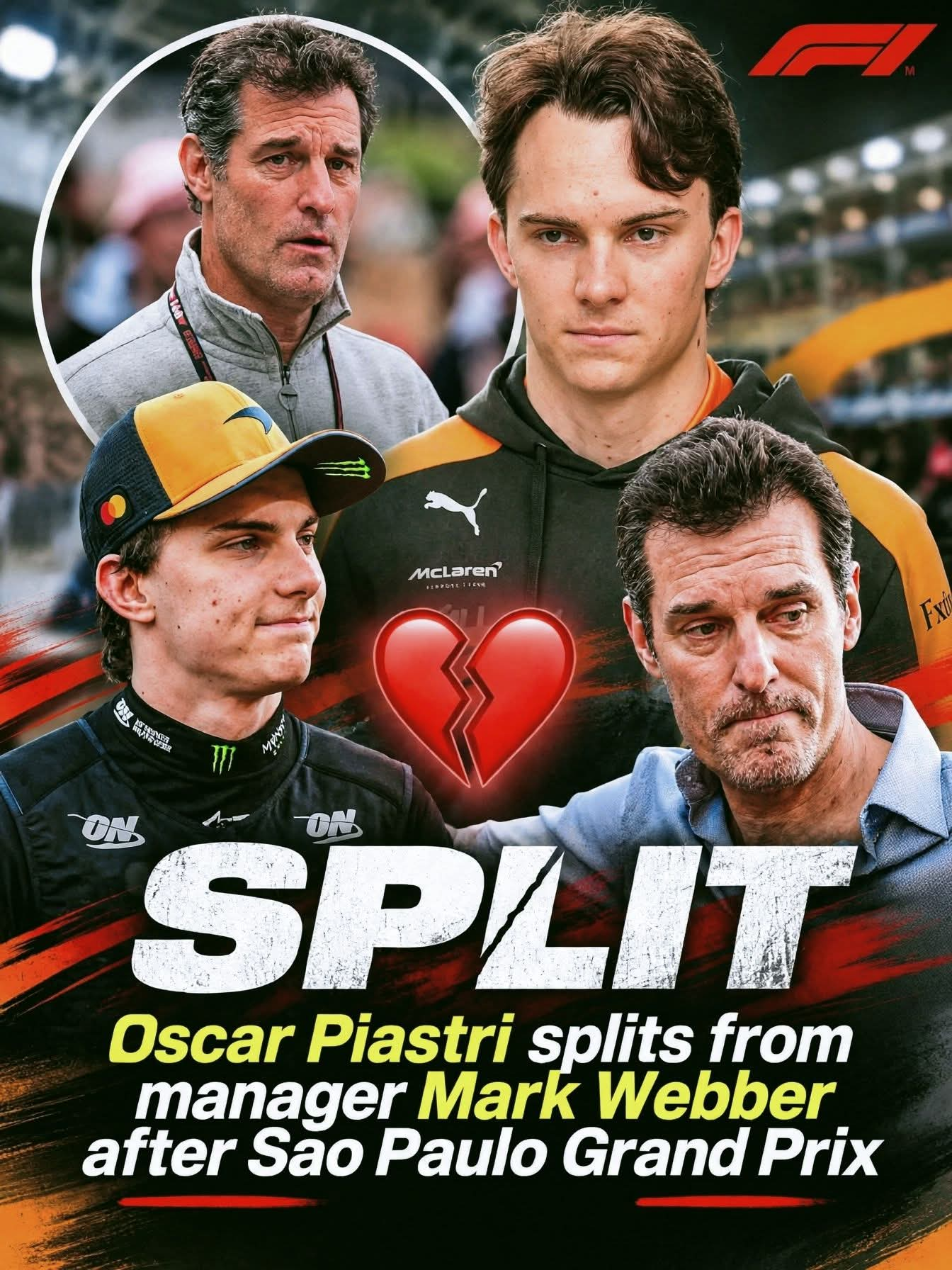
After guiding Oscar Piastri from junior formula dominance to the front of the Formula 1 grid, Mark Webber and the McLaren driver have mutually agreed to end their management relationship. The announcement came on the Monday following the 2026 Sao Paulo Grand Prix, closing a chapter that began in 2019 and delivered one of the most carefully engineered rises of the modern era.
The split is clean, respectful, and timed after Webber had already stepped back from regular trackside duties. Both sides say the moment is right for Piastri to operate under a new structure while the Webbers pursue other projects. Yet the decision carries weight far beyond a simple contractual change. It marks the end of a partnership that reshaped a young driver’s career and, by extension, the competitive balance at McLaren.
HOW THE WEBBER-PIASTRI ALLIANCE BEGAN AND WHY IT MATTERED
Mark Webber, a nine-time Grand Prix winner and one of Australia’s most respected racing figures, began working with Piastri in 2019. At the time, the young Australian was climbing through the single-seater ranks. Under the guidance of Webber and his partner Ann, Piastri claimed the Formula 3 title in 2020 and the Formula 2 championship the following year. Those results alone would have made him a prospect. The real impact came in the delicate negotiations that placed him at McLaren for 2023.
Alpine had expected to promote Piastri after Fernando Alonso’s departure. Instead, the Webber team engineered a move that saw Piastri join McLaren, effectively blocking a path that would have kept him in the Renault orbit. That decision accelerated his exposure to a team already building momentum. Piastri arrived ready, adapted quickly, and eventually delivered race wins. By the end of 2025 he had nine victories to his name—matching Webber’s own tally—and had led the championship for long stretches before finishing third behind teammate Lando Norris.
The partnership was never merely administrative. Webber’s presence in the paddock offered institutional knowledge, commercial leverage, and a buffer against the political undercurrents that surround young drivers. For Piastri, it provided continuity from the junior formulas into the highest level of the sport.
THE SHIFT THAT PRECEDED THE FINAL SPLIT
Heading into the 2026 season, the arrangement changed. Webber reduced his trackside appearances. Piastri brought in Pedro Matos, his former Formula 2 race engineer, and mental coach Emma Murray for greater day-to-day support. At the time, Piastri described the adjustment as practical rather than personal. Contact with Webber continued on commercial matters. The full termination of the management agreement, confirmed after Sao Paulo, simply completed the transition.
Piastri’s 2026 campaign has been more difficult. While Norris has remained a consistent threat, the Australian has yet to win a race and currently sits seventh in the standings, a significant gap behind his teammate. The Sao Paulo weekend itself produced a sixth-place finish, 56 seconds adrift of Norris’s victory. Whether the management change is connected to on-track results is a matter of speculation; both parties have framed the decision as mutual and forward-looking.
WHY THIS MATTERS FOR PIASTRI, MCLAREN, AND THE WIDER PADDOCK
Driver-manager relationships in Formula 1 often last longer than team contracts. When they end, the consequences ripple outward. For Piastri, the immediate task is establishing a new support network capable of handling commercial opportunities, long-term strategy, and the inevitable contract conversations that arise even for drivers under multi-year deals. McLaren extended his contract in 2025, yet the driver market remains fluid. A new manager will shape how Piastri is positioned relative to other top seats if circumstances change.
McLaren itself benefits from clarity. The team has invested heavily in Piastri as a cornerstone of its future alongside Norris. A settled management structure reduces external noise and allows the driver to focus on performance. In a season where the orange cars have not always delivered the results expected after strong previous campaigns, internal stability matters.
For the broader industry, the split highlights how quickly the needs of a driver evolve. The skills required to extract a junior from a manufacturer’s academy and place him in a competitive seat are different from those needed once that driver is established, winning races, and negotiating from a position of strength. Webber’s reduced trackside role in 2026 already signaled that evolution. The formal end simply acknowledges it.
LOOKING AHEAD: WHAT COMES NEXT FOR BOTH SIDES
Piastri has not named a replacement. That silence is deliberate. The next management appointment will reveal whether he seeks another high-profile former driver, a more commercial-focused agency, or a hybrid approach. Whatever the choice, the expectation is continuity of the professional standards that defined the Webber years.
Webber and Ann have indicated they will pursue new ventures. After seven years closely tied to one of the sport’s brightest young talents, the freedom to explore other opportunities is understandable. Their legacy with Piastri is already secure: they helped deliver a driver who reached the front of the grid earlier than most and who has already collected multiple wins.
The timing after Sao Paulo feels deliberate. Three races remain in the 2026 season. Closing the chapter now allows both parties to move into the off-season without unresolved business hanging over them. For Piastri, the final races become an opportunity to finish the year with momentum and enter 2027 under a refreshed support structure.
A PARTNERSHIP THAT DELIVERED RESULTS, NOW GIVING WAY TO THE NEXT PHASE
Seven years is a long time in Formula 1. From Formula Renault Eurocup success to consecutive junior titles, the McLaren seat, race wins, and a genuine championship challenge, the Webber-Piastri alliance achieved what many management relationships only promise. Ending it by mutual agreement, with public statements of respect on both sides, is the cleanest possible outcome.
Whether the decision ultimately proves the right one will be judged by Piastri’s results and career trajectory in the seasons ahead. For now, the facts are straightforward: a successful partnership has reached its natural conclusion. Oscar Piastri steps into the next phase of his career with the experience of those formative years behind him and the freedom to define the structure that will carry him forward. Mark Webber leaves having helped shape one of the most impressive rises of the current generation. In a sport that rarely allows tidy endings, this one arrives with unusual clarity.