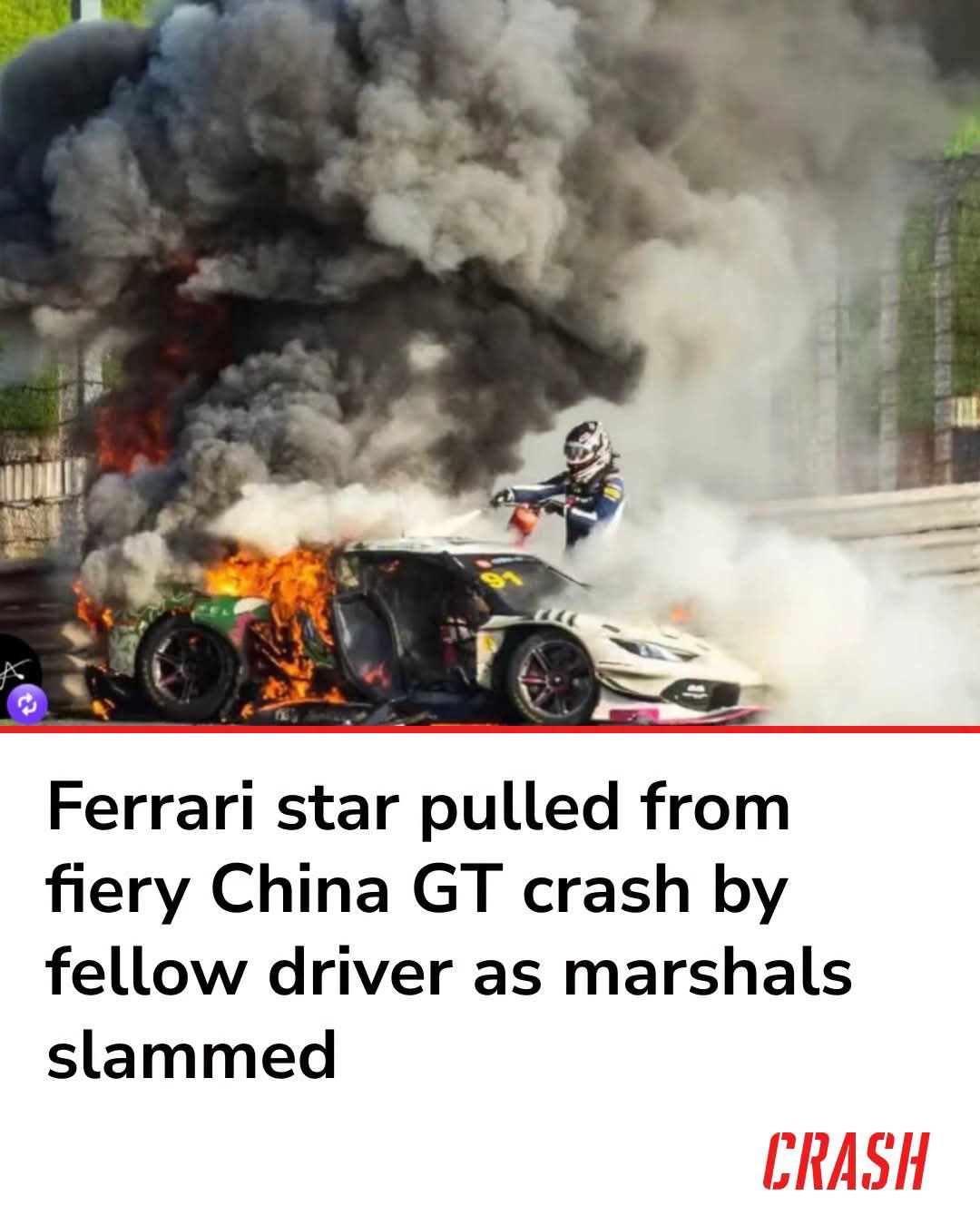
British racing driver Ollie Millroy survived a terrifying China GT accident at the Shanghai International Circuit after his Ferrari was engulfed in flames and fellow driver Loek Hartog reportedly stopped his own race to pull him from the burning wreck.
The dramatic crash occurred during China GT Race 1 on Saturday, with Millroy’s AAI Motorsports Ferrari becoming involved in a high-speed incident on the back straight. The race was stopped after approximately 20 minutes as the severity of the accident became clear.
Millroy suffered multiple injuries, including five broken ribs, a fractured collarbone, a broken hand and finger, and a bruised lung. Despite the seriousness of those injuries, the Ferrari driver survived what could have been a far more devastating incident.
LOEK HARTOG RUSHED TOWARD THE BURNING FERRARI
The most extraordinary part of the incident was what happened immediately afterward.
Porsche driver Loek Hartog stopped his car and reportedly ran toward the burning Ferrari after becoming concerned that Millroy was still trapped inside. According to accounts from the scene, Hartog searched for a fire extinguisher before eventually reaching the wreck and helping extract Millroy.
Millroy later credited Hartog with saving his life.
In a statement shared on social media, the British driver described Hartog as a “superhero” and said he would remember the Dutch driver’s actions for the rest of his life.
Millroy also revealed that he has no memory of roughly the first hour surrounding the accident, highlighting just how serious the impact was.
THE CRASH ERUPTED INTO A MASSIVE FIREBALL
The accident began when the No. 33 BMW driven by Neil Verhagen reportedly lost control after touching the grass while battling David Chen’s Ferrari.
The cars made contact, with the incident sending the Ferrari driven by Millroy into the chain of events. His car subsequently caught fire, creating an extremely dangerous situation on the Shanghai circuit.
Video footage circulating from the incident showed the Ferrari burning heavily while the rescue unfolded.
The race was eventually abandoned, but the immediate priority was no longer competition. It was getting Millroy out of the vehicle alive.
AAI MOTORSPORTS QUESTIONS THE SAFETY RESPONSE
While Millroy survived, his team has raised serious concerns about the response from the event’s safety and medical personnel.
AAI Motorsports criticised what it described as an unacceptable delay in firefighting and medical assistance, arguing that the driver remained trapped inside the burning car for far too long.
The team subsequently announced that it would withdraw from the China GT event and said it would no longer participate in events organised by China GT. AAI also indicated that it reserves the right to pursue further action.
The team’s criticism goes beyond the outcome of one accident. Its argument is that professional motorsport accepts the inherent risks of racing, but the safety infrastructure surrounding the competition must be capable of responding immediately when something goes catastrophically wrong.
UNCONFIRMED CLAIMS ADD TO THE CONTROVERSY
There have also been reports circulating that the nearest fire marshal was asleep when the accident occurred. However, that allegation remains unconfirmed and should not be treated as established fact without further evidence.
The central concern raised by the team, however, is the reported delay in reaching Millroy while his Ferrari was burning.
That distinction is important. Motorsport safety procedures exist precisely because drivers can be involved in accidents that leave them unable to escape independently. Fire crews, marshals, medical teams and extraction equipment are expected to work together within seconds.
MILLROY’S SURVIVAL PUTS THE SPOTLIGHT ON MOTORSPORT SAFETY
The incident is a sobering reminder that even modern GT racing remains inherently dangerous.
For Millroy, the immediate focus will be recovery from his injuries. But his survival has also created an uncomfortable conversation about how quickly safety teams can respond when a driver is trapped inside a burning race car.
Hartog’s intervention has rightly received enormous praise, but it also raises a difficult question: should another competitor have to risk their own life to perform a rescue before the official emergency response reaches the scene?
That is ultimately the issue AAI Motorsports wants addressed.
Racing will always involve danger. Drivers understand that every time they climb into a car. But the fundamental expectation is that when something goes wrong, the safety system surrounding them responds without hesitation.
For Ollie Millroy, the fact that he survived the Shanghai fireball is the biggest result of all—and Loek Hartog’s decision to stop racing and run toward the flames could become the defining act of bravery from this year’s China GT season.