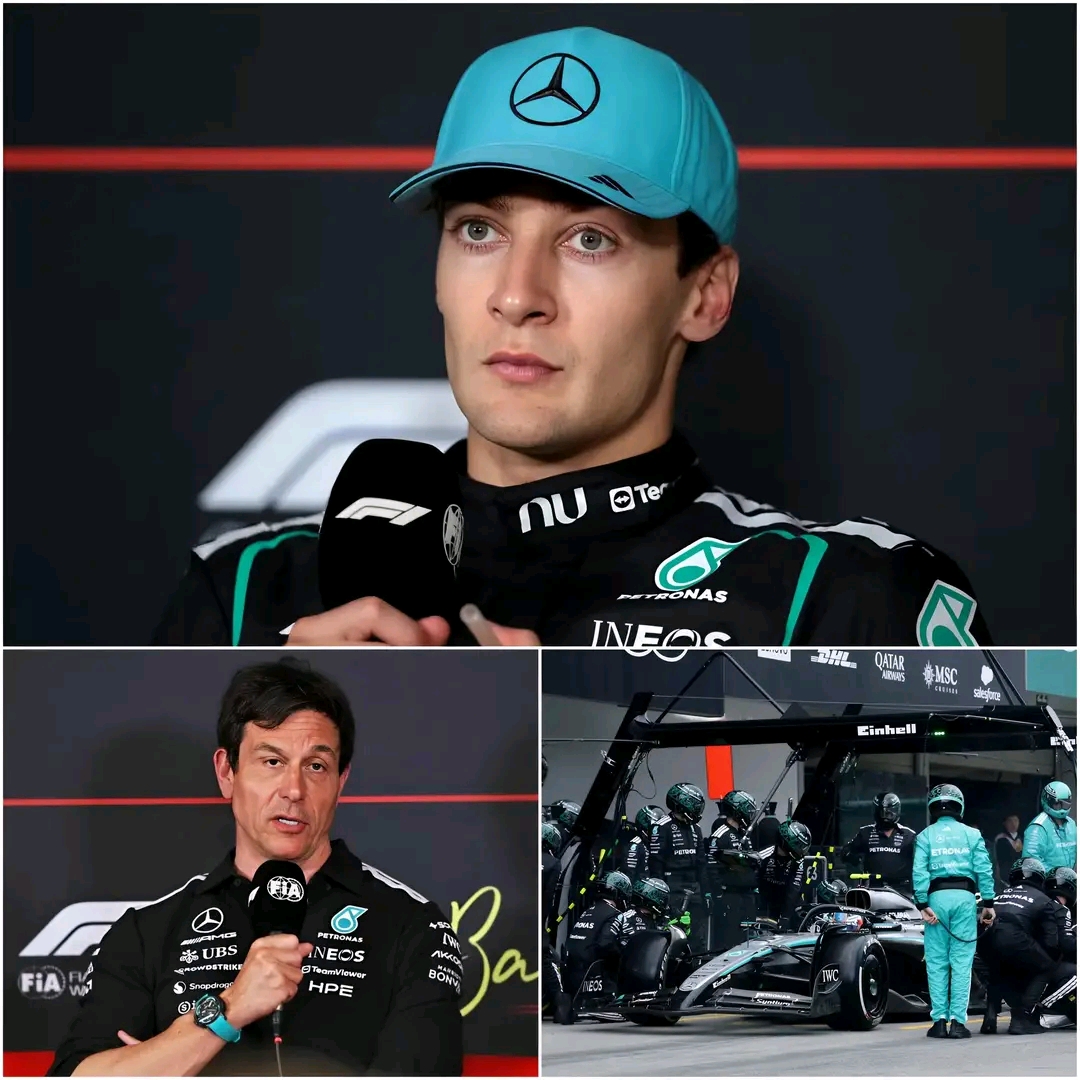
Tension is rising inside the Mercedes-AMG Petronas Formula One Team as George Russell openly questioned whether he is truly in a fair position to fight for the championship following a costly setup mistake during the Barcelona weekend.
The situation reportedly unfolded after a front wing setup error severely affected his race pace in the final stint. What should have been a competitive push for valuable points instead turned into damage limitation, leaving the British driver frustrated and visibly concerned about repeated operational issues at critical moments in the season.
His emotional reaction has now sparked wider debate in the paddock about consistency, internal execution, and whether Mercedes is maximizing its championship potential.
A FRONT WING ERROR THAT CHANGED THE RACE
According to reports from the Barcelona round, a misconfigured front wing setup compromised Russell’s balance and tire performance in the closing stages of the race. In modern Formula 1, even the smallest aerodynamic misstep can dramatically alter car behavior, especially in high-degradation circuits like Barcelona.
For a team like Mercedes-AMG Petronas F1 Team, which operates at the highest technical level in the sport, such an error is particularly damaging. It not only costs lap time but also undermines driver confidence during critical championship moments.
Russell’s frustration reflects a deeper concern: whether repeated operational mistakes are preventing him from mounting a consistent title challenge.
“ARE THESE MISTAKES FOLLOWING MY CAR?” RUSSELL’S IMPLICATION
Russell’s post-race comments carried a strong emotional tone, suggesting that costly issues seem to appear at the worst possible moments in his campaign. While he did not directly accuse the team of sabotage or bias, the implication was clear: too many avoidable problems are impacting his championship rhythm.
In Formula 1, drivers rely heavily on precision execution from the garage. When strategy calls, mechanical setup, or pit operations falter, the consequences are immediate and often irreversible.
For Russell, the concern is not just one race, but a pattern that could define his season if not corrected quickly.
TOTO WOLFF RESPONDS AND INTENSIFIES THE DEBATE
The internal tension escalated further when Mercedes team principal Toto Wolff responded shortly after Russell’s comments.
Wolff reportedly pushed back firmly against the suggestion of systemic issues, defending the team’s operational standards while acknowledging that the Barcelona setback was unacceptable at this level. His response was described as strong and direct, signaling that Mercedes leadership is not willing to let internal criticism spiral without control.
This public contrast between driver frustration and management defense has added a new layer of pressure inside the garage.
WHY THIS MATTERS FOR MERCEDES’ CHAMPIONSHIP AMBITIONS
Mercedes is currently operating in a highly competitive midfield-to-front transition phase, where margins between podium finishes and P5 results are extremely tight. In such an environment, internal mistakes can be as costly as outright performance deficits.
If Russell continues to lose points due to operational errors, it could have three major consequences:
First, it weakens his individual championship standing and momentum.
Second, it reduces Mercedes’ ability to challenge consistently at the front.
Third, it increases internal pressure between drivers, engineers, and leadership.
Even small recurring errors can define a season in Formula 1, especially when rival teams are executing clean weekends.
IMPACT ON GEORGE RUSSELL’S TITLE ASPIRATIONS
Russell has long been viewed as one of the most consistent and technically sharp drivers on the grid. However, championship fights are rarely decided by pace alone. Execution, reliability, and timing are equally important.
If operational mistakes continue, Russell may find himself in a position where his raw performance is not reflected in the standings. That can be mentally draining for any driver, particularly in a long season where momentum is crucial.
His recent comments suggest growing frustration, but also a clear desire for accountability and improvement from within the team.
WHAT THIS MEANS FOR THE REST OF THE SEASON
Looking ahead, Mercedes must respond quickly to prevent this situation from escalating further. The team will likely review internal processes, particularly around setup verification and race weekend execution.
If corrected, this incident could serve as a turning point that sharpens the team’s focus. If not, it risks becoming a recurring narrative that undermines both Russell’s campaign and Mercedes’ overall performance trajectory.
Rivals will also be watching closely, as any sign of internal instability at Mercedes could open opportunities in both the drivers’ and constructors’ championships.
FINAL THOUGHTS
The Barcelona incident is more than just a setup mistake. It highlights how fragile modern Formula 1 campaigns are and how quickly internal errors can shift championship narratives.
With Russell demanding answers and Wolff defending the team’s integrity, Mercedes now faces a crucial moment of reflection. The next few races may determine whether this is a temporary setback or the beginning of a deeper structural concern inside one of F1’s most successful teams.