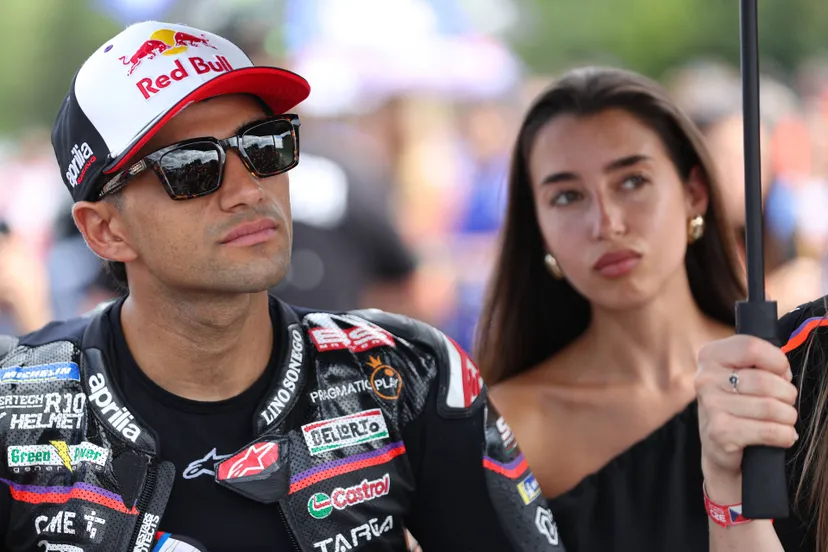
MotoGP star Jorge Martín has opened up about one of the most terrifying moments of his racing career, revealing that during his devastating crash in Qatar, he genuinely believed he might not survive and even called his girlfriend to say goodbye.
The emotional admission has sent shockwaves through the motorsport world, highlighting just how dangerous modern racing still is, even with today’s advanced safety standards.
While MotoGP and Formula 1 often showcase precision, speed, and elite performance, moments like this remind fans and drivers alike that motorsport is still an extreme environment where split-second incidents can change everything.
WHAT HAPPENED IN THE QATAR CRASH
The Qatar incident was described as one of the most severe moments of Martín’s career. During the race, a high-speed crash left him in a vulnerable and critical state, with the rider later admitting he immediately feared the worst.
What stood out most from his account was not just the physical impact, but the psychological reality of believing the situation could be fatal.
In those seconds after the crash, Martín reportedly reached for his phone and contacted his girlfriend, believing it could be his final goodbye.
This detail has resonated deeply across the motorsport community because it strips away the usual competitive narrative and exposes the raw human fear behind racing.
WHY THIS MOMENT SHOOK THE MOTORSPORT WORLD
Incidents like this do more than affect one rider. They ripple through the entire paddock.
For riders and drivers, it reinforces a truth that is often mentally suppressed during competition: every race carries risk, no matter how advanced the safety systems are.
For teams, it raises ongoing questions about bike stability, race conditions, and how to further reduce high-speed crash severity.
For fans, it creates a sobering reminder that behind every helmet is a person with family, relationships, and emotions that extend far beyond the racetrack.
SAFETY IN MODERN MOTORSPORT: STILL NOT PERFECT
Over the last decade, MotoGP and Formula 1 have made massive improvements in safety technology. Airbag suits, improved run-off areas, stronger barriers, and medical response systems have all significantly reduced fatal outcomes.
However, Martín’s experience shows that:
High-speed crashes can still create life-threatening moments
Psychological trauma during incidents is often overlooked
Even elite athletes can feel completely exposed in seconds
This is especially relevant in MotoGP, where riders are more physically exposed compared to F1 drivers inside a survival cell cockpit.
The Qatar crash becomes another case study in why continuous safety evolution is still necessary.
MENTAL IMPACT: THE MOMENT THAT CHANGES EVERYTHING
Beyond physical recovery, the mental impact of such incidents can be long-lasting.
Martín’s decision to call his girlfriend is not just a dramatic detail, it reflects a moment of absolute vulnerability. In motorsport psychology, these experiences can lead to:
Increased caution in future races
Heightened awareness of risk
Emotional fatigue after returning to competition
Stronger motivation to improve safety conversations within the sport
Some riders return stronger mentally, while others take time to rebuild confidence at full racing intensity.
IMPLICATIONS FOR THE CHAMPIONSHIP AND FUTURE PERFORMANCE
While a single crash may not define a season, moments like this can indirectly influence performance across a championship.
If Martín returns fully fit, the key question becomes whether he can maintain his aggressive racing style or adjust slightly to reduce risk exposure.
In a tightly contested MotoGP title fight, even small psychological shifts can affect:
Overtaking decisions
Qualifying aggression
Late-race tire management under pressure
Teams will also monitor recovery closely to ensure both physical and mental readiness before pushing for maximum performance again.
WHAT THIS MEANS FOR MOTORSPORT GOING FORWARD
The broader motorsport world, including Formula 1, often studies MotoGP incidents for safety insights and vice versa. Martín’s crash adds renewed urgency to discussions around:
Barrier energy absorption improvements
Rider and driver protection systems
Medical response timing
Track safety design consistency across circuits
It also strengthens the argument that safety development is not a completed project, but an ongoing responsibility.
FINAL THOUGHTS: A REMINDER BEYOND THE SPORT
Jorge Martín’s Qatar crash is more than just another racing incident. It is a reminder of the fine line between elite performance and real danger in motorsport.
The fact that a top-level rider felt compelled to say goodbye to a loved one in the middle of a race weekend brings a human perspective that statistics and highlights often hide.
As he moves forward in his career, this moment will likely remain a defining chapter, not just for him personally, but for ongoing conversations about safety, risk, and the true cost of speed in motorsport.