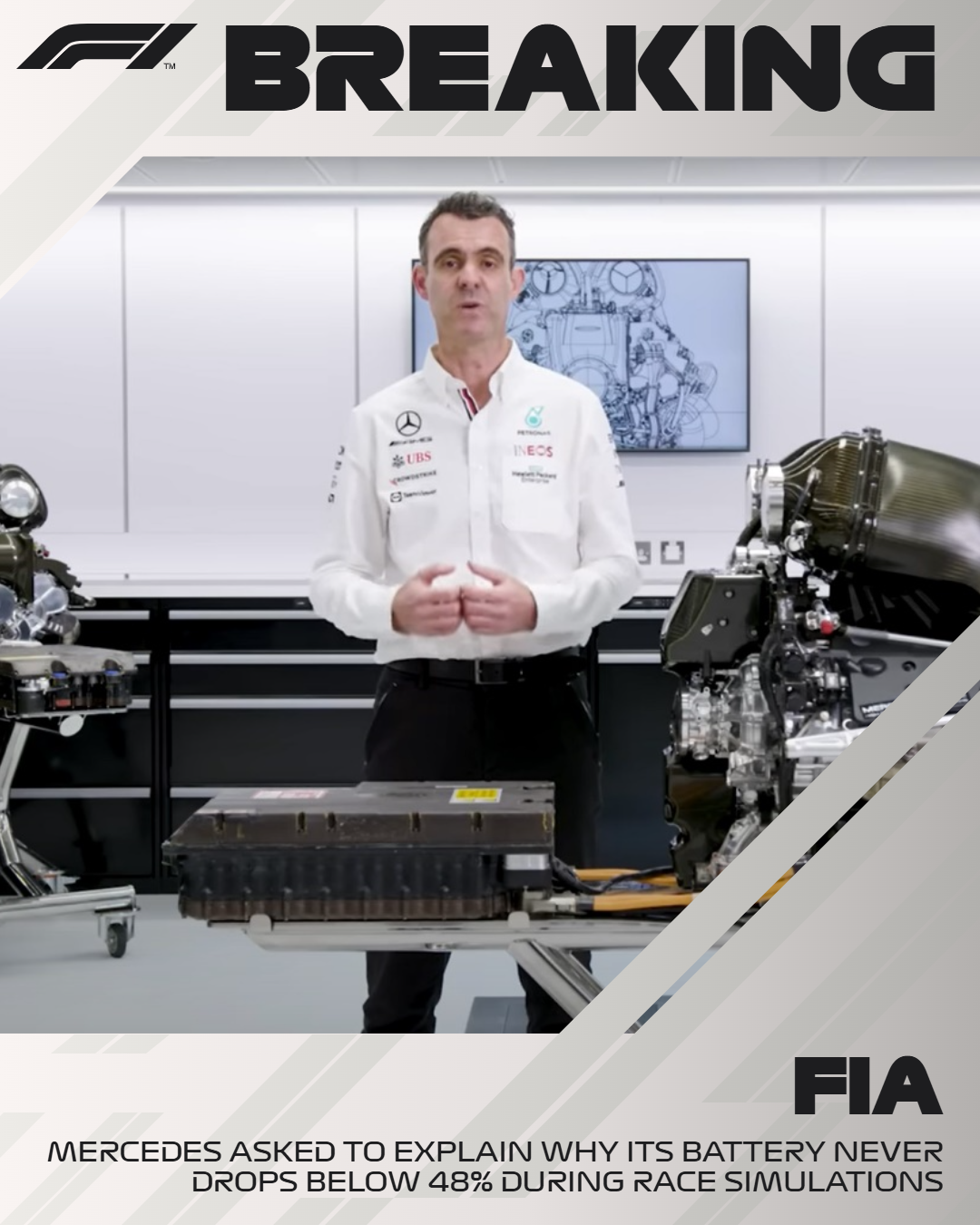
Formula 1’s technical spotlight has once again turned toward Mercedes after reports emerged that the team was asked to explain unusual battery management data observed during race simulations ahead of the Belgian Grand Prix. The discussion centers on telemetry that reportedly showed the car’s energy store remaining above the 48% threshold throughout long-run simulations—an operating pattern that immediately caught the attention of rival engineers and technical observers.
While unusual technical data often becomes a topic of conversation in the Formula 1 paddock, requests for clarification are a normal part of the FIA’s regulatory process. Teams are frequently asked to explain systems, software behavior, or performance trends whenever officials believe additional information is necessary to ensure compliance with the sport’s highly detailed technical regulations.
WHY BATTERY MANAGEMENT IS CRITICAL IN MODERN FORMULA 1
The hybrid power unit has transformed Formula 1 into one of the most technologically advanced championships in motorsport. Every lap involves a carefully calculated balance between harvesting electrical energy under braking and deploying that stored energy for maximum performance on straights and corner exits.
Managing battery charge is far more complex than simply keeping it full. Engineers constantly determine when to save energy, when to deploy maximum electrical power, and how to optimize the system without compromising reliability or race strategy.
Because every manufacturer develops unique energy management philosophies within FIA regulations, even small differences in battery behavior can generate significant interest across the grid.
WHY THE 48% FIGURE HAS BECOME A TALKING POINT
During race simulations, battery levels typically fluctuate depending on circuit layout, braking zones, deployment strategy, tire degradation, and traffic conditions.
If telemetry consistently shows a battery maintaining an unusually stable state of charge during extended runs, competitors naturally become curious about how that result is being achieved.
That curiosity does not automatically imply wrongdoing. Formula 1 teams constantly search for more efficient software calibration, improved harvesting techniques, and optimized deployment maps that remain fully compliant with FIA regulations.
Whenever one team appears to gain an efficiency advantage, rival engineers immediately begin asking questions.
THE FIA’S TECHNICAL OVERSIGHT IS DESIGNED FOR EXACTLY THESE MOMENTS
Formula 1 operates under one of the strictest technical rulebooks in world sport.
The FIA routinely requests explanations regarding software logic, sensor readings, component behavior, and operational strategies whenever unusual patterns emerge. These interactions occur throughout every season and form an essential part of maintaining competitive fairness.
Such inquiries are often resolved through technical documentation, engineering data, or software verification without resulting in any rule violations.
For teams, responding to these requests is simply another aspect of competing at the highest level of motorsport.
WHY MERCEDES HAS ATTRACTED EXTRA SCRUTINY
Mercedes remains one of Formula 1’s most respected engineering organizations. Even during seasons in which victories have been harder to achieve, rival teams continue to monitor every technical development emerging from Brackley.
The Silver Arrows have built a reputation for innovation across multiple generations of regulations. That history means any unexpected performance trend—whether related to aerodynamics, suspension, tire management, or hybrid systems—quickly becomes a subject of discussion throughout the paddock.
When a team with Mercedes’ technical pedigree demonstrates something different, competitors naturally want to understand the engineering behind it.
BELGIAN GRAND PRIX PRESENTS A UNIQUE CHALLENGE
Spa-Francorchamps is one of the most demanding circuits for hybrid power units.
The combination of long full-throttle sections, heavy braking zones, dramatic elevation changes, and unpredictable weather creates an ideal environment for evaluating energy recovery systems.
Efficient battery management can make a significant difference over a lap at Spa, especially through iconic sections such as Eau Rouge, Raidillon, Kemmel Straight, and Blanchimont.
Any advantage in electrical deployment can influence overtaking opportunities, defensive positioning, and overall race strategy.
THE ENGINEERING BATTLE BEHIND THE SCENES
Modern Formula 1 championships are won as much inside engineering offices as they are on the racetrack.
Thousands of simulations are completed before a single practice session begins. Engineers analyze everything from battery temperature and regeneration efficiency to tire degradation, aerodynamic balance, and fuel consumption.
Software specialists continually refine algorithms that determine how electrical energy is harvested and deployed under varying conditions.
Small improvements in efficiency often translate into meaningful gains over an entire Grand Prix distance.
WHAT THIS COULD MEAN FOR THE COMPETITION
If Mercedes has identified a more effective method of managing hybrid energy within the regulations, the implications could extend beyond one race weekend.
Improved electrical efficiency enhances acceleration, supports stronger overtaking performance, and provides greater strategic flexibility throughout a race.
Rival manufacturers would undoubtedly study any repeatable advantage, potentially accelerating their own development programs as the championship progresses.
In Formula 1, one technical breakthrough frequently triggers a wave of innovation across the grid.
RIVALS WILL BE WATCHING CLOSELY
The leading teams rarely ignore unexpected technical trends.
Engineers from Ferrari, Red Bull, McLaren, Aston Martin, and other competitors constantly evaluate publicly available telemetry, onboard footage, GPS traces, and sector analysis in search of clues.
Should Mercedes continue displaying exceptional energy management throughout the Belgian Grand Prix weekend, expect competitors to intensify their own investigations into possible performance gains.
This continuous cycle of observation and innovation is one of Formula 1’s defining characteristics.
THE IMPORTANCE OF REGULATORY TRANSPARENCY
Formula 1 depends on trust in its technical regulations.
Routine requests for explanations help preserve that trust by ensuring every team competes under the same standards.
For fans, these procedures reinforce confidence that race results are determined by engineering excellence operating within the rulebook rather than by undisclosed technical advantages.
Transparency remains one of the cornerstones of the sport’s credibility.
WHY THIS STORY MATTERS BEYOND ONE RACE
Technical discussions like this influence far more than a single qualifying session or Grand Prix.
Manufacturers invest hundreds of millions of dollars into developing hybrid technology, much of which eventually contributes to innovations in road cars.
Every improvement in efficiency, energy recovery, battery management, and software optimization carries significance beyond Formula 1 itself.
That makes technical scrutiny an essential component of both sporting integrity and technological progress.
PREDICTIONS FOR THE BELGIAN GRAND PRIX WEEKEND
If Mercedes continues to demonstrate impressive energy management through practice and qualifying, confidence within the team could grow considerably heading into Sunday’s race.
However, Spa-Francorchamps has a long history of producing unpredictable outcomes. Weather changes, safety cars, tire strategy, and reliability often reshape the competitive order regardless of outright pace.
Should Mercedes successfully translate efficient battery management into stronger race performance, it could emerge as a genuine contender for a podium finish and potentially strengthen its position in the Constructors’ Championship battle.
As attention turns toward the Belgian Grand Prix, every practice session, qualifying lap, and race simulation will be analyzed closely. Whether Mercedes has simply optimized its existing package or uncovered a significant competitive advantage, one thing is certain: the technical battle behind Formula 1’s hybrid era remains every bit as fascinating as the racing itself.