Mercedes became the center of attention following a breathtaking qualifying session that left rivals searching for answers after the team produced one of its strongest single-lap performances of the season. The unexpected leap in pace immediately fueled conversations throughout the Formula 1 paddock, with engineers, analysts, and fans attempting to identify what allowed the Silver Arrows to unlock such impressive speed.
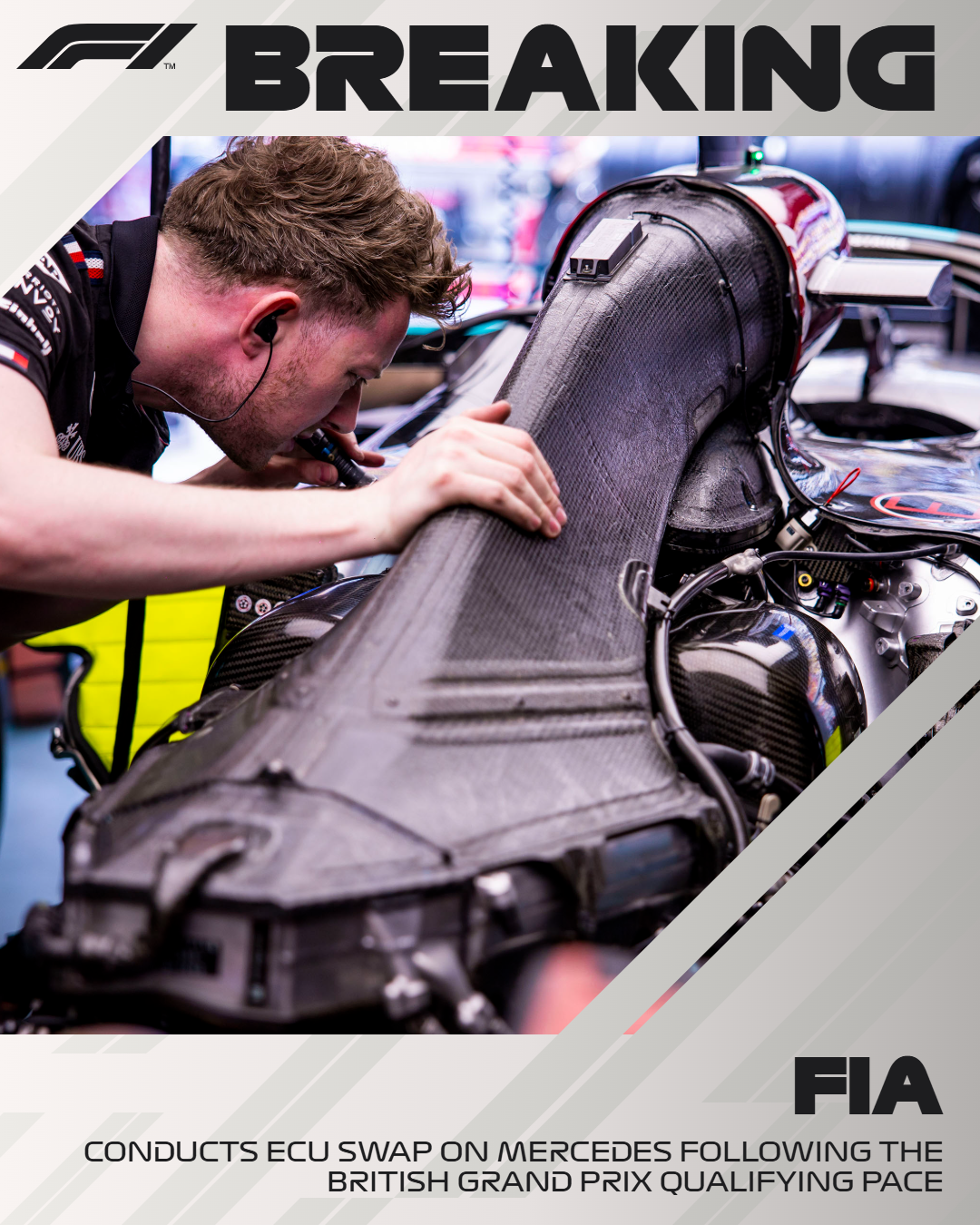
As scrutiny naturally intensified, FIA technical officials carried out a random Electronic Control Unit (ECU) swap as part of the governing body’s standard post-session technical procedures. While routine in nature, the inspection quickly became one of the biggest talking points of the weekend because it followed Mercedes’ remarkable turnaround.
Rather than indicating wrongdoing, the inspection highlighted Formula 1’s commitment to ensuring technical fairness whenever standout performances capture the attention of the entire grid.
WHAT AN ECU SWAP ACTUALLY MEANS
For casual fans, hearing that the FIA has performed an ECU swap may sound dramatic, but within Formula 1 it is an established technical process.
The ECU serves as the central computer that manages countless aspects of a Formula 1 car’s operation, including power unit communication, data logging, sensor monitoring, and regulatory compliance. Because every team operates under strict technical regulations, the FIA has the authority to inspect, replace, or verify ECUs at various points throughout a race weekend.
These procedures are designed to confirm that every competitor operates within identical regulatory boundaries.
An ECU swap does not automatically suggest suspicion or an ongoing investigation. Instead, it forms part of Formula 1’s extensive technical monitoring system that has become increasingly sophisticated during the hybrid era.
WHY MERCEDES’ QUALIFYING PACE TURNED HEADS
The biggest reason the technical check attracted attention was the dramatic nature of Mercedes’ qualifying improvement.
Throughout much of the season, Mercedes has fought inconsistency while attempting to close the performance gap to Formula 1’s leading teams. Finding several tenths of a second in qualifying can completely reshape the competitive order, making any sudden leap worthy of detailed analysis.
Formula 1 engineers know that gains of even one-tenth of a second often require months of aerodynamic development, suspension refinements, simulator work, and data analysis. Producing a major jump during a single weekend naturally raises curiosity—not accusations—across the paddock.
Competitors immediately began studying Mercedes’ cornering speed, tire preparation, straight-line efficiency, and overall balance to determine where the team had made its biggest breakthrough.
THE FIA’S ROLE IN PROTECTING THE SPORT
Modern Formula 1 relies heavily on technical oversight to maintain credibility.
The FIA continuously monitors every team through pre-race inspections, parc fermé regulations, software verification, fuel sampling, component examinations, and random technical checks.
These procedures exist to ensure that every championship battle is decided by engineering excellence operating within clearly defined regulations.
Random inspections are especially important because they reinforce confidence that every team competes under identical standards regardless of manufacturer, budget, or championship position.
In many ways, the inspections protect successful teams just as much as they protect the competition, eliminating unnecessary speculation whenever exceptional performances occur.
WHY RIVALS ARE PAYING CLOSE ATTENTION
Formula 1 is often described as an engineering arms race, where every innovation is scrutinized almost as closely as the racing itself.
Whenever one team uncovers meaningful performance, competitors immediately begin searching for clues.
Has the suspension geometry changed?
Is tire warm-up more efficient?
Did aerodynamic upgrades finally unlock expected performance?
Has the setup window become significantly wider?
Sometimes the answer proves remarkably simple. Other times, it reflects months of development finally producing measurable gains under ideal track conditions.
Regardless of the explanation, Mercedes’ qualifying speed ensured the team became the primary focus of technical discussions throughout the paddock.
THE PRESSURE OF OPERATING UNDER CONSTANT SCRUTINY
Success in Formula 1 brings enormous visibility.
The faster a team becomes, the more attention every aspect of its operation receives.
Championship contenders understand this reality better than anyone.
Every pit stop, software update, aerodynamic component, cooling duct, brake assembly, and suspension modification is carefully examined not only by FIA officials but also by rival engineers looking for competitive advantages.
For Mercedes, operating under that microscope is nothing new.
The team dominated Formula 1 for years, and with dominance came constant technical scrutiny from competitors hoping to uncover any secret behind its success.
THE IMPACT ON THE CHAMPIONSHIP BATTLE
If Mercedes has genuinely unlocked sustainable qualifying performance, the competitive landscape could shift dramatically over the remaining races.
Track position remains one of Formula 1’s greatest strategic advantages.
Starting near the front allows drivers greater flexibility with tire strategy, reduces exposure to first-lap incidents, and creates opportunities to dictate race pace rather than react to competitors.
Even modest qualifying improvements can transform championship momentum over multiple race weekends.
Should Mercedes consistently challenge for pole positions, both the Drivers’ Championship and Constructors’ Championship could become significantly more competitive.
WHY TECHNICAL TRANSPARENCY BENEFITS EVERYONE
One of Formula 1’s greatest strengths is its willingness to publicly enforce technical regulations.
Random inspections reassure fans that victories result from engineering brilliance rather than regulatory loopholes.
That transparency also strengthens confidence among sponsors, manufacturers, broadcasters, and commercial partners who invest billions into the championship.
Every successful inspection reinforces the integrity of Formula 1’s technical rulebook.
THE HUMAN SIDE OF THE STORY
Behind every remarkable qualifying lap are hundreds of engineers, mechanics, software specialists, aerodynamicists, strategists, and factory personnel whose work often goes unnoticed.
When a team suddenly finds performance, it frequently reflects months of late nights, simulator sessions, wind tunnel testing, computational fluid dynamics analysis, and relentless problem-solving.
A standout qualifying performance is rarely accidental.
Instead, it represents the combined effort of an entire organization working toward tiny performance gains that eventually produce significant results on track.
COULD THIS MARK A MERCEDES RESURGENCE?
Momentum plays an enormous role in Formula 1.
One exceptional weekend can inspire confidence throughout an organization, accelerating development while boosting morale among drivers and engineers alike.
If Mercedes has finally discovered a setup philosophy that consistently extracts maximum performance from its package, rivals may soon find themselves responding instead of leading.
Conversely, if the qualifying pace proves circuit-specific, the competitive order could quickly return to normal at the next venue.
The coming race weekends will reveal whether this performance was an isolated breakthrough or the beginning of a genuine resurgence.
WHAT HAPPENS NEXT
Following the FIA’s routine ECU procedure, attention now shifts entirely to race performance.
Qualifying speed provides headlines, but championships are ultimately decided over race distance through tire management, strategy execution, reliability, and consistent points finishes.
Mercedes now carries the added expectation that comes with impressing the paddock.
Every session moving forward will be closely analyzed as rivals search for evidence that the team’s remarkable qualifying pace represents a lasting competitive leap.
Whether this weekend becomes remembered as the moment Mercedes rejoined the fight at the very front of Formula 1 or simply an exceptional qualifying performance, one thing is already certain: the Silver Arrows have reminded everyone that in Formula 1, every fraction of a second has the power to reshape an entire championship narrative.