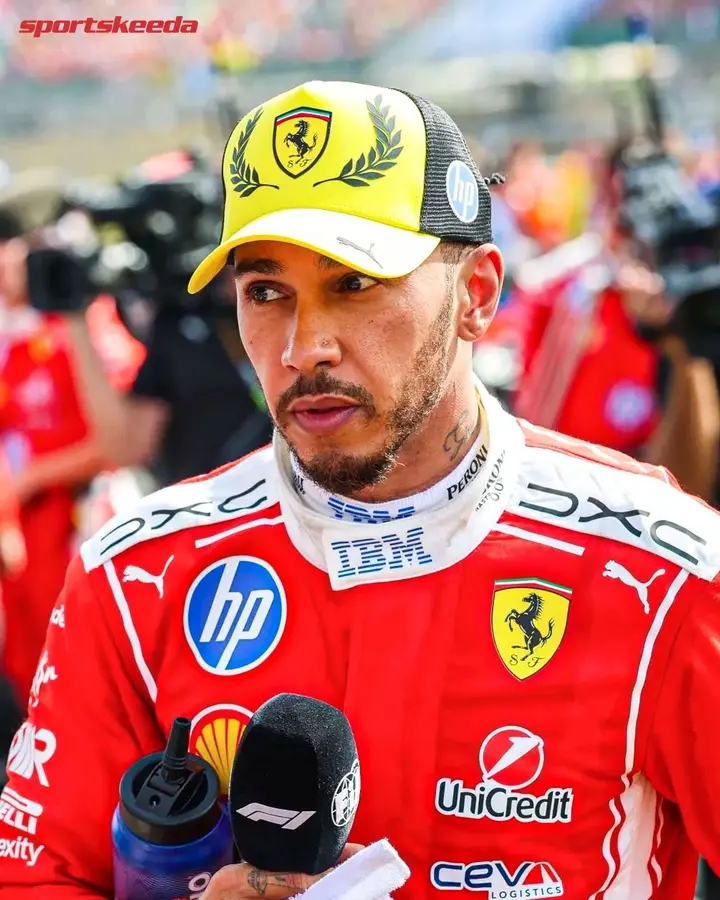
Lewis Hamilton and Ferrari have undoubtedly emerged as one of Formula 1’s biggest success stories in recent weeks. A string of strong performances has transformed the Scuderia from an early-season midfield challenger into a team capable of fighting for victories. Hamilton has reduced his championship deficit to Mercedes rookie Kimi Antonelli from 59 points to just 32 over the last five races, collecting multiple podiums and another race win along the way. With Ferrari also claiming two victories in its last three outings, optimism is naturally growing around the team’s championship ambitions.
FERRARI’S RAPID DEVELOPMENT HAS CHANGED THE PICTURE
At the opening race of the season, Ferrari was significantly off the pace compared to Mercedes, with the performance gap approaching a full second per lap in Australia. Since then, however, the Italian squad has made remarkable progress through an aggressive development program. Major upgrade packages introduced since Miami have steadily improved both qualifying speed and race pace, allowing Hamilton and Charles Leclerc to challenge Mercedes far more consistently.
The improvement has been particularly noticeable in tire management, where Ferrari has narrowed one of its biggest weaknesses. By Silverstone, the overall pace difference between Ferrari and Mercedes had fallen to only a few tenths of a second, proving that the team’s engineers have made substantial gains over the course of the season.
THE UPGRADE STRATEGY COULD CREATE FUTURE PROBLEMS
While Ferrari deserves praise for its development rate, there is another side to the story. The team has invested heavily in early-season upgrades, introducing multiple major performance packages while several rivals have adopted a more measured development schedule.
Formula 1’s budget cap limits how many significant upgrades teams can introduce throughout the year. Ferrari’s aggressive approach could leave fewer resources available during the second half of the season, exactly when Mercedes and McLaren may begin rolling out their own larger performance improvements. If those rivals close the gap later in the campaign, Ferrari’s current momentum could become much harder to maintain.
THE POWER UNIT REMAINS A CRITICAL WEAKNESS
Despite the chassis improvements, Ferrari continues to struggle with straight-line speed. Even after introducing power unit updates, the team still appears to lose valuable time on long straights compared to Mercedes.
That weakness forces Hamilton and Leclerc to push harder through corners to compensate, placing greater stress on the tires over a race distance. Silverstone offered another clear example, as Antonelli was able to pass Hamilton using superior straight-line performance before pulling comfortably clear. Until Ferrari fully addresses its engine deficit, competing consistently against Mercedes across different circuits will remain a difficult challenge.
HAMILTON’S CHAMPIONSHIP CHARGE HAS BEEN HELPED BY MERCEDES MISFORTUNE
Hamilton’s impressive reduction in the championship standings deserves recognition, but the numbers alone do not tell the complete story. Much of the gap has closed because Antonelli has endured costly reliability problems during recent races.
The Mercedes rookie suffered two retirements in three events, including one while running near the front in Barcelona and another at Silverstone when he was fighting Charles Leclerc for victory. Without those mechanical failures, Hamilton’s championship deficit would likely be considerably larger. Ferrari has undoubtedly improved, but Mercedes’ reliability setbacks have also played a major role in tightening the title race.
CHARLES LECLERC COULD BECOME HAMILTON’S BIGGEST CHALLENGE
Another important factor is Ferrari’s own driver lineup. Leclerc appears increasingly comfortable with the SF-26 and delivered one of his strongest performances at Silverstone. While circumstances played a role in his victory, his overall race pace suggested he may have found a setup direction that suits the car better than Hamilton’s current configuration.
If Leclerc continues building on that performance at upcoming races, Ferrari could soon face an internal battle between its two drivers. Rather than focusing solely on Mercedes and McLaren, Hamilton may first need to establish himself as Ferrari’s clear number one if he hopes to mount a serious championship challenge.
WHY THE TITLE RACE REMAINS UNCERTAIN
Ferrari has unquestionably transformed itself into a genuine race-winning team, and Hamilton’s recent consistency has reignited excitement among fans. However, several obstacles still stand between the seven-time world champion and another title fight.
The team’s front-loaded development strategy, lingering power unit disadvantage, Mercedes’ potential to respond with future upgrades, and Leclerc’s improving form all suggest that Ferrari’s championship hopes remain far from guaranteed. With plenty of races still to come, the competitive order can shift quickly.
Hamilton is firmly back in contention for regular podiums and victories, but turning that momentum into a sustained championship campaign will require Ferrari to maintain its development pace while solving the technical weaknesses that continue to limit its ultimate performance. As the season progresses, the Belgian Grand Prix and the races that follow may provide a much clearer indication of whether Ferrari can truly challenge for the Formula 1 crown.