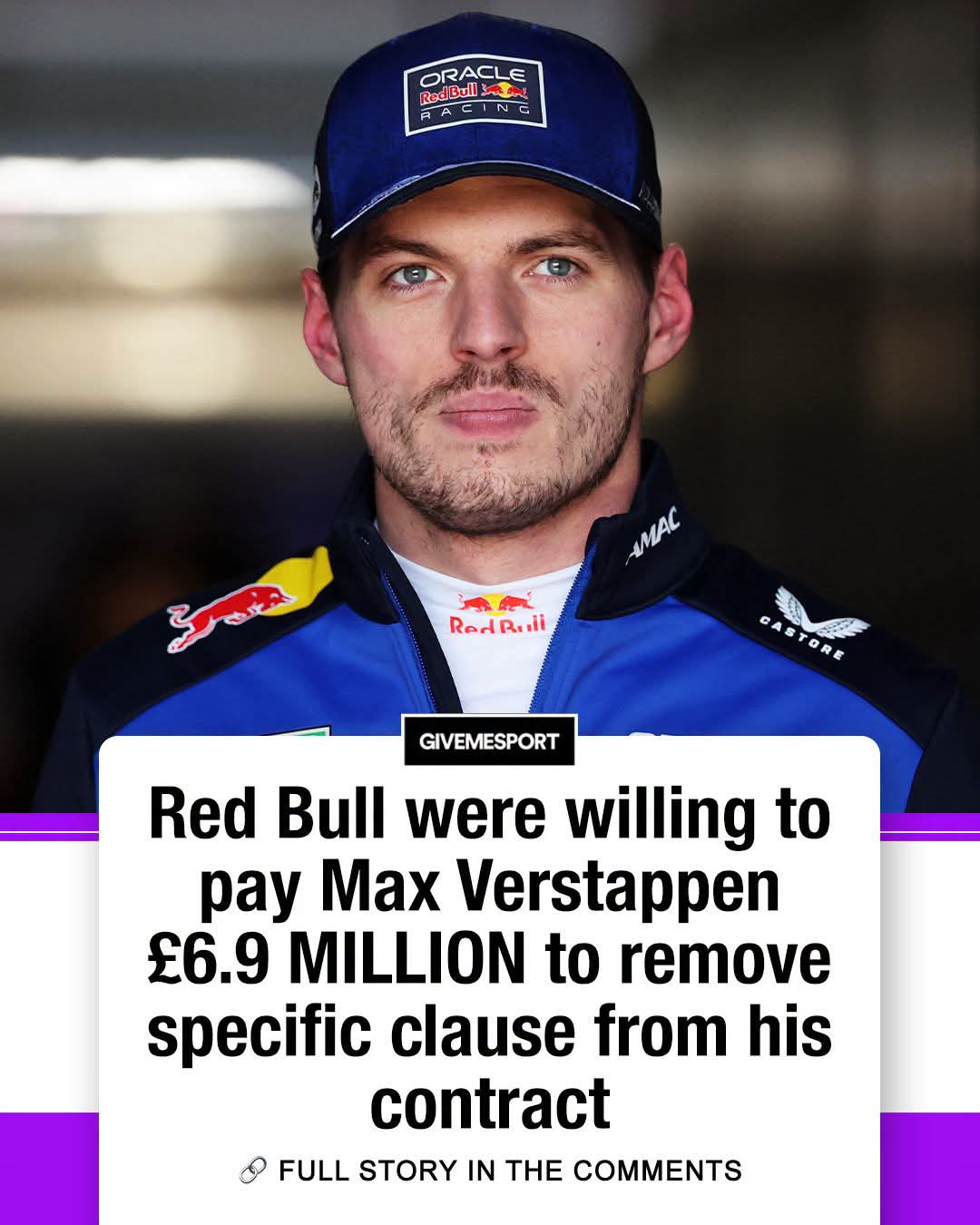
Max Verstappen’s future at Red Bull has become one of Formula 1’s biggest talking points, and fresh reports suggest the reigning four-time world champion was offered a substantial financial incentive to eliminate a key exit clause from his contract. According to reports, Red Bull was prepared to pay Verstappen €8 million—approximately £6.9 million—to remove the clause that could allow him to leave the team before the end of his existing deal.
The reported offer highlights just how determined Red Bull is to keep the Dutch superstar despite growing speculation linking him with rival teams. With the 2026 Formula 1 season approaching a critical phase, Verstappen’s next move could reshape the competitive landscape for years to come.
VERSTAPPEN’S CONTRACT HAS BECOME FORMULA 1’S HOTTEST TOPIC
Although Verstappen remains contracted to Red Bull until the end of 2028, his agreement reportedly includes a performance-based release clause that could become active if he sits outside the top two in the Drivers’ Championship by the summer break.
That scenario currently looks realistic.
Following a difficult opening half of the season, Verstappen occupies seventh place in the standings after enduring reliability problems and inconsistent performances. Despite an impressive second-place finish at the Austrian Grand Prix, he remains a significant distance behind championship leader Andrea Kimi Antonelli and second-placed George Russell.
With only a handful of races remaining before the summer break, every point now carries enormous importance—not only for the championship but potentially for Verstappen’s future.
RED BULL’S FINANCIAL OFFER SHOWS ITS LEVEL OF CONCERN
According to reports from the Formula 1 paddock, Red Bull attempted to resolve the uncertainty by offering Verstappen approximately £6.9 million to voluntarily remove the release clause from his contract.
Reports indicate the Dutch driver declined the proposal.
While the financial figure is substantial, the decision makes strategic sense from Verstappen’s perspective.
Maintaining the release clause preserves flexibility. If Red Bull cannot consistently produce a race-winning car under Formula 1’s new regulations, Verstappen retains the option of exploring opportunities elsewhere rather than committing to several more seasons without championship-winning machinery.
For Red Bull, however, the uncertainty creates a major planning problem.
WHY RED BULL WANTS AN EARLY DECISION
One of Red Bull’s biggest concerns reportedly revolves around timing.
The release clause is believed to remain active until late September, meaning Verstappen could potentially wait until after most teams have finalized their driver plans before making his decision.
That would leave Red Bull scrambling to replace arguably the most complete driver on the Formula 1 grid.
Replacing Verstappen would never be straightforward.
Beyond his exceptional speed, he has become the focal point around which Red Bull has built its entire technical and operational philosophy. Losing him would force the team to rethink not only its driver lineup but potentially its long-term development strategy.
It’s understandable why Red Bull reportedly hopes to bring that decision forward rather than waiting until autumn.
THE AUSTRIAN GRAND PRIX CHANGED THE CONVERSATION
Just days before these latest reports emerged, Verstappen delivered one of his strongest performances of the season at the Austrian Grand Prix.
Starting from a difficult position after problems in qualifying, the Dutchman recovered brilliantly to finish second behind George Russell, finishing less than two seconds behind the Mercedes driver.
Perhaps more importantly, Red Bull introduced a major upgrade package that appeared to significantly improve the RB22’s competitiveness.
For the first time in several races, Verstappen looked capable of genuinely challenging for victory.
That performance may ultimately prove just as valuable as any financial offer Red Bull could make.
MERCEDES AND MCLAREN REMAIN CLOSELY LINKED
While Mercedes had long been viewed as Verstappen’s most likely destination, the situation has evolved rapidly.
George Russell has publicly expressed confidence about remaining with Mercedes, while Andrea Kimi Antonelli has emerged as the championship leader and one of Formula 1’s brightest young stars.
Replacing either driver would be a difficult decision for Toto Wolff, particularly considering Mercedes currently leads the Constructors’ Championship.
Meanwhile, McLaren continues to appear in transfer speculation despite CEO Zak Brown insisting both Oscar Piastri and Lando Norris remain committed to the team.
Reports suggesting conversations between Verstappen’s representatives and McLaren have only intensified speculation, even as all parties publicly deny active negotiations.
Should McLaren seriously pursue Verstappen, it would create one of the biggest driver market stories in modern Formula 1 history.
RED BULL’S DRIVER DEPTH REMAINS A QUESTION
Another factor increasing Red Bull’s urgency is the difficulty of replacing Verstappen internally.
Over recent years, several talented drivers—including Pierre Gasly, Alex Albon, Sergio Perez, Liam Lawson, and Yuki Tsunoda—have struggled alongside the Dutchman.
The latest rising talent, Isack Hadjar, has shown encouraging promise during 2026 and currently sits just behind Verstappen in the standings. However, expecting any young driver to immediately replace a four-time world champion would place enormous pressure on the Frenchman.
Red Bull has consistently built its championship ambitions around Verstappen’s extraordinary ability to outperform the machinery available to him.
Finding another driver capable of delivering that level of performance simply isn’t realistic in the current Formula 1 market.
THE NEXT THREE RACES COULD DEFINE THE FUTURE
The upcoming stretch of races may ultimately determine whether Verstappen remains with Red Bull.
Strong performances at Silverstone, Spa-Francorchamps, and the Hungaroring would reduce the championship deficit while reinforcing confidence in Red Bull’s development direction.
Conversely, another series of disappointing weekends would likely strengthen arguments for exploring alternative options.
From Verstappen’s perspective, the decision extends beyond money.
His priority has always been competing for championships, and whichever team offers the strongest long-term opportunity under Formula 1’s evolving regulations will naturally become the most attractive destination.
WHY THIS STORY MATTERS FOR FORMULA 1
Few driver decisions carry as much influence as Verstappen’s.
A move away from Red Bull would immediately transform the competitive balance across the grid, forcing multiple teams to reconsider their driver lineups and potentially triggering a domino effect throughout the paddock.
For Red Bull, retaining Verstappen would represent stability during a period of significant organizational change.
For rival teams, signing him could instantly elevate their championship ambitions.
As the summer break approaches, Formula 1’s biggest storyline is no longer just who will win the 2026 championship—it is where Max Verstappen will race when the next chapter of his remarkable career begins.