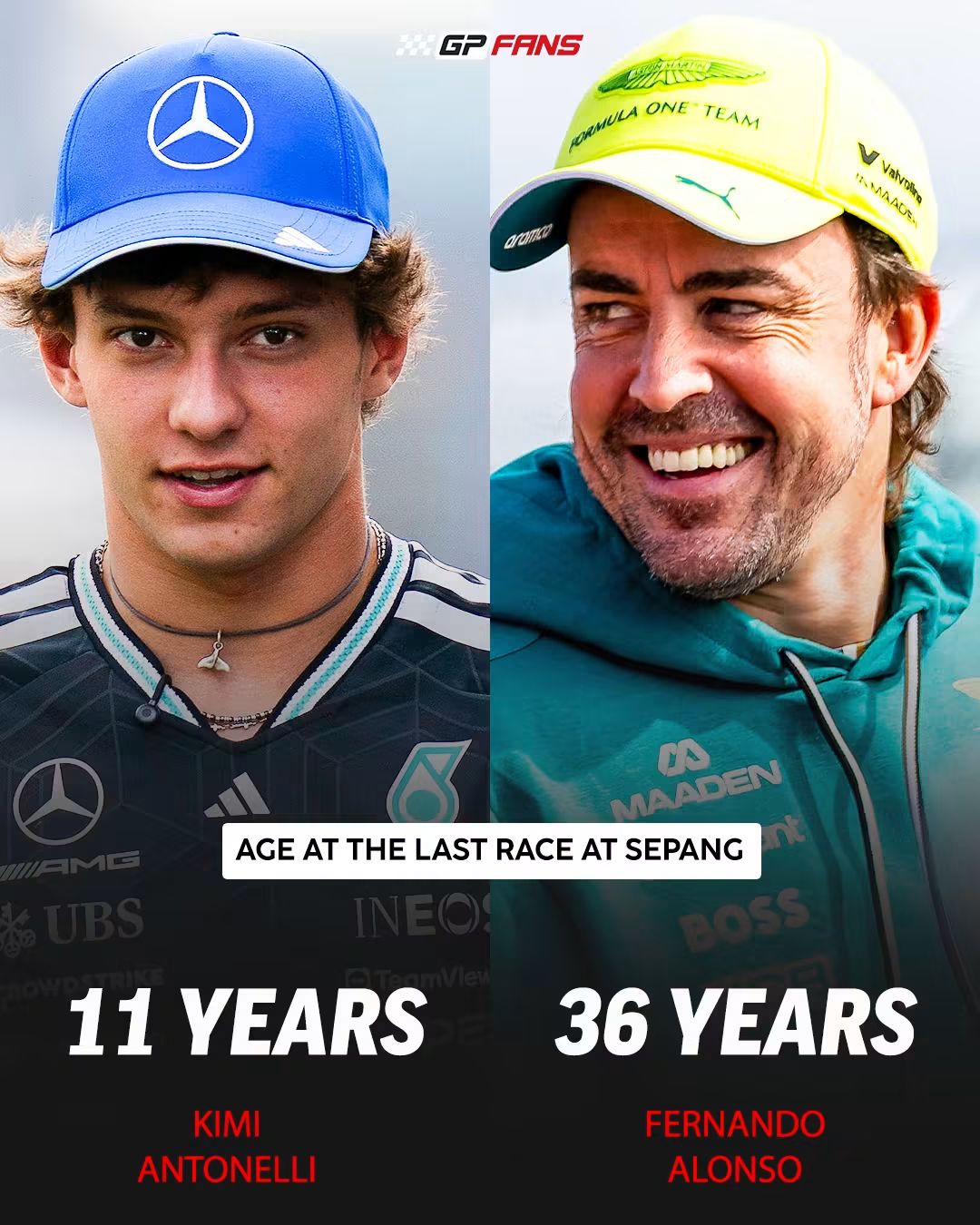
When Formula 1 cars last thundered around the Sepang International Circuit, Andrea Kimi Antonelli was still in primary school. Born on 25 August 2006, the Italian was just 11 years old when Max Verstappen won the final Malaysian Grand Prix on 1 October 2017. He had not yet turned 13. He was not a teenager. Now, as the sport prepares to return to Malaysia in October 2026 for the first time in nine years, that same driver will line up as a Mercedes race winner, championship contender, and one of the most exciting talents of the new generation.
The gap in time is more than a quirky statistic. It underlines how dramatically Formula 1, its drivers, and the wider motorsport landscape have changed since the Malaysian Grand Prix disappeared from the calendar.
WHY SEPANG VANISHED AND WHY IT IS COMING BACK
Sepang hosted Formula 1 every year from 1999 to 2017. Designed by Hermann Tilke, the 5.543 km circuit became known for its wide layout, long straights, sweeping corners, and the ever-present threat of tropical rain. It produced memorable races and developed a strong following among drivers who appreciated its challenge.
By the mid-2010s the numbers no longer stacked up. Rising host fees, declining local attendance, and competition from newer venues led Malaysia to end its contract after the 2017 event. Verstappen’s victory that day, coming the day after his 20th birthday, closed the chapter. Sebastian Vettel holds the record with four wins at the track. Fernando Alonso, still racing in 2026, claimed three.
The 2026 return is not a planned permanent comeback. It is a pragmatic solution. The original Bahrain Grand Prix was cancelled earlier in the season because of conflict in the Middle East. Bahrain worked with Formula 1, the FIA, and Malaysian authorities to relocate the race to Sepang for 2-4 October, keeping the Bahrain Grand Prix name. The event slots between Azerbaijan and Singapore, creating a late-season triple-header while restoring the calendar to 23 races.
For Malaysia the arrangement is attractive. Bahrain is covering the bulk of the rights fees, leaving local organisers with more manageable preparation costs. Early estimates suggest the weekend could generate significant economic activity through tourism, hospitality, and related spending. For Formula 1 it demonstrates flexibility in an unstable geopolitical environment while giving fans a classic circuit many current drivers have never raced on in an F1 car.
THE GENERATION GAP ON THE GRID
Antonelli’s age relative to the last Sepang race captures a broader shift. When Verstappen won in 2017, the Dutchman himself was only 20. Lewis Hamilton, then a Mercedes driver, finished second. Many of today’s regulars were either not yet in Formula 1 or still climbing the junior ranks.
By the time Antonelli arrives at Sepang in 2026 he will be 20 years old with a full season of Formula 1 experience already behind him. He made his debut for Mercedes in 2025, replacing Hamilton, and quickly established himself as a race winner and polesitter. The contrast is stark: a driver who was not even a teenager when the previous Malaysian Grand Prix took place will now compete at the circuit as a proven Grand Prix winner.
This generational turnover is typical of modern Formula 1. The sport’s rapid promotion pathway, sophisticated junior programmes, and the high cost of staying competitive mean careers can accelerate or end quickly. Antonelli’s rise through karting, Formula 4, Formula Regional, and Formula 2 into a top-team seat by age 18 is extreme even by current standards. His presence at a revived Sepang illustrates how the grid has renewed itself almost completely since 2017.
WHAT THE RETURN MEANS FOR DRIVERS, TEAMS, AND THE SPORT
For the majority of the 2026 grid, Sepang will be a new track in Formula 1 machinery. A handful of veterans have raced there before. The rest will rely on simulator work, data, and free practice sessions to adapt to a layout that rewards precision through the high-speed sweeps and careful management of tyres and brakes in the heat and humidity.
Weather remains a major variable. Afternoon storms are common. The 2017 race and many before it were affected by rain, creating strategic complexity and opportunities for drivers who can adapt quickly. In the current ground-effect era, with different aerodynamic characteristics and tyre compounds, the circuit will present fresh challenges compared with the cars that last raced there.
Teams will treat the weekend as both a competitive opportunity and a valuable data-gathering exercise. Performance relative to the Singapore night race that follows will offer insights into how the cars handle contrasting track surfaces and conditions. For Mercedes, Antonelli’s first visit carries particular interest. The team has invested heavily in his development. A strong result at a circuit with historical significance would add another chapter to his early career narrative.
Beyond the competitive element, the return carries commercial and cultural weight. Formula 1 has expanded aggressively into new markets while occasionally revisiting traditional venues. A successful Sepang weekend could reopen conversations about a longer-term Malaysian presence, especially if local economic benefits materialise and the geopolitical situation allows more stable calendar planning. It also gives Asian fans a second race in the region within a short window, following Singapore.
THE BIGGER PICTURE FOR FORMULA 1’S FUTURE
The story of Antonelli and Sepang is a reminder of how quickly time moves in elite motorsport. Circuits come and go. Drivers who once seemed permanent fixtures move on. Youngsters who were children during previous eras suddenly find themselves at the sharp end of the grid.
Formula 1’s ability to adapt its calendar mid-season shows organisational maturity, even if the circumstances that forced the change are undesirable. It also highlights the sport’s growing reliance on a small number of willing hosts when disruptions occur. Malaysia benefits from infrastructure that has been maintained through MotoGP and other series, making a relatively short-notice return feasible.
Looking ahead, the 2026 Sepang weekend will be watched closely for more than race results. Attendance figures, local economic impact, driver feedback, and logistical smoothness will all influence whether this is a one-off rescue or the start of a renewed relationship. For Antonelli personally, it closes a personal timeline that began when he was an 11-year-old boy watching Formula 1 from afar.
Nine years is a long time in racing. In that span a child who had not yet reached his teens has become a Grand Prix winner. A circuit written off as too expensive has been pressed back into service by global events. And Formula 1 continues to evolve, balancing tradition, commercial reality, and the relentless arrival of new talent.
When the lights go out at Sepang in October 2026, one of the most striking stories will not be about lap times or strategy alone. It will be the simple fact that the last time Formula 1 raced there, Kimi Antonelli was still years away from becoming a teenager. Now he is part of the story itself.