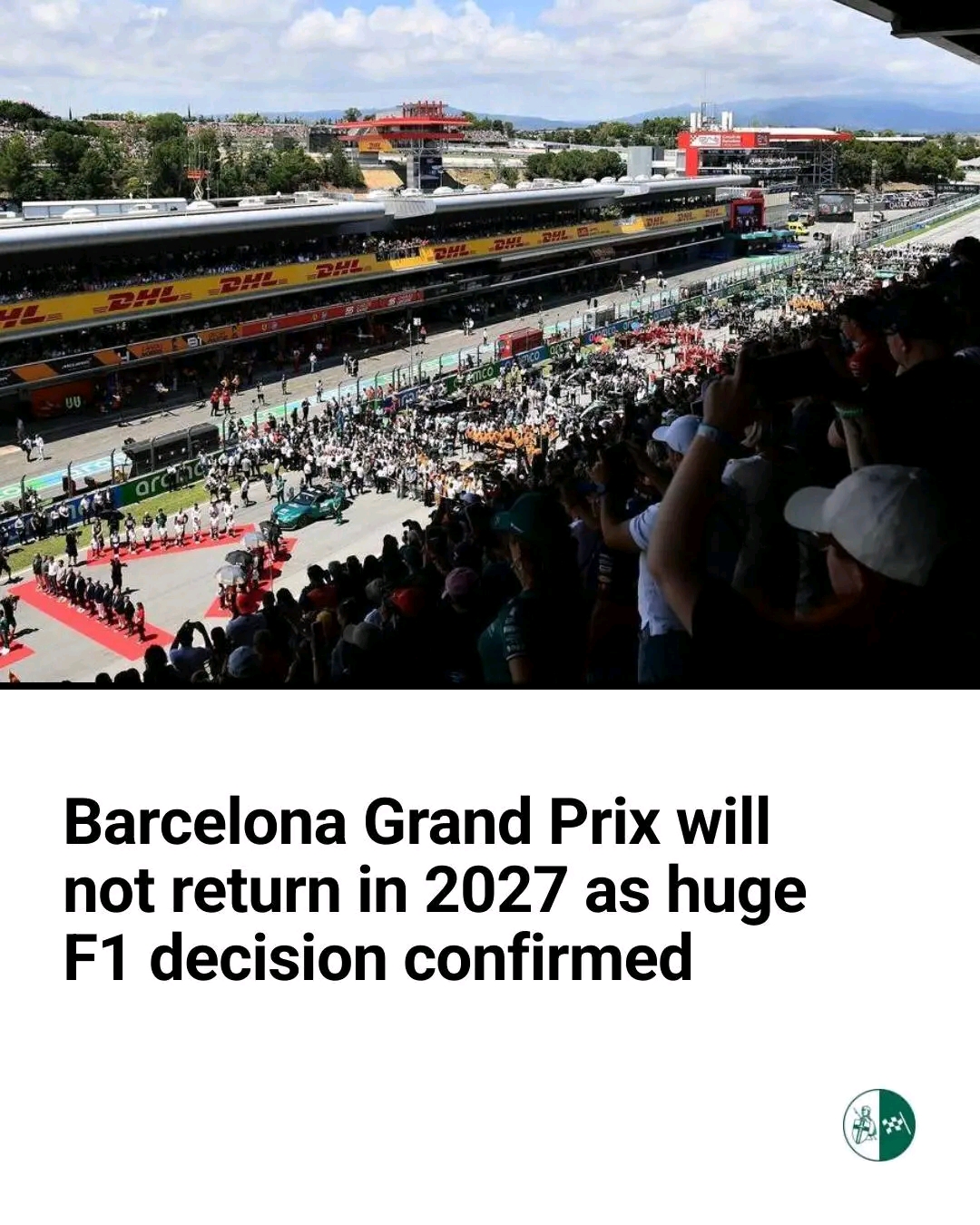
Formula 1 is heading for another major shake-up as reports indicate that the Barcelona Grand Prix will not feature on the 2027 calendar following a decision by F1’s governing leadership on the race’s long-term future. The Spanish venue, long known as a staple of pre-season testing and a technical benchmark circuit for teams, appears to be facing an uncertain exit as F1 continues its global expansion strategy.
While official confirmation is still developing, the implications of this move are already sparking debate across the paddock.
WHY BARCELONA HAS BEEN SO IMPORTANT TO FORMULA 1
The Circuit de Barcelona-Catalunya has played a crucial role in Formula 1 for decades. Known for its balanced layout combining high-speed corners, technical sectors, and tyre-degrading surfaces, it has traditionally been one of the most important “car development” circuits on the calendar.
Teams often rely on Barcelona to:
Evaluate aerodynamic upgrades
Test tyre performance under real race conditions
Compare long-run race pace data
Prepare for the European leg of the season
Because of its technical demands, engineers often refer to it as a “truth-telling circuit” where car strengths and weaknesses are clearly exposed.
Losing this track would not just remove a race weekend, but also a key development reference point.
WHY FORMULA 1 IS MOVING AWAY FROM TRADITIONAL VENUES
The potential removal of Barcelona reflects a wider trend in Formula 1’s modern direction: global expansion and commercial growth.
Over the past few years, F1 has added or prioritised races in:
The Middle East
North America
Street circuits in major cities
New entertainment-driven venues
This shift is part of F1’s strategy to grow its global fanbase and attract larger commercial deals.
However, this approach often comes at the expense of traditional European circuits, which have been the backbone of the sport for decades.
Barcelona now appears to be one of the latest casualties of this transition.
IMPACT ON TEAMS AND DRIVER PREPARATION
If Barcelona is removed, teams will lose one of the most reliable data-gathering tracks in the sport.
KEY TEAM IMPACTS
Reduced pre-race development correlation data
Fewer opportunities to validate aerodynamic upgrades
Loss of a consistent tyre degradation benchmark
This could particularly affect midfield teams that rely heavily on Barcelona data to close the gap to front-runners.
DRIVER IMPACTS
For drivers, Barcelona is often a physically demanding circuit that tests:
Tyre management skills
Consistency over long stints
Precision in medium-speed corners
Veteran drivers often perform well here because experience plays a major role in tyre conservation and race strategy execution.
WHAT THIS MEANS FOR THE CHAMPIONSHIP CALENDAR
With Barcelona potentially out, Formula 1 may use the slot in several ways:
Extend existing European race contracts
Introduce a new city-based street circuit
Strengthen races in emerging markets
One possibility being discussed in the paddock is a reshuffling that could further strengthen circuits like Spa-Francorchamps in Belgium, which already holds iconic status in the sport.
The long-term direction suggests F1 is prioritising spectacle and market growth over tradition.
FANS REACTION: TRADITION VS MODERN F1
The reaction among fans is expectedly divided.
Traditionalists argue that removing Barcelona weakens the sport’s heritage and removes a key testing ground for true driver skill.
On the other hand, newer audiences often welcome the addition of more city-based races, entertainment-focused weekends, and global accessibility.
This tension between heritage and modernisation continues to define the current Formula 1 era.
WHAT COMES NEXT FOR BARCELONA
At this stage, Barcelona’s future is not entirely closed. Several scenarios could still unfold:
A rotation system with other European circuits
A reduced long-term contract renewal
A return in a revised calendar format
Much will depend on negotiations between F1 management, local organisers, and commercial partners in the coming months.
FINAL THOUGHTS
If confirmed, the removal of the Barcelona Grand Prix marks another significant step in Formula 1’s transformation into a more global entertainment product. While it may make commercial sense for the sport’s leadership, it raises important questions about how much of F1’s historic identity is being traded for expansion.
For teams, it’s a strategic loss. For fans, it’s an emotional one. And for Formula 1 itself, it’s another reminder that the sport is evolving faster than ever.