Kimi Antonelli’s rise to the top of Formula 1 has been remarkably rapid. The young Italian entered the sport carrying enormous expectations after being selected by Mercedes, a team with championship ambitions and a long history of demanding excellence from its drivers. Now leading the 2026 Formula 1 championship, Antonelli appears more confident and composed than ever. Yet behind that success lies a difficult rookie season that, by his own admission, pushed him close to his psychological limits.
Antonelli’s revelation offers a rare glimpse into the reality of becoming a Formula 1 driver at the highest level. While fans often see the glamour, speed and success associated with the sport, the transition from junior racing to F1 can be brutally demanding. Every mistake is analyzed, every qualifying lap is compared with a teammate’s performance, and every result can influence public opinion about a driver’s future.
For Antonelli, those pressures were magnified by the fact that he was not simply joining any team. He was stepping into the Mercedes seat at a time when the team was undergoing a major transition and when expectations surrounding its young talent were extremely high.
ANTONELLI’S ROOKIE SEASON WAS A TEST OF MENTAL STRENGTH
The move into Formula 1 represents one of the biggest challenges in motorsport. Drivers must adapt to heavier media obligations, more complex technical demands, longer race weekends and an unforgiving level of competition. For Antonelli, the learning curve was particularly steep.
The Italian arrived in F1 with a reputation as one of the brightest young talents in motorsport. That reputation, however, quickly became a double-edged sword. Every strong performance reinforced the belief that he was destined for greatness, while every mistake attracted even greater scrutiny.
That environment can create a difficult psychological cycle. A driver who is constantly thinking about expectations can begin to focus less on driving naturally and more on avoiding failure. In Formula 1, where confidence and instinct are essential, that mindset can quickly become destructive.
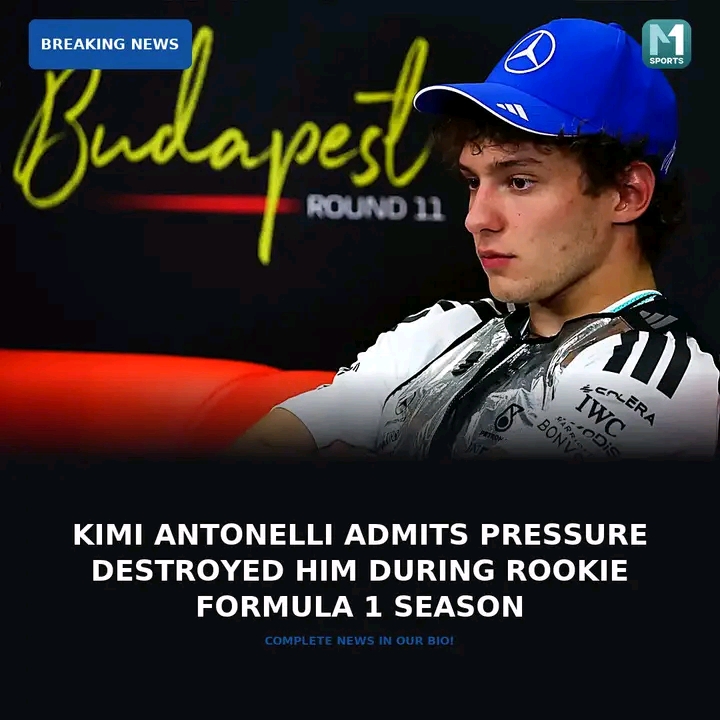
Antonelli’s admission that the pressure “destroyed” him during his rookie campaign therefore provides important context for his development. His struggles were not necessarily evidence of a lack of ability. Instead, they highlighted how difficult it can be for even the most talented young drivers to cope with the weight of expectation.
WHY THE MERCEDES SEAT MADE THE PRESSURE EVEN GREATER
Driving for Mercedes carries a unique level of responsibility. The team is one of the most successful organizations in modern Formula 1, and its drivers are expected to fight for victories and championships whenever the car is capable of delivering those results.
Antonelli was also following a driver whose legacy had become deeply connected with the Mercedes brand. That created an unavoidable comparison and increased the attention surrounding his performances.
For a young driver, the challenge is not only to drive quickly but also to establish an identity of his own. Antonelli had to prove that he deserved his place on the grid while simultaneously demonstrating that Mercedes had made the right decision by investing in him.
That is a difficult balance.
A rookie can normally afford a period of adjustment at a midfield team, where mistakes may receive less attention. Antonelli did not have that luxury. His every move was watched closely, and his performances were judged against the standards of a championship-winning organization.
THE DIFFERENCE BETWEEN TALENT AND EXPERIENCE
One of the most important lessons from Antonelli’s experience is that natural speed cannot replace experience.
A driver can be exceptionally quick and still struggle with the mental demands of Formula 1. The sport requires an enormous amount of information to be processed at high speed, from tire management and energy deployment to race strategy and communication with engineers.
There is also the emotional side of the sport.
A driver must learn how to recover from a poor qualifying session, ignore criticism after an accident and remain focused when a race does not go according to plan. These skills generally develop over time.
Antonelli’s rookie season appears to have accelerated that learning process. The pressure that once threatened to overwhelm him may ultimately have become one of the experiences that helped shape him into a stronger competitor.
ANTONELLI’S 2026 FORM SHOWS HOW MUCH HE HAS GROWN
The biggest indication of Antonelli’s development is his current position at the top of the 2026 championship.
Going from a rookie who openly struggled with pressure to a driver capable of leading the world championship represents a significant transformation.
The most impressive aspect of his progress is not simply his speed. It is the apparent improvement in his ability to manage the environment around him.
Championship contenders must deal with pressure differently from rookies. Every race carries greater consequences, and mistakes become more expensive as the season progresses. The fact that Antonelli is now operating at the front suggests that he has developed a much stronger mental framework.
That could prove to be just as important as his raw pace.
WHY THIS MATTERS FOR MERCEDES
Antonelli’s emergence is potentially enormous for Mercedes.
The team has been searching for a new long-term leader capable of carrying its competitive ambitions into the future. If Antonelli can maintain his current trajectory, Mercedes may have found exactly that driver.
His development also gives the team a valuable advantage. A driver who grows within a top organization can become deeply integrated into its technical philosophy and working methods.
Mercedes will still need to ensure that it manages Antonelli carefully. Championship pressure can become overwhelming even for experienced drivers, and the team must avoid placing unrealistic expectations on a young driver simply because he has delivered impressive results.
The best approach may be to allow Antonelli to develop without constantly framing every weekend as a referendum on his career.
THE CHAMPIONSHIP PRESSURE WILL ONLY GET WORSE
Ironically, Antonelli’s success could create the very pressure he once struggled to handle.
Leading the championship means the spotlight is now brighter than ever. Instead of asking whether he belongs in Formula 1, fans and media will increasingly ask whether he can win the title.
That is a completely different challenge.
A rookie is judged on potential. A championship leader is judged on results.
Every mistake will be analyzed in the context of the title fight. Every rival’s victory will raise questions about whether Antonelli is losing momentum. The psychological demands will continue to increase as the season moves toward its decisive stages.
The key difference is that Antonelli now has experience dealing with pressure. He has already faced the difficult transition into Formula 1, survived it and emerged as a championship contender.
ANTONELLI COULD BECOME THE FACE OF A NEW F1 GENERATION
Formula 1 is entering another period of generational change, and Antonelli’s emergence could be one of the defining stories of the era.
Young drivers are increasingly arriving in F1 with extensive junior careers and enormous expectations. Antonelli represents that new generation, but his story is particularly compelling because it demonstrates that even elite prospects can struggle behind the scenes.
His journey also provides an important reminder that success in Formula 1 is about more than talent.
Mental resilience, emotional control and the ability to learn from difficult experiences can determine whether a promising driver becomes a genuine championship contender.
Antonelli appears to be developing those qualities rapidly.
WHAT COULD HAPPEN NEXT FOR KIMI ANTONELLI
If Antonelli continues to lead the championship, the obvious prediction is that he will become a central figure in Mercedes’ long-term plans.
The more interesting question is whether he can maintain his performance when the championship pressure reaches its peak.
There will almost certainly be difficult weekends ahead. No driver goes through an entire season without mistakes, mechanical problems or races where the car simply does not perform. Antonelli’s response to those setbacks could tell us more about his championship credentials than his victories.
If he can lose a race without losing confidence, recover from a poor qualifying session and respond to criticism without allowing it to affect his performance, then Mercedes may have a genuine future world champion on its hands.
My prediction is that Antonelli’s greatest challenge in 2026 will not be proving that he has the speed to win races. He has already demonstrated that. The real test will be managing the emotional weight of being the driver everyone is now trying to beat.
THE BIGGER LESSON BEHIND ANTONELLI’S CONFESSION
Kimi Antonelli’s admission about the pressure he experienced during his rookie season adds an important human dimension to his remarkable rise.
Formula 1 drivers are often presented as almost invulnerable athletes who can withstand extraordinary physical and mental demands. Antonelli’s experience shows that even the most gifted competitors can struggle when expectations become overwhelming.
His story is ultimately one of development rather than weakness.
The pressure that once threatened to derail his progress may have helped him understand himself better as a driver. Now, as the 2026 championship leader, Antonelli has the opportunity to prove that the lessons of his difficult rookie season have made him stronger.
The next chapter will be fascinating. If he can transform the pressure of being a championship favorite into motivation rather than a burden, Kimi Antonelli could be on the verge of establishing himself as one of Formula 1’s defining stars of the next decade.