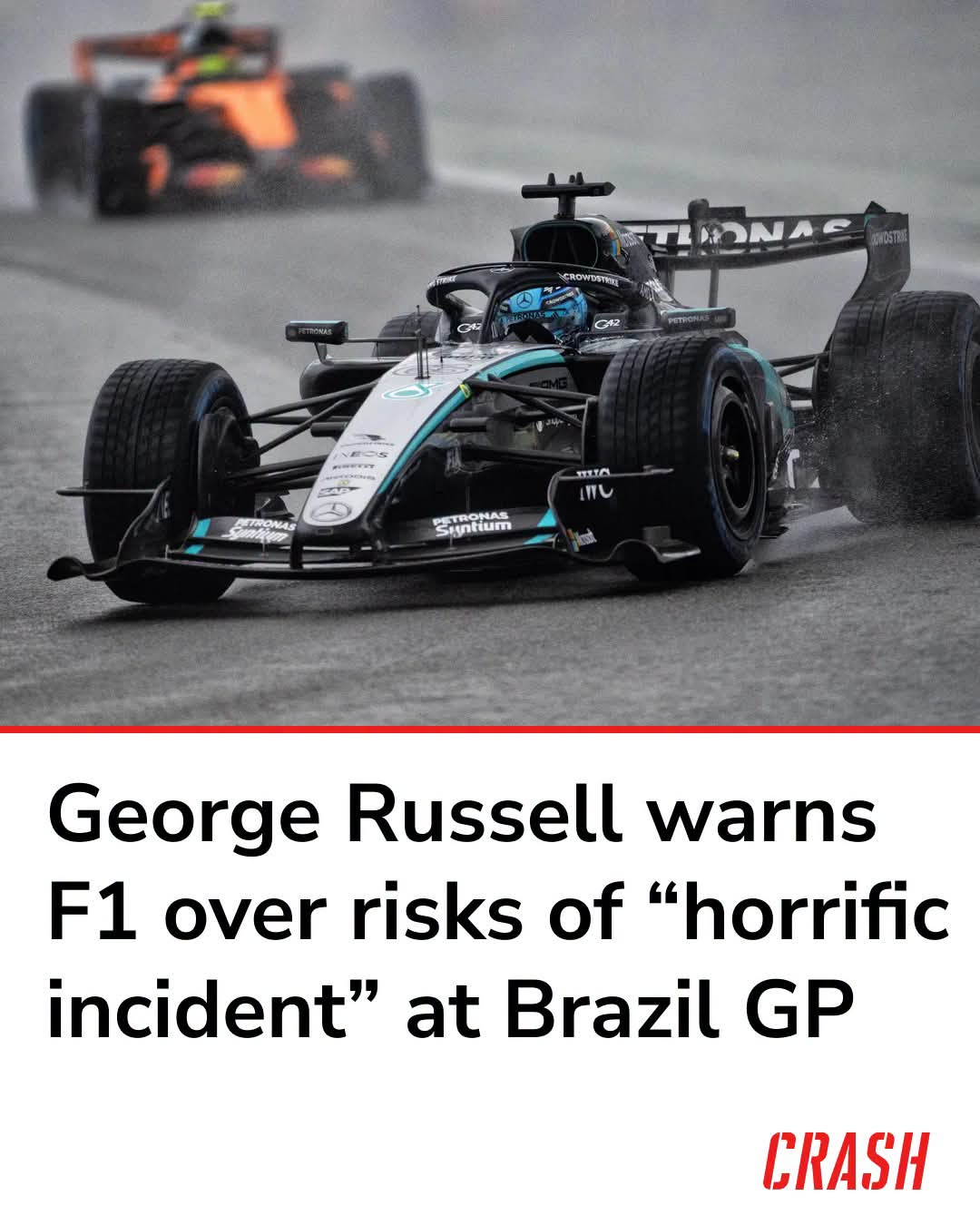
George Russell has issued a serious warning to Formula 1 after experiencing what he described as extremely dangerous conditions during qualifying for the 2026 Brazilian Grand Prix. The Mercedes driver believes a repeat of the torrential rain and visibility problems at Interlagos could result in a horrific accident, raising fresh concerns about how far drivers should be expected to push in extreme weather. His comments have reignited the debate over safety, visibility and the limits of Formula 1 racing in heavy rain.
GEORGE RUSSELL WARNS F1 ABOUT EXTREME INTERLAGOS CONDITIONS
Russell’s warning followed a qualifying session that was interrupted almost immediately after torrential rain overwhelmed the Interlagos circuit.
The conditions became so dangerous that officials suspended the session for approximately 90 minutes before allowing qualifying to resume.
Although the remaining sessions were eventually completed, several drivers expressed concerns about the intensity of the rainfall and the difficulty of maintaining control at high speeds.
Russell was particularly troubled by the visibility problems experienced during Q1.
The Mercedes driver explained that visibility approaching Turn 4 was effectively zero, leaving him struggling to identify what was happening ahead of him.
He also described experiencing aquaplaning while travelling above 200 kilometres per hour in fifth gear.
For Russell, the combination of high speed, standing water and almost nonexistent visibility created a situation that could easily have resulted in a serious accident.
RUSSELL DESCRIBES A POTENTIALLY HORRIFIC ACCIDENT
The British driver made it clear that his concerns were not simply about the difficulty of driving in the wet.
Russell enjoys competing in rainy conditions and believes such races can provide some of the most exciting moments in Formula 1.
However, he warned that there is a significant difference between challenging conditions and circumstances where drivers cannot see or control their cars properly.
According to Russell, the visibility problems experienced during qualifying would have made racing in those conditions unacceptable.
He warned that if the same weather had occurred during a Grand Prix, the probability of a horrific incident would have been extremely high.
His comments highlighted a particularly dangerous aspect of modern Formula 1 racing: drivers can experience aquaplaning at tremendous speeds while approaching corners without knowing whether another car is directly ahead.
That combination leaves little opportunity to react when something goes wrong.
WHY VISIBILITY REMAINS FORMULA 1’S BIGGEST RAIN PROBLEM
One of the most significant challenges facing Formula 1 during heavy rain is the enormous spray generated by modern cars.
When cars run through standing water, their tyres produce clouds of spray that can dramatically reduce visibility for following competitors.
The problem becomes particularly severe when several cars are closely grouped together.
Drivers behind the leading cars may struggle to identify braking points, track boundaries or approaching corners.
Even when they have sufficient grip, the inability to see clearly can make overtaking and defending positions extremely dangerous.
This creates a difficult situation for race officials because the circuit might technically offer enough grip for racing while visibility remains dangerously inadequate.
Russell’s experience at Interlagos demonstrated why weather decisions cannot be based exclusively on track conditions.
The ability of drivers to see what lies ahead is equally important when determining whether a session or race should continue.
INTERLAGOS PRODUCES ANOTHER CONTROVERSIAL WET QUALIFYING SESSION
The Brazilian Grand Prix has long been associated with unpredictable weather, and the 2026 qualifying session provided another reminder of that reputation.
Interlagos is particularly challenging because rainfall can arrive suddenly and affect different sections of the circuit at varying intensities.
Drivers must constantly adjust their approach depending on where the track is wettest and where standing water has accumulated.
During qualifying, Russell described wheel-spin and aquaplaning even at speeds where drivers would ordinarily expect to maintain substantial control.
The conditions forced competitors to balance the desire for a fast lap against the risks of making a mistake.
Lando Norris eventually secured pole position for McLaren, delivering an impressive performance despite the difficult circumstances.
The British driver also acknowledged that qualifying had been among the wettest conditions he had experienced.
He explained that Q3 was particularly challenging because identifying dry patches, wet sections and puddles became difficult.
Nevertheless, Norris remained confident throughout the session and successfully converted his pace into another pole position.
SHOULD FORMULA 1 HAVE STOPPED QUALIFYING EARLIER?
Russell’s comments have renewed questions about how Formula 1 should respond when rainfall becomes extreme.
The decision to suspend qualifying demonstrated that officials recognised the danger posed by the initial conditions.
However, the fact that the session eventually resumed does not necessarily mean every driver considered the conditions comfortable or safe.
Formula 1 faces a difficult balance whenever rain threatens a race weekend.
Fans want to see drivers competing in challenging weather, while competitors understand that wet conditions can create extraordinary opportunities for overtaking and unexpected results.
Yet the sport cannot allow excitement to become more important than driver safety.
The central question is whether qualifying should continue whenever drivers can theoretically maintain control or whether visibility concerns should become an independent reason for stopping the session.
Russell’s warning strongly suggests that the latter deserves greater attention.
RUSSELL’S BRAZILIAN GP WEEKEND COMPLICATED BY GRID PENALTY
Despite his impressive qualifying performance, Russell’s Brazilian GP weekend was not entirely positive.
The Mercedes driver finished qualifying second-fastest but was forced to start seventh because of an engine-related grid penalty.
That setback reduced his opportunity to challenge for a stronger starting position, particularly with several competitive drivers positioned ahead of him.
However, his qualifying performance demonstrated that Mercedes remained capable of competing at the front in difficult conditions.
Russell’s concerns about safety also came during a season in which Mercedes had already secured the Constructors’ Championship.
The team ultimately celebrated another historic achievement, but Russell’s comments ensured that the discussion surrounding Interlagos extended beyond competitive results.
His warning was a reminder that even championship-winning teams can experience dangerous circumstances when weather conditions become unpredictable.
WHAT RUSSELL’S WARNING MEANS FOR F1’S FUTURE
Russell’s comments could contribute to renewed discussions about wet-weather racing procedures and the conditions under which Formula 1 should suspend sessions.
The sport has repeatedly faced criticism when heavy rain produces visibility problems that make racing difficult to manage.
Although wet-weather races remain among Formula 1’s most memorable spectacles, the danger increases dramatically when drivers cannot see approaching competitors.
The challenge for the FIA is to establish a balance that protects drivers without unnecessarily preventing competition whenever rainfall becomes heavy.
Russell’s experience at Interlagos provides another important example of why that balance remains difficult.
His warning should not be interpreted as a demand to eliminate wet-weather racing entirely.
Instead, it highlights the need to recognise when visibility and aquaplaning combine to create conditions that are simply too dangerous.
CONCLUSION: RUSSELL’S WARNING SHOULD NOT BE IGNORED
George Russell’s Brazilian GP qualifying experience has once again exposed one of Formula 1’s most persistent safety challenges.
The Mercedes driver demonstrated that even highly experienced competitors can struggle when standing water and poor visibility combine at extreme speeds.
His warning about a potentially horrific incident deserves serious consideration, particularly as Formula 1 continues to seek ways of improving wet-weather competition.
Interlagos delivered dramatic qualifying, impressive performances and another memorable weekend for the championship.
But Russell’s comments also provided an important reminder that the sport’s most exciting conditions can quickly become its most dangerous.
Ultimately, Formula 1 must ensure that the pursuit of spectacular racing never comes at the expense of the drivers who make the sport possible.