Lewis Hamilton’s hopes of converting his historic pole position into a Mexican Grand Prix victory were thrown into chaos after an opening-lap collision with Ferrari teammate Charles Leclerc triggered an FIA investigation and an angry exchange over team radio.
The incident happened as the two Ferrari drivers fought for position through the opening corners. Hamilton started from pole, but Leclerc immediately challenged him before the pair approached Turn 4. Hamilton attempted to make a move around the outside, but contact followed heading into Turn 5. Leclerc went off the track and emerged ahead, while Max Verstappen took advantage of the situation to move into second place.
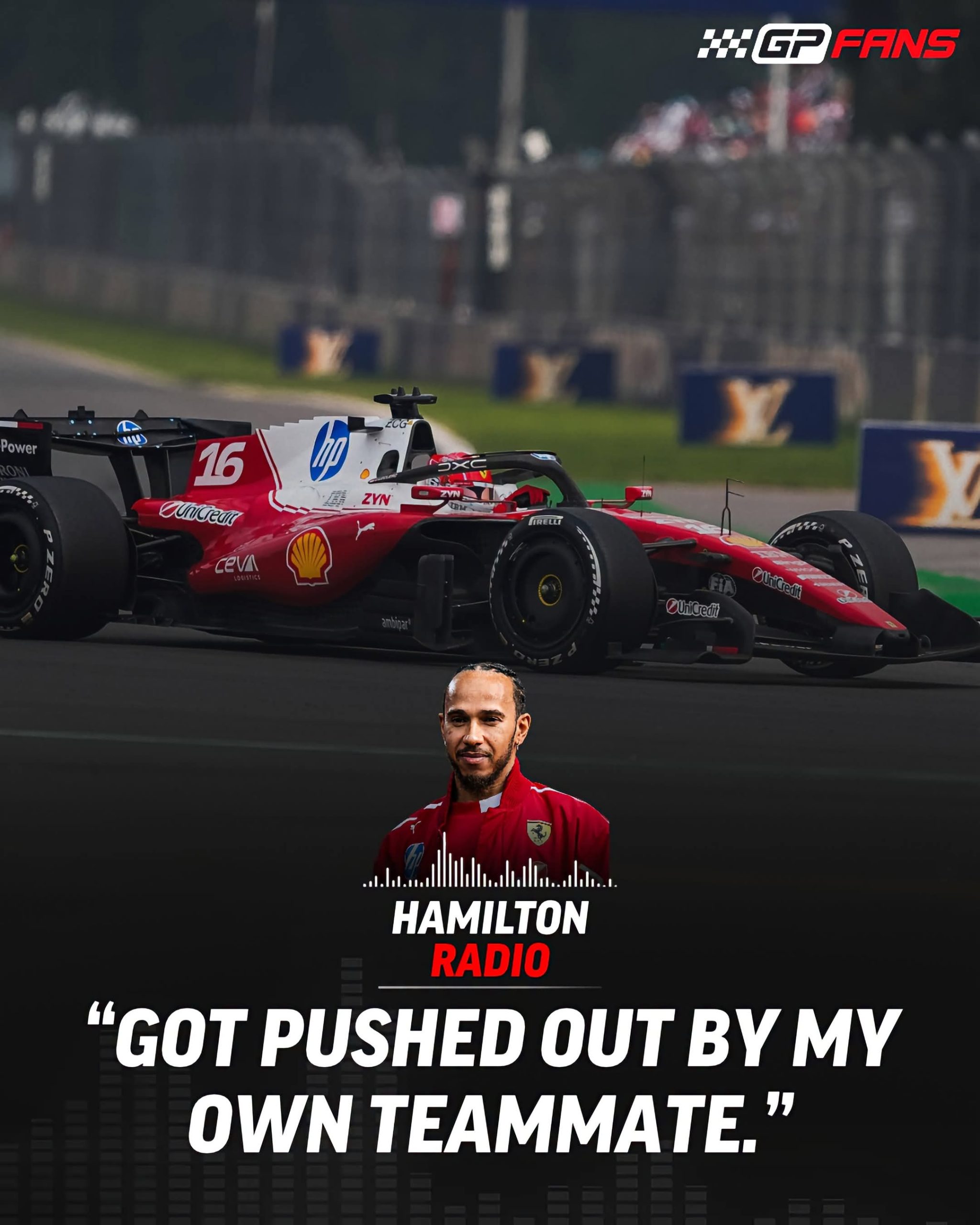
Hamilton was clearly unhappy with what had happened, particularly because the driver who had compromised his race was his own teammate. His first reaction over the radio left little doubt about his frustration: “Got pushed out by my own team-mate.”
FIA INVESTIGATES LECLERC AFTER HAMILTON’S COMPLAINT
The stewards quickly launched an investigation into the incident, with Hamilton demanding an explanation from Ferrari as the race continued.
After two laps, he asked his team over the radio: “What’s happening about Charles?”
The FIA took several more laps to reach its decision. Eventually, the stewards concluded that Leclerc had gained an unfair advantage by leaving the track and retaining his position. He was handed a five-second time penalty, which Ferrari would have to manage during his next pit stop.
The decision confirmed that the stewards believed Leclerc had benefited from the incident. However, the punishment immediately created another controversy because Hamilton felt the penalty did not adequately address the advantage his teammate had gained.
HAMILTON QUESTIONS THE FIA’S FIVE-SECOND PENALTY
Hamilton’s frustration intensified after learning the details of the punishment. His biggest concern was that Leclerc had clear track ahead, allowing him to build a gap while Hamilton remained trapped behind Verstappen.
The seven-time world champion argued that a five-second penalty was not enough under those circumstances.
“The problem with a five-second penalty is he’s got clean air and doesn’t have to manage like the rest of us,” Hamilton told his race engineer.
He then made his preferred solution clear: “Should have just given the position back.”
Hamilton was still unhappy around ten laps later, suggesting that the decision contradicted discussions during the drivers’ briefing.
“Stewards are basically handing Charles this win! We agreed in the drivers briefing,” he complained.
His comments expose a familiar problem in Formula 1: a time penalty can appear straightforward on paper but produce very different consequences depending on where a driver is positioned on the circuit.
MAX VERSTAPPEN ALSO QUESTIONS THE FIA’S DECISION
Hamilton was not the only driver questioning the punishment. Verstappen, who had moved into second place after the Ferrari collision, also expressed surprise when his race engineer, Gianpiero Lambiase, informed him about Leclerc’s penalty.
The Red Bull driver responded: “I thought all these penalties were 10 seconds.”
Verstappen’s reaction added another layer to the controversy, particularly because he was directly involved in the fight for the leading positions. A five-second penalty could potentially allow Leclerc to maintain his advantage if he built a sufficient gap before making his pit stop.
The disagreement also raises questions about consistency in stewarding. Drivers want to know that similar incidents will receive comparable punishments, especially when the consequences can determine podium positions and race victories.
FERRARI’S TEAMMATE PROBLEM IS BECOMING DIFFICULT TO IGNORE
This is not the first time Hamilton and Leclerc have found themselves in trouble while competing against each other. Their earlier clash at the Italian Grand Prix also saw Hamilton forced towards the gravel, costing him positions.
No action was taken against either driver on that occasion, but Hamilton reportedly called for Ferrari team principal Fred Vasseur to establish clearer rules governing battles between teammates.
The comparison with Mercedes is particularly relevant. Hamilton spent years alongside Nico Rosberg, experiencing both the benefits and dangers of having two highly competitive drivers fighting for the same victories. Mercedes eventually had to manage that rivalry through clearer internal expectations.
Ferrari now faces a similar challenge. Hamilton and Leclerc are both elite competitors, and neither is likely to accept being treated as the secondary driver without a fight. If the team fails to establish clear expectations, further clashes could become inevitable.
VASSEUR FACES A DIFFICULT DECISION
Ferrari must now decide how it wants its drivers to compete when they are fighting for the same piece of track. Allowing both drivers complete freedom can produce exciting racing, but it also creates the risk of throwing away valuable points.
Hamilton’s complaint is understandable because he started from pole and lost track position following contact with his teammate. However, Ferrari must also consider Leclerc’s perspective and avoid creating a situation where one driver feels unfairly restricted.
The team needs consistent rules that apply to both drivers, regardless of their championship positions or qualifying results. Without that clarity, internal disagreements could become a bigger problem than the competition from Mercedes, Red Bull and McLaren.
HAMILTON’S FERRARI DREAM FACES ANOTHER TEST
Hamilton arrived in Mexico with a major achievement behind him after securing his first Ferrari pole position and the 105th of his Formula 1 career. It was the kind of qualifying result that could have provided a turning point in his Ferrari journey.
Instead, his race was immediately complicated by an incident involving the very teammate expected to help Ferrari fight for the biggest prizes.
The five-second penalty against Leclerc may satisfy the stewards’ assessment of the incident, but it has clearly not satisfied Hamilton. His frustration also sends a message to Ferrari’s leadership: he expects the team to protect fair competition between its drivers and ensure that opening-lap battles do not leave one teammate carrying the consequences of another’s actions.
Ferrari has the pace to fight at the front in Mexico, but its biggest challenge may now be managing the rivalry inside its own garage.