Hamilton launched his Austrian Grand Prix from third on the grid and immediately looked competitive. Ferrari’s pace in the opening laps allowed him to stay with the leading group while engaging in an entertaining battle with Max Verstappen.
However, the encouraging start soon disappeared as Ferrari committed to an aggressive tyre strategy designed to maximise outright pace rather than preserve track position.
Instead of producing another strategic masterclass similar to Hamilton’s victory in Barcelona, the plan backfired. Multiple pit stops and rapidly degrading tyres meant Hamilton gradually slipped away from the battle for victory while Mercedes and Red Bull executed more balanced race strategies.
KARUN CHANDHOK SPOTTED THE TYRE PROBLEM EARLY
Former Formula 1 driver and Sky Sports F1 analyst Karun Chandhok noticed Ferrari’s tyre troubles long before the race reached its decisive stages.
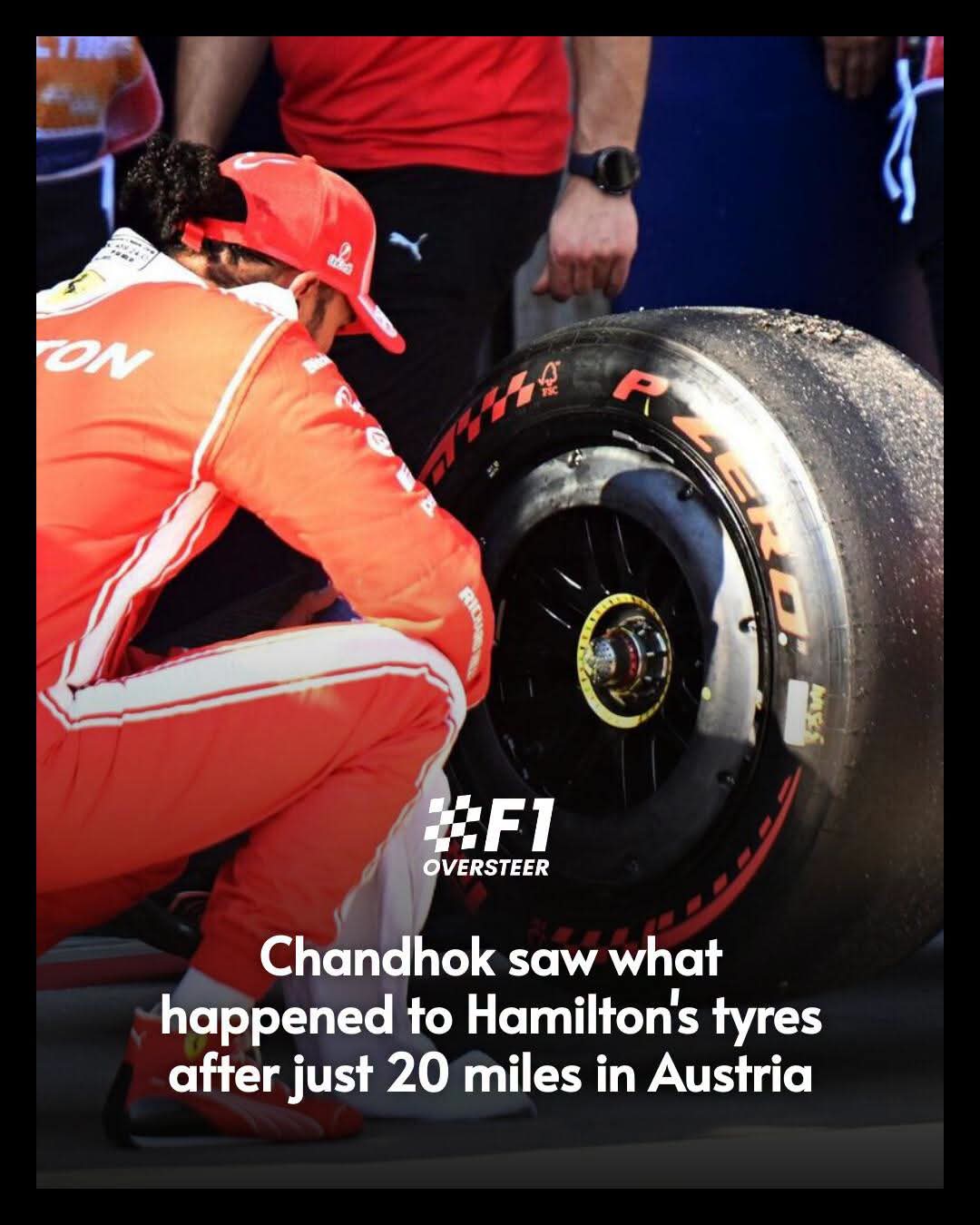
Just eight laps after Hamilton’s first pit stop, Chandhok pointed out that the inside shoulder of Hamilton’s front-left tyre already appeared heavily worn. Considering the Red Bull Ring is a clockwise circuit that places enormous stress on that particular tyre, the early signs suggested Ferrari would struggle to complete competitive stints.
Hamilton had covered only around 20 miles on that tyre set before significant degradation became visible—far earlier than expected for a front-running Formula 1 car.
That observation proved accurate as Ferrari’s pace steadily declined throughout the afternoon.
TYRE DEGRADATION WASN’T THE ONLY ISSUE
While tyre wear became the most visible problem, Ferrari’s challenges extended beyond rubber management.
Hamilton later admitted that none of the tyre compounds worked effectively for him during the race, with the rear tyres also suffering unexpected performance drops throughout each stint.
The situation became even more complicated as Ferrari battled overheating issues.
Team radio repeatedly instructed Hamilton to switch to lower engine modes to control temperatures and protect reliability. Those adjustments inevitably cost valuable lap time, preventing the Briton from responding to the pace of George Russell, Max Verstappen, and Mercedes rookie Andrea Kimi Antonelli.
Ferrari team principal Fred Vasseur acknowledged after the race that outright pace remained a larger concern than strategy execution, particularly on a circuit where engine performance and straight-line speed played such a crucial role.
WHY AUSTRIA EXPOSED FERRARI’S BIGGEST WEAKNESS
The Austrian Grand Prix provided a perfect storm of conditions that magnified Ferrari’s current limitations.
High ambient temperatures exceeding 35 degrees placed enormous stress on tyres, cooling systems, and power units. Mercedes appeared better prepared for those conditions, while Ferrari struggled to maintain tyre performance over longer stints.
The aggressive strategy only amplified those weaknesses.
Although Hamilton initially benefited from fresher tyres, the rapid degradation erased that advantage almost immediately, forcing Ferrari into another pit stop long before its rivals.
Instead of gaining strategic flexibility, Ferrari found itself reacting to problems rather than controlling the race.
HAMILTON’S TITLE CHALLENGE FACES A CRUCIAL TEST
Despite the disappointing finish, Hamilton remains firmly involved in the championship battle.
Mercedes youngster Andrea Kimi Antonelli continues to lead the standings with George Russell strengthening Mercedes’ position through victory in Austria. Every missed opportunity, however, increases the pressure on Ferrari as the season enters its decisive middle phase.
Silverstone now becomes a critical weekend for both Hamilton and Ferrari.
Unlike Austria, the British Grand Prix presents a different technical challenge, but Ferrari must demonstrate that its recent upgrades can perform consistently across varying circuit characteristics. More importantly, the team needs to solve its tyre management issues if it hopes to match Mercedes over full race distances.
FERRARI MUST FIND ANSWERS QUICKLY
Austria reinforced a growing concern that Ferrari’s performance window remains too narrow.
The SF-26 has shown flashes of genuine race-winning speed, particularly when conditions suit the car, but consistency continues to separate Ferrari from Mercedes.
For Hamilton, the positives remain obvious. His racecraft, qualifying pace, and ability to fight at the front have all returned during 2026. The missing ingredient is a car capable of maintaining competitive pace across an entire Grand Prix without destroying its tyres.
If Ferrari can unlock better tyre management while improving cooling and straight-line efficiency, Hamilton still possesses every tool needed to mount a serious championship challenge. If not, Mercedes may continue extending its advantage as the Formula 1 season heads toward its pivotal summer stretch.