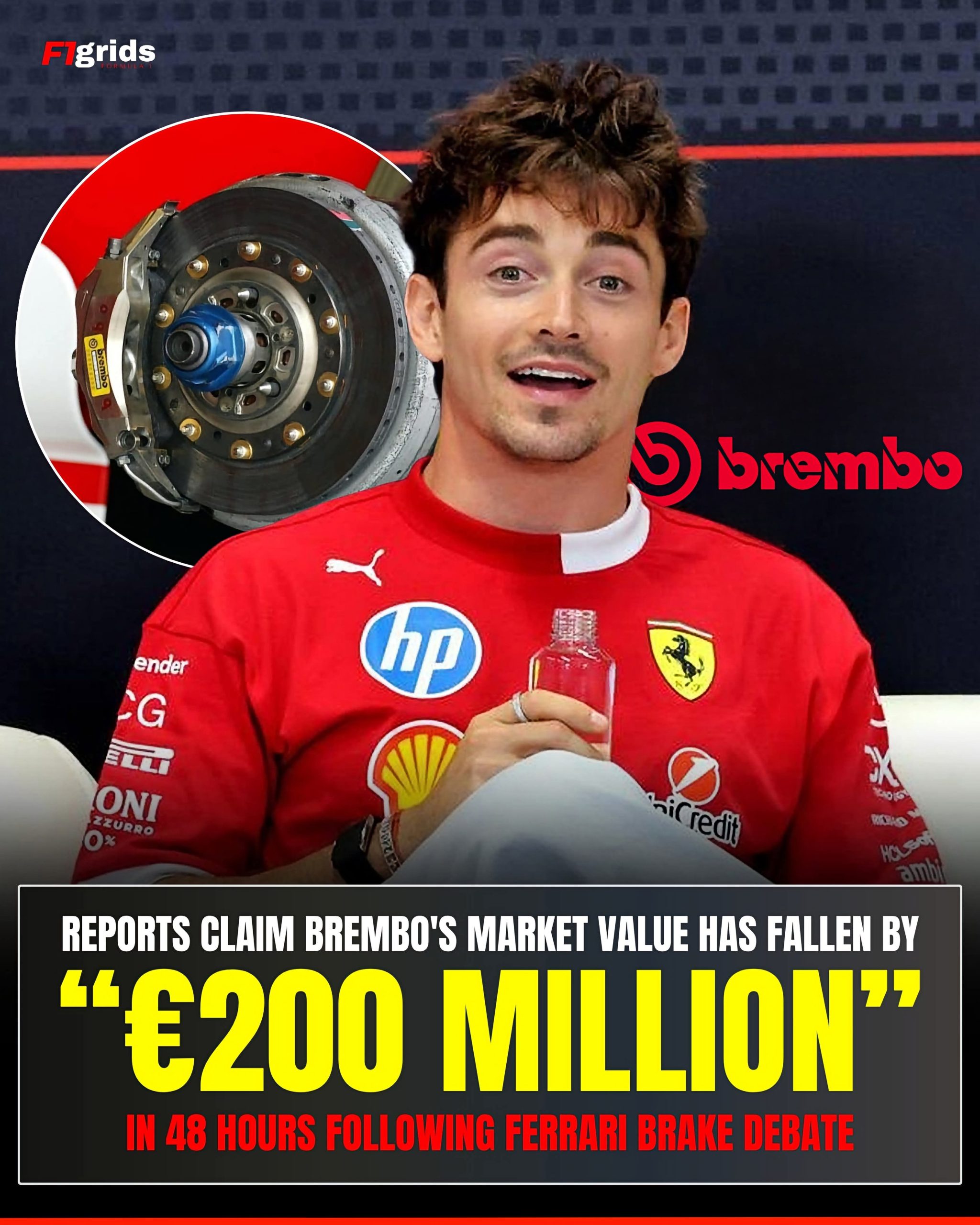
Charles Leclerc’s recent public frustration over Ferrari’s braking performance has done more than spark debate inside the paddock. It has also pulled braking supplier Brembo into the spotlight, with reports suggesting that market sentiment around the company has faced pressure following renewed attention on Ferrari’s recurring brake-related complaints.
While Formula 1 drivers frequently comment on performance limitations, this situation stands out because it connects a top driver’s technical criticism with a major supplier whose technology is widely used across the grid.
WHAT CHARLES LECLERC ACTUALLY REVEALED
Charles Leclerc has been vocal this season about inconsistent braking feel in the Ferrari car, particularly under high-pressure race conditions.
His comments point to a recurring issue rather than a one-off failure: brake instability during long stints, unpredictable pedal response, and difficulty maintaining confidence when attacking into corners.
In modern F1, where lap time margins are extremely small, braking confidence is not just a comfort issue. It directly influences qualifying performance, tire management, and overtaking ability.
WHY BREMBO HAS BEEN DRAGGED INTO THE CONVERSATION
The increased attention naturally extends to Brembo, one of the most prominent braking suppliers in motorsport.
Although Brembo is not uniquely responsible for Ferrari’s overall braking performance, F1 narratives often simplify technical issues into single-cause discussions. When a driver highlights braking inconsistency, public discussion frequently shifts toward the supplier rather than the full system, which includes:
Brake materials and temperature behavior
Car design and airflow management
Energy recovery system integration
Driver braking style and setup choices
Reports suggesting pressure on Brembo’s market valuation reflect more on perception than direct technical blame. In motorsport-linked industries, sentiment can move quickly when high-profile teams struggle.
WHY FERRARI’S BRAKING ISSUES MATTER SO MUCH
For Ferrari, this is not just a comfort problem. It is a performance limiter that affects the entire race weekend.
Braking instability impacts:
Corner entry speed
Tire degradation patterns
Consistency in qualifying laps
Driver confidence under close racing conditions
In Formula 1, confidence is performance. A driver who cannot trust the brake pedal will naturally leave margins, and those margins often decide grid positions.
For Ferrari, already under pressure to close the gap to championship leaders, even small inefficiencies become strategically costly.
THE WIDER IMPACT ON THE F1 GRID
One of the most important aspects of this situation is that Brembo supplies multiple teams across Formula 1. That means any perceived issue linked to its systems immediately becomes a paddock-wide talking point.
However, engineers across teams know that braking performance is highly integrated into car design. Even identical components behave differently depending on:
Cooling architecture
Suspension setup
Aerodynamic load distribution
So while headlines may focus on a single supplier, the reality inside the paddock is far more complex.
Still, perception matters. In Formula 1, technical reputation can influence confidence, partnerships, and even development direction.
MEDIA FOCUS AND MARKET REACTION
The suggestion that Brembo’s market value has come under pressure highlights how sensitive motorsport-linked companies can be to public narrative.
When a top driver publicly highlights a performance concern, it can lead to:
Increased media scrutiny
Short-term investor caution
Misinterpretation of technical responsibility
Social media amplification of simplified narratives
This does not necessarily reflect a structural problem, but rather how quickly sentiment can shift in high-visibility sports industries.
WHAT THIS MEANS FOR CHARLES LECLERC AND FERRARI
For Leclerc, the issue is personal and performance-driven. He is in a phase of his career where consistency and championship competitiveness are critical, and repeated technical limitations become increasingly frustrating.
For Ferrari, it creates pressure on two fronts:
Internal engineering resolution
External narrative control
Even if the braking system is functioning within expected parameters, perception of instability can affect driver confidence and public expectations.
FUTURE OUTLOOK: WILL THE ISSUE BE RESOLVED?
Looking ahead, Ferrari is expected to continue refining brake cooling and integration systems through incremental upgrades rather than radical redesigns.
Key expectations include:
Improved thermal stability in high-degradation circuits
Better pedal consistency over long runs
Enhanced integration between aero load and braking response
As for Brembo, the company is unlikely to face long-term commercial impact from this situation unless broader technical issues are identified across multiple teams, which currently appears unlikely.
FINAL THOUGHTS
This situation highlights a recurring truth in Formula 1: performance narratives often move faster than technical reality.
A driver’s comment can shift attention across teams, suppliers, and even financial markets in a matter of hours. But behind the headlines, braking systems are part of a deeply complex engineering ecosystem where no single component tells the full story.
For Ferrari, the priority remains clear: restore braking confidence, stabilize race performance, and ensure that driver feedback translates into measurable on-track gains rather than off-track speculation.