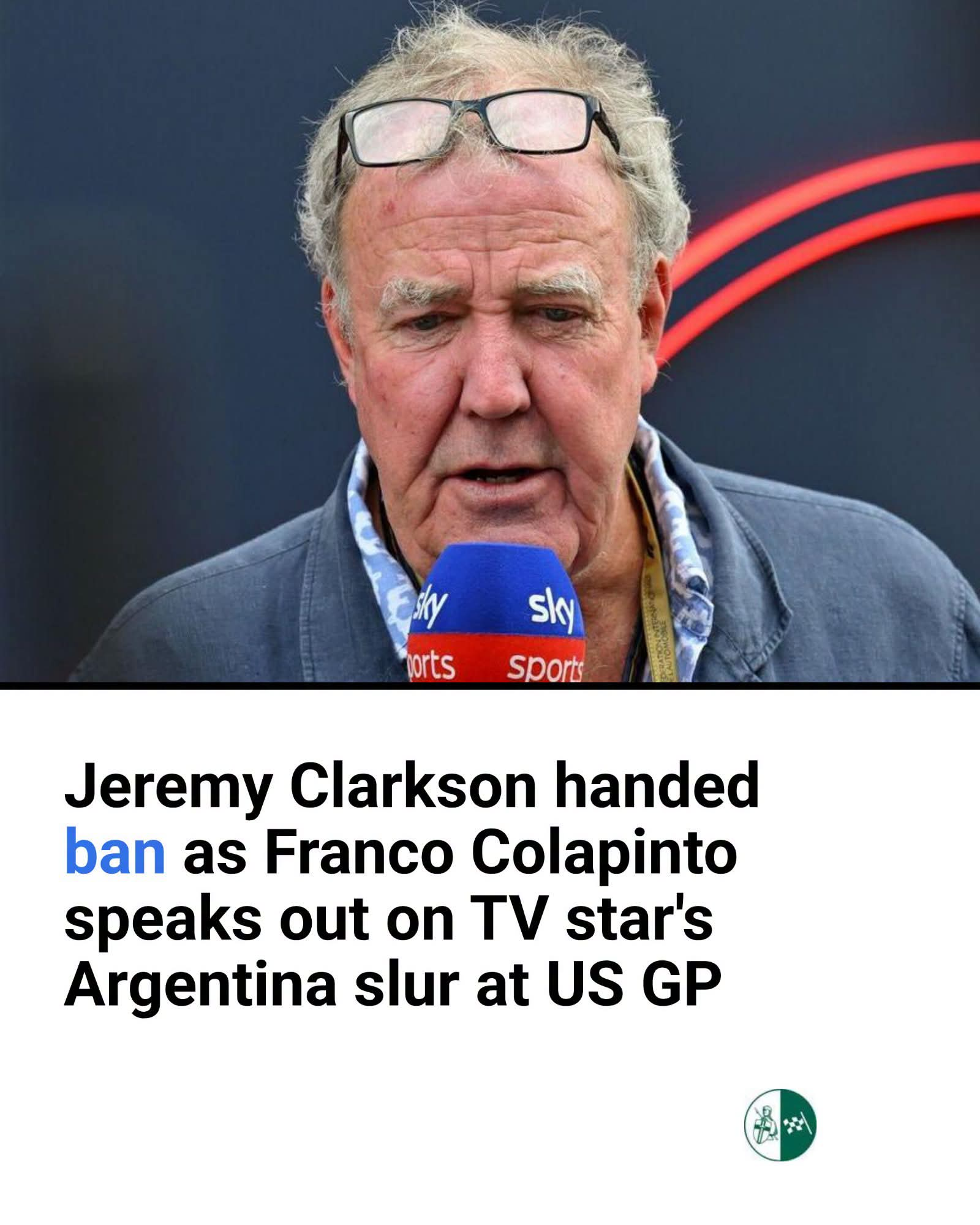
Jeremy Clarkson found himself at the centre of a Formula 1 controversy at the United States Grand Prix after a joke about Franco Colapinto’s Argentine nationality sparked widespread criticism. The former Top Gear presenter reportedly stayed away from television interviews for the remainder of the race weekend, with his longtime friend and former producer Andy Wilman revealing that Clarkson had been placed under a “no talking” restriction on race day. The incident attracted attention across the F1 community, prompting a response from Colapinto’s management and an official statement from Alpine distancing the team from the remarks.
The controversy began when Clarkson appeared on Sky Sports F1 in Austin and joked that Colapinto deserved a grid penalty because he was Argentinian. Although the comment appeared to be intended as humour, it quickly spread across social media and drew angry reactions from Argentine fans, some of whom accused the presenter of making xenophobic remarks. The episode has since raised questions about the boundaries of humour in international sport, particularly when comments about nationality are made by prominent public figures.
JEREMY CLARKSON’S ARGENTINA JOKE SPARKS F1 BACKLASH
Clarkson was in Austin as a guest of Alpine, the team for which Colapinto competes. During an interview with Sky Sports, he made a remark suggesting that the Argentine driver should receive a grid penalty because of his nationality.
The comment quickly became controversial after clips circulated online. Critics argued that using a driver’s nationality as the basis for a penalty joke crossed a line, even if the intention was not serious.
For many Argentine supporters, the issue was not simply whether Clarkson meant to offend Colapinto personally. Instead, the criticism focused on the suggestion that someone should be treated differently because of where they come from.
The reaction illustrates how quickly comments made during a Grand Prix weekend can spread beyond the paddock. Formula 1 attracts a global audience, and remarks about nationality can resonate differently across countries and fan communities.
Clarkson is well known for his provocative humour, but the response demonstrated that jokes made in a sporting environment can carry consequences when audiences interpret them as disrespectful or discriminatory.
FRANCO COLAPINTO’S MANAGEMENT ISSUES A STRONG RESPONSE
Colapinto initially avoided commenting directly on the controversy, but Jamie Campbell-Walter, director of Bullet Sports Management, publicly criticised Clarkson’s remarks.
Campbell-Walter said comments about Colapinto’s nationality were unacceptable and argued that Formula 1 should promote respect regardless of who makes a remark or whether it is presented as a joke.
He also highlighted the importance of maintaining a respectful environment for drivers and supporters, warning against allowing hostile comments to undermine efforts to reduce abuse within the sport.
The response reflected a broader concern in modern motorsport about the treatment of drivers online and in public discussions. Competitors routinely face criticism over their performances, decisions and results, but their nationality should not become a reason to subject them to unfair treatment.
Colapinto has developed a significant following in Argentina, where his Formula 1 career has attracted considerable attention. Consequently, comments involving his national identity can quickly become a wider issue involving supporters, sponsors and the teams associated with him.
Campbell-Walter’s statement made clear that the management organisation did not consider Clarkson’s remarks harmless simply because they were delivered as humour.
ALPINE DISTANCES ITSELF FROM CLARKSON’S COMMENTS
The controversy also placed Alpine in an uncomfortable position because Clarkson was attending the United States Grand Prix as a guest of the team.
Alpine issued a statement clarifying that Clarkson’s personal views did not align with the team’s values, which it said included promoting kindness and respect.
The statement was significant because it separated the organisation from remarks made by someone attending the event in connection with the team. Alpine’s position indicated that Clarkson’s comments should not be interpreted as representing its official attitude towards Colapinto or Argentina.
For a Formula 1 team, maintaining relationships with drivers, supporters and commercial partners is important. A controversy involving a high-profile guest can create unnecessary distractions, particularly when the team is already working to improve its on-track performance.
By distancing itself from the remarks, Alpine sought to make its position clear without suggesting that Clarkson had been speaking on its behalf.
The situation also highlighted the responsibilities associated with hosting public figures at major sporting events. Although guests are entitled to express personal opinions, their comments can attract scrutiny when they involve the team or its drivers.
WHY JEREMY CLARKSON DID NOT SPEAK TO MARTIN BRUNDLE
Clarkson did not give another television interview during the remainder of the weekend, according to the report. His absence became particularly noticeable during Martin Brundle’s famous grid walk before the United States Grand Prix.
Brundle encountered Clarkson on the grid, but the presenter did not take part in a conversation with him. Instead, Andy Wilman, Clarkson’s longtime friend and former producer on Top Gear and The Grand Tour, briefly spoke to Brundle.
Wilman reportedly explained that Clarkson had been placed under a “no talking” ban for race day.
The circumstances surrounding the reported restriction were not fully explained, and there was no clear confirmation that it was an official penalty imposed by Formula 1, Alpine or Sky Sports. It would therefore be premature to conclude that Clarkson had received a formal sporting sanction.
Nevertheless, his absence from the usual television coverage added another talking point to the controversy. What began as a short comment during an interview had become a story involving a driver’s management, his team and one of Britain’s most recognisable television personalities.
FRANCO COLAPINTO BREAKS HIS SILENCE AFTER THE US GRAND PRIX
Colapinto was eventually asked about the incident after the race, which he did not finish following damage sustained in a collision with Racing Bulls driver Arvid Lindblad.
The Argentine made it clear that he did not know Clarkson personally and had not followed the full details of what was said.
He also stressed that the comments were unrelated to Alpine as an organisation, explaining that Clarkson had conducted the interview independently.
Colapinto acknowledged that he understood Clarkson was known for making jokes, but did not turn the exchange into a personal confrontation. Instead, he emphasised the need to focus on his own performance and the broader circumstances affecting his situation.
His measured response helped distinguish the driver’s position from the stronger criticism expressed by his management. While Campbell-Walter publicly condemned the remarks, Colapinto did not present the controversy as a personal feud.
He also suggested that improving the situation required help from more people than just himself, although he did not elaborate further on that point.
THE CONTROVERSY RAISES QUESTIONS ABOUT HUMOUR AND RESPECT IN FORMULA 1
The Clarkson-Colapinto episode highlights the difficult line between provocative humour and comments that audiences perceive as discriminatory. A remark intended as a joke by one person may be received very differently by the people it references, particularly when it concerns nationality or identity.
Formula 1’s international audience makes the issue especially significant. Drivers represent teams and compete in front of supporters from countries around the world, and their national identities are often an important part of their public profiles.
That does not mean every controversial joke should automatically be treated as deliberate hostility. Intent, context and the actual wording all matter when assessing what was said. However, an intention to be humorous does not prevent a comment from causing offence or attracting legitimate criticism.
For Clarkson, the episode created an unwanted distraction during a major sporting weekend. For Colapinto, it became an issue he had to address despite his immediate priority being his racing career.
Alpine’s response and the statement from Colapinto’s management also demonstrated how quickly a seemingly brief exchange can become an organisational concern.
Ultimately, the controversy moved beyond the original joke to become a wider discussion about respect, public accountability and the responsibilities that accompany visibility in Formula 1. Colapinto has chosen to focus on his racing, while the reaction to Clarkson’s remarks serves as a reminder that words spoken in the paddock can have consequences far beyond the circuit.