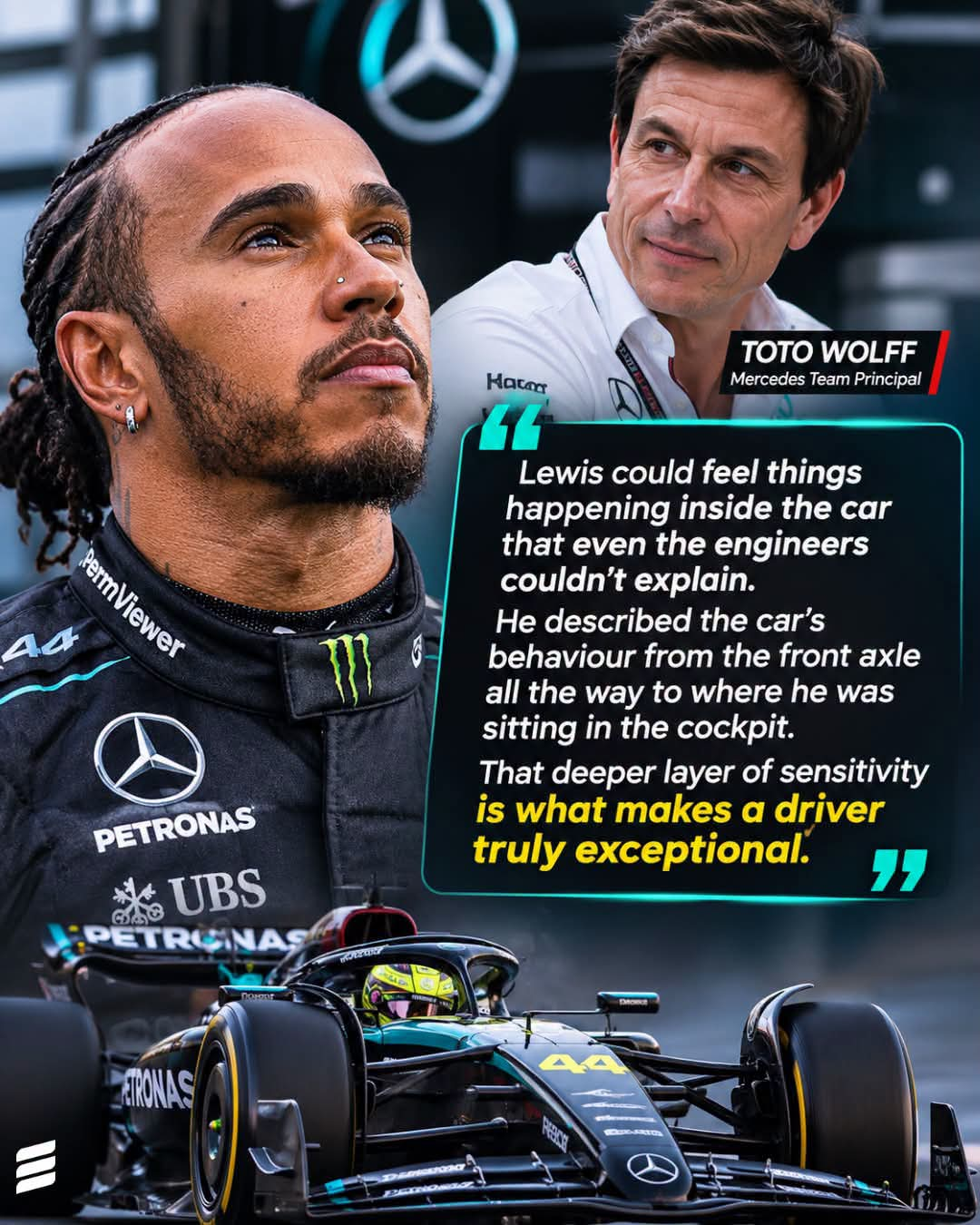
In Formula 1, raw speed wins races. But the drivers who dominate seasons and rewrite record books usually possess something harder to measure. Lewis Hamilton has long been described as one of those rare talents, and a comment from Mercedes team principal Toto Wolff offers a window into why.
Wolff once shared that Hamilton could sense behaviour in the car that the engineers themselves struggled to diagnose. The seven-time world champion would describe sensations running from the front axle through the chassis to the cockpit in language that went beyond data traces and telemetry. What the engineers saw as numbers, Hamilton experienced as physical feedback. His body and brain registered changes the instruments had not yet fully captured.
That level of sensitivity is not common. It is one of the quiet differences that separates very good drivers from the all-time greats.
WHY FEELING THE CAR MATTERS MORE THAN MOST FANS REALISE
Modern Formula 1 cars generate enormous amounts of data. Sensors measure suspension movement, tyre temperature, aerodynamic load, and chassis flex thousands of times per second. Yet the best drivers still talk about “feel.” They notice when the front end starts to push a fraction earlier than expected, when the rear begins to step out under power, or when the balance shifts mid-corner because of a small change in track temperature or tyre wear.
Hamilton’s ability goes further. According to Wolff, he could articulate sensations that the technical team found difficult to isolate. That feedback loop becomes invaluable during practice and qualifying. Instead of the engineers having to interpret vague comments, they receive precise descriptions that help them zero in on setup changes. The result is a car that is dialled in faster and a driver who can extract the maximum from it.
In a sport where tenths of a second separate pole position from the second row, that advantage compounds over a weekend and across a season.
THE DIFFERENCE BETWEEN LEARNED SKILL AND NATURAL INSTINCT
Plenty of drivers improve their technical understanding over years of racing. They learn to translate what the car is doing into useful information for the engineers. Experience builds that bridge. Hamilton’s case appears different. Wolff’s description suggests a deeper, almost instinctive layer of perception that cannot be taught in the same way.
This is not unique to motorsport. Elite athletes in other precision sports sometimes report similar heightened awareness. A top tennis player feels the exact moment the ball leaves the racket. A great basketball shooter senses the release before the ball even reaches the rim. In F1, that equivalent is the ability to read the car’s behaviour through the seat of the pants, the steering wheel, and the pedals simultaneously.
When that talent is paired with Hamilton’s work ethic, racecraft, and consistency, the results speak for themselves. Multiple championships, a record number of wins, and a career that has stretched across different technical regulations all point to more than just talent. They point to an unusually complete package.
HOW THIS SENSITIVITY SHAPES TEAM DYNAMICS AND CAR DEVELOPMENT
For a team like Mercedes, having a driver who can describe problems others cannot easily measure creates both opportunity and pressure. The engineering group must trust the driver’s feedback even when the data does not immediately confirm it. That trust accelerates development when it works. It can also create friction if the data and the driver’s feelings diverge for long periods.
Hamilton’s long partnership with Mercedes showed both sides of that relationship. There were seasons when the car was dominant and his feedback helped refine an already strong package. There were also harder years when the car was less competitive and his ability to extract performance from an imperfect machine became even more valuable. In both situations, the team benefited from a driver who could communicate at a higher resolution than most.
Younger drivers watching Hamilton’s career can take a practical lesson from this. Technical feedback is a skill that can be developed, but the deepest level of car feel often starts as an innate gift. The smartest approach is to protect and refine that gift rather than trying to force every sensation into existing data models.
WHAT THIS MEANS FOR THE FUTURE OF DRIVER DEVELOPMENT
Formula 1 is moving toward more sophisticated simulation tools and tighter performance windows. Cars are becoming more complex, and the margin for error is shrinking. In that environment, drivers who can still sense subtle changes before the sensors fully register them will remain extremely valuable.
Teams already invest heavily in driver-in-the-loop simulators and detailed debrief processes. The next step may involve better ways of capturing and translating a driver’s subjective feedback into actionable engineering changes. Hamilton’s example shows why that investment is worthwhile. The drivers who can feel what the data has not yet explained will continue to give their teams an edge.
Hamilton’s career also demonstrates that this kind of sensitivity does not disappear with age. While physical fitness and reaction times change over time, the ability to read a car can remain a lasting strength. That is one reason veterans with exceptional feel often stay competitive longer than expected.
THE QUIET MARK OF GREATNESS
Not every great driver possesses the same gifts. Some dominate through pure aggression. Others excel at strategy and tyre management. Hamilton’s combination of speed, consistency, and this deeper mechanical sympathy has produced one of the most complete careers in the history of the sport.
Toto Wolff’s observation is more than a nice anecdote. It points to a real performance differentiator that data alone cannot fully capture. In a sport obsessed with numbers, the human ability to feel what the car is doing remains irreplaceable.
That is why Lewis Hamilton stands among the greatest. Some skills can be coached. Some instincts simply set a driver apart.