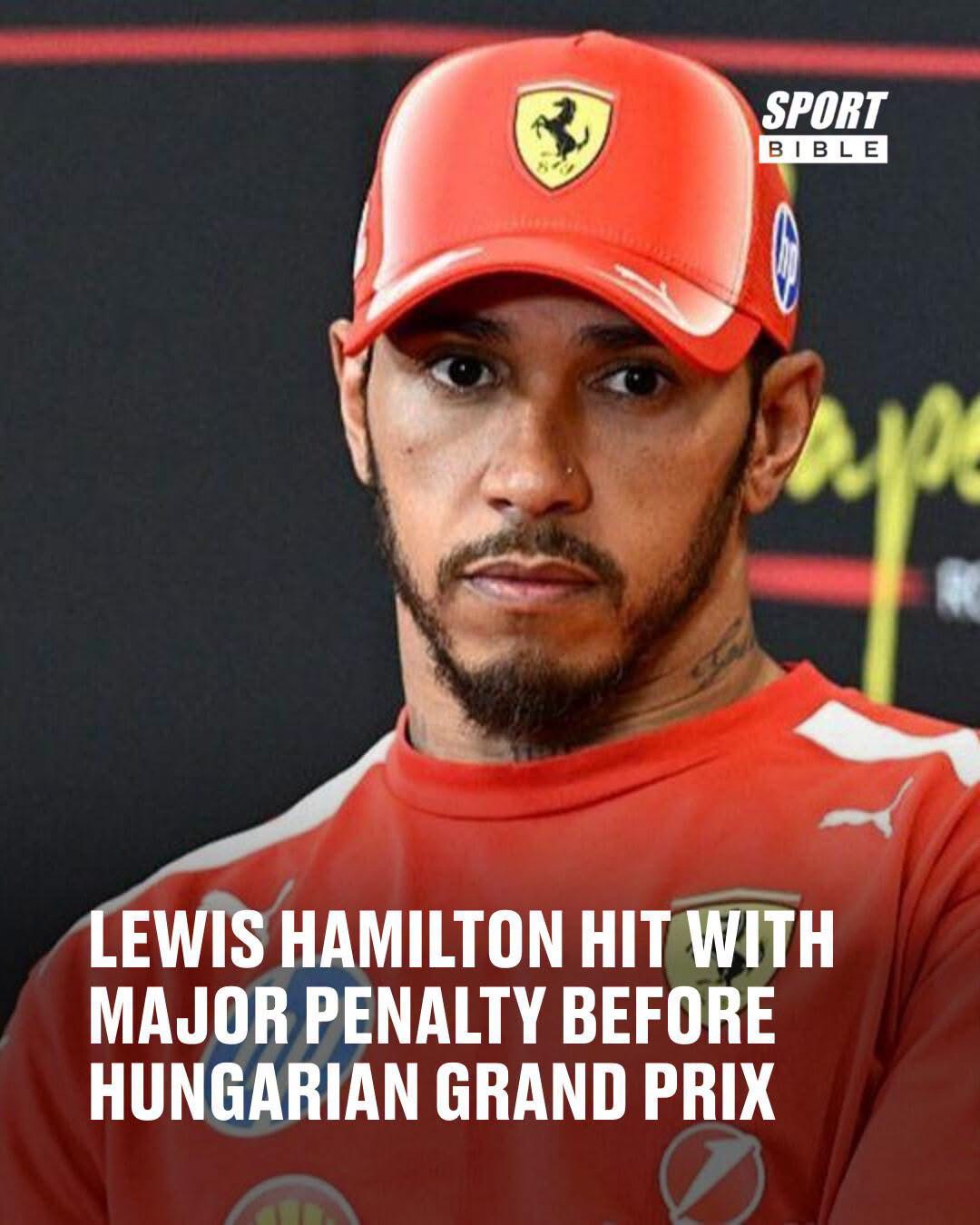
Lewis Hamilton’s remarkable qualifying performance at the Hungarian Grand Prix has been overshadowed by a costly FIA decision that could dramatically alter Ferrari’s race strategy and the outcome of Sunday’s event. After initially securing a front-row start alongside McLaren’s Lando Norris, the seven-time Formula 1 world champion has been handed a three-place grid penalty for impeding Oscar Piastri during the closing stages of qualifying.
The ruling drops Hamilton from second to fifth on the starting grid, promoting Charles Leclerc, Mercedes championship leader Andrea Kimi Antonelli, and Piastri one place each. While Ferrari demonstrated genuine race-winning pace throughout the weekend, the penalty has transformed what looked like an ideal opportunity for Hamilton into a far more difficult challenge.
FIA RULES HAMILTON IMPEDED OSCAR PIASTRI DURING QUALIFYING
The controversial moment unfolded during the decisive final minutes of qualifying at the Hungaroring.
Hamilton had just completed a lap that temporarily put him in contention for pole position before Norris edged him by a razor-thin 0.012 seconds. As the Ferrari driver slowed after his flying lap, Piastri approached Turn 1 on his own final qualifying attempt.
The Australian was forced to alter his line after encountering Hamilton on the racing line, an incident that immediately caught the attention of race control. Piastri’s frustration was evident as he gestured toward Hamilton after passing him, and the FIA quickly announced that the incident would be investigated.
Following a hearing involving both drivers and their respective teams, the stewards concluded that Hamilton had unnecessarily impeded Piastri, resulting in the standard three-place grid penalty.
HAMILTON AND FERRARI ADMIT COMMUNICATION FAILED
Speaking after qualifying, Hamilton made it clear that he had no intention of blocking the McLaren driver.
The Ferrari star explained that he only received a warning from his team about Piastri’s approaching car when it was already too late to move safely out of the way.
According to Hamilton, he believed the cars behind him had already completed their laps and had no reason to expect another driver arriving at full speed.
Ferrari team principal Fred Vasseur also accepted responsibility for the mistake.
Rather than blaming Hamilton, Vasseur acknowledged that the team failed to provide timely information over the radio, leaving the driver without enough warning to avoid the situation.
Although both Hamilton and Ferrari argued the incident resulted from poor communication rather than deliberate obstruction, FIA regulations place responsibility on the driver to avoid impeding competitors during qualifying.
FERRARI LOSES A MAJOR STRATEGIC ADVANTAGE
The penalty is particularly painful because the Hungaroring is one of the most difficult circuits on the Formula 1 calendar for overtaking.
Starting from second would have given Hamilton a realistic opportunity to challenge Norris into Turn 1 and place immediate pressure on McLaren’s race strategy.
Instead, the Ferrari driver now begins from fifth, behind Leclerc, Antonelli, and Piastri.
That changes Ferrari’s entire approach to Sunday’s Grand Prix.
Rather than attacking for the lead immediately, Hamilton will first need to clear multiple front-running cars while carefully managing tyre wear and avoiding incidents in heavy traffic.
At a circuit where qualifying often determines the final result, losing three grid positions represents one of the biggest setbacks a driver can suffer before the race even begins.
THE TITLE FIGHT COULD FEEL THE EFFECTS
Hamilton remains one of the leading contenders in the 2026 drivers’ championship, making every point increasingly valuable as the season progresses.
The penalty also benefits several direct rivals.
Leclerc gains a front-row start, strengthening Ferrari’s chances of fighting Norris at the opening corner.
Andrea Kimi Antonelli moves into third, giving Mercedes another excellent opportunity to extend its championship lead.
Piastri, meanwhile, recovers the position he potentially lost during qualifying and remains firmly in the battle for another strong finish.
If Hamilton struggles to recover from fifth, the championship standings could become even tighter heading into the second half of the season.
FERRARI’S PERFORMANCE REMAINS A POSITIVE SIGN
Despite the disappointing penalty, Ferrari has every reason to feel encouraged by its outright speed in Budapest.
Hamilton and Leclerc have consistently matched McLaren and Mercedes throughout practice and qualifying, confirming that Ferrari’s recent development programme is delivering tangible improvements.
Hamilton missed pole position by just 0.012 seconds—a margin that highlights how competitive the SF-26 has become.
That pace means Ferrari should still have a genuine chance of fighting for a podium, provided strategy, tyre management, and race execution go their way.
CAN HAMILTON PRODUCE ANOTHER RECOVERY DRIVE?
Hamilton has built his legendary Formula 1 career on overcoming adversity, and Sunday’s Hungarian Grand Prix presents yet another opportunity to showcase that resilience.
Winning from fifth at the Hungaroring will be difficult, but it is far from impossible.
Strategy calls, safety cars, changing weather conditions, and tyre degradation could all play decisive roles over the race distance.
Ferrari’s race pace has looked promising enough to keep Hamilton in contention if he can navigate the opening laps without losing further ground.
While the FIA’s verdict has undoubtedly complicated Ferrari’s afternoon, it has also created one of the most intriguing storylines of the Hungarian Grand Prix. Whether Hamilton can recover from the setback—or whether Norris capitalizes on his pole position—may ultimately define one of the most important races of the 2026 Formula 1 season.