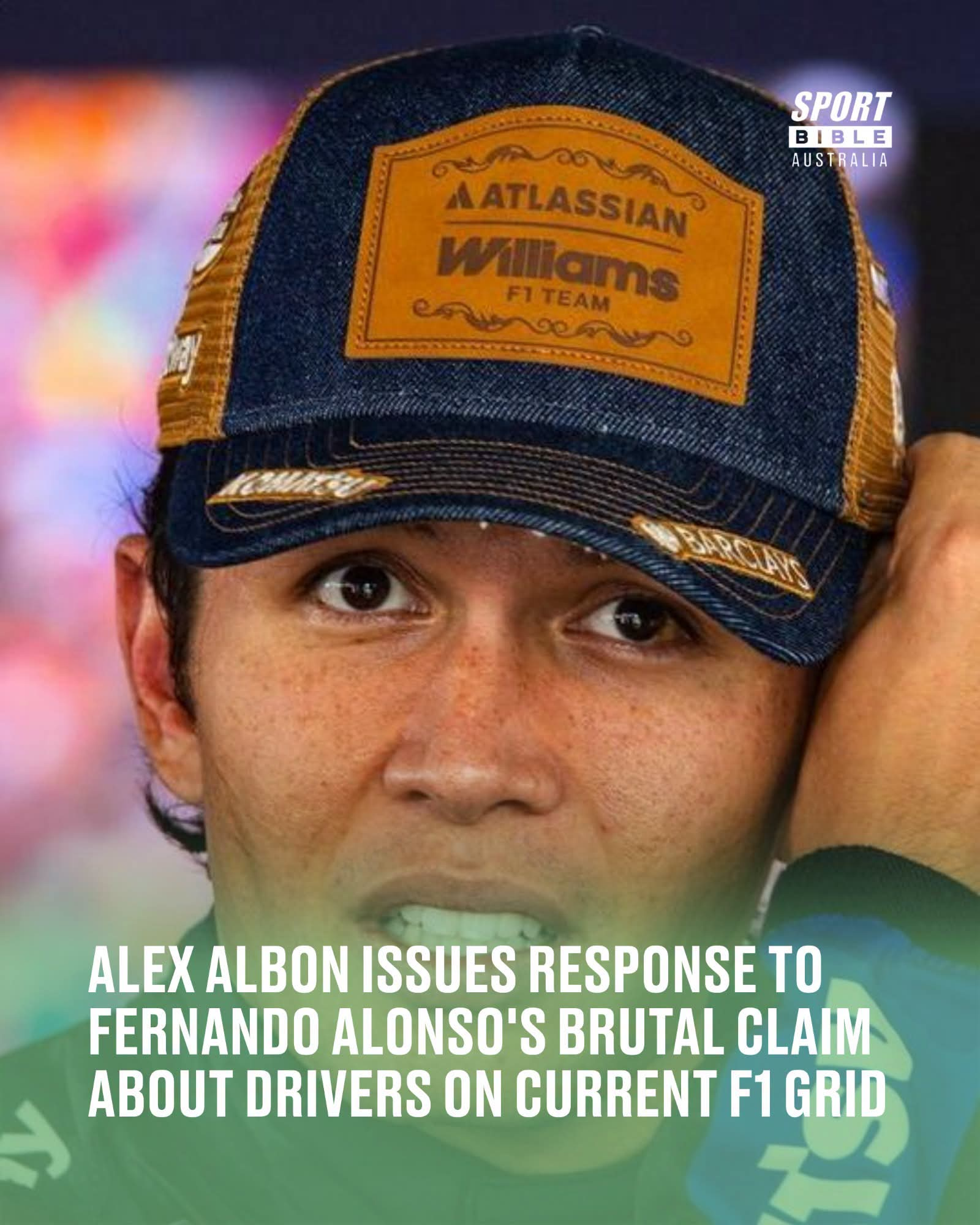
Alex Albon has responded to Fernando Alonso’s controversial comments about the quality of drivers towards the back of the Formula 1 grid after the pair clashed during the United States Grand Prix. While the Aston Martin veteran appeared frustrated with the standard of racing he encountered, the Williams driver offered a more playful assessment of their battle, describing the contest as fun and insisting that racing against Alonso is always enjoyable. The exchange has added another layer of tension to an already eventful weekend, raising questions about Alonso’s criticism and how drivers competing outside the leading positions are viewed.
The incident occurred on the opening lap at the Circuit of the Americas, when Albon attempted an inside move on Alonso at the Turn 11 hairpin. Contact followed, damaging the Aston Martin’s aerodynamic components and leaving both drivers with work to do for the remainder of the race. Neither driver managed to secure a points finish, with Alonso ending the race in 16th and Albon finishing 17th. Although the stewards did not penalise Albon for the collision, the incident clearly left Alonso dissatisfied.
FERNANDO ALONSO SPARKS CONTROVERSY WITH BRUTAL DRIVER COMMENTS
Alonso did not hide his frustration after the race, suggesting that Aston Martin needed to improve its performance and qualify further up the grid to avoid the problems associated with fighting in the lower positions.
The two-time world champion reportedly remarked that the quality of drivers towards the back of the field was very low at the moment. Although he did not explicitly identify Albon as an example, the comment attracted attention because of the collision involving the Williams driver.
Alonso is one of the most experienced competitors in Formula 1, having raced against multiple generations of drivers throughout his career. His ability to identify opportunities, manage tyre life and defend aggressively has helped establish his reputation as one of the sport’s most accomplished racers.
However, his comments also invite a wider debate about the difficulties of competing in the midfield and at the back of the grid. Drivers in those positions frequently operate with less competitive machinery, making it harder to demonstrate their abilities through finishing positions alone.
A damaged car, limited tyre performance or an unfavourable strategic decision can quickly turn a promising race into a difficult afternoon. For Alonso, the incident was another frustrating moment in Aston Martin’s attempt to compete more effectively, but his broader criticism risked overshadowing the circumstances of the collision itself.
ALEX ALBON RESPONDS WITH A PLAYFUL COMPARISON
Albon appeared keen to avoid turning the disagreement into a serious public feud. Instead, the Williams driver used a humorous comparison involving a Ford Mustang and a Mini at the Goodwood Festival of Speed to explain how he viewed the battle.
He suggested that the duel resembled a more powerful Mustang being challenged by a Mini through the corners, using the comparison to illustrate the different characteristics of the cars.
Albon described racing Alonso as fun and praised the Spaniard’s ability, adding that the Aston Martin driver was generally fair to compete against.
His response was notable because it acknowledged the challenge without directly attacking Alonso. Rather than escalating the disagreement, Albon presented the collision as an unfortunate part of a competitive battle.
The comparison also highlighted an important reality in Formula 1: a car’s straight-line speed and its performance through corners can differ significantly. A driver may have an advantage on one section of a circuit but struggle to complete an overtake because of the other car’s handling or positioning.
That difference can create close battles, particularly when drivers are competing for the same track space. Even experienced racers can misjudge how much room is available when several cars converge on a corner.
ALBON EXPLAINS HOW THE US GP COLLISION HAPPENED
Albon also offered his account of the opening-lap incident, explaining that he believed another car was positioned alongside Alonso and that the available space narrowed as the drivers entered the corner.
According to the Williams driver, he attempted to move out of the way by using the kerb but was unable to avoid contact. The collision damaged his own front wing, leaving him to continue with a compromised car.
That damage was a significant setback because front-wing performance influences aerodynamic balance, cornering grip and tyre management. Even a relatively small loss of aerodynamic efficiency can make a car more difficult to control, particularly through fast corners.
Albon’s explanation does not necessarily settle the question of responsibility, but the stewards’ decision not to issue a penalty indicates that the incident did not result in a sporting sanction.
The situation also illustrates how quickly a race can become complicated when drivers fight for position early on. With multiple cars occupying the same section of track, a move that initially appears possible can become difficult to complete safely.
For Alonso, the contact meant damage to his Aston Martin’s aerodynamic package. For Albon, it created an additional performance problem that made an already challenging race even harder.
WHY ALBON STRUGGLED TO KEEP THE ASTON MARTINS BEHIND
The Williams driver’s difficulties continued beyond the collision. Albon explained that his strategy involved an early pit stop for his final set of tyres, leaving him facing a lengthy stint on the hard compound.
The strategy might have remained manageable under different circumstances, but traffic and blue-flag situations cost him valuable time. Albon estimated that he lost approximately 10 to 12 seconds while dealing with those interruptions.
That time loss proved important as the race approached its closing stages. Albon had expected to remain ahead of the Aston Martin drivers, but the combination of his compromised car, tyre strategy and the pace of his rivals made defending increasingly difficult.
He also explained that he was conscious of teammate Carlos Sainz’s position and tried to hold off the Aston Martins to give Sainz a better opportunity to challenge them.
However, the plan ultimately failed, with the Aston Martin drivers making their way through.
The result was frustrating for Albon, who had hoped to finish ahead of the rival cars. Nevertheless, his explanation shows why finishing positions alone rarely tell the complete story of a Formula 1 race. Strategy, traffic, damage and the timing of pit stops can all influence the final classification.
ALONSO’S EXPERIENCE AND ALBON’S CHALLENGE HIGHLIGHT F1’S MIDFIELD BATTLE
The disagreement between Alonso and Albon reflects the pressure experienced by drivers competing outside the leading positions. When a team lacks the pace to fight for podiums, battles for lower points positions can become especially important, leaving little room for mistakes.
Alonso’s frustration is understandable in the context of Aston Martin’s competitive ambitions, but the quality of a driver cannot be measured simply by where their car finishes. Formula 1 machinery differs considerably across the grid, and drivers must often extract the maximum from equipment that cannot match the leading teams.
Albon has faced that challenge throughout his time in Formula 1, regularly having to balance aggressive racing with the limitations of the Williams package. His ability to compete against more experienced drivers has helped establish him as an important part of the team’s efforts.
Meanwhile, Alonso’s vast experience means he remains a formidable opponent, even when Aston Martin is not fighting at the front. Their battle in Austin demonstrated that midfield racing can be every bit as intense as the contests for podiums and victories.
The incident also serves as a reminder that even respected drivers can disagree over what constitutes fair racing. One competitor may see a legitimate overtaking attempt, while another believes the move was too aggressive or left insufficient room.
MEXICO CITY GRAND PRIX OFFERS ALBON A CHANCE TO RESPOND ON TRACK
Attention now turns to the Mexico City Grand Prix, where Albon will have an opportunity to put the Austin disappointment behind him. A cleaner race weekend could help Williams recover from the setbacks caused by contact, aerodynamic damage and an unfavourable sequence of race circumstances.
Alonso, meanwhile, will be looking for a stronger result with Aston Martin and hoping to avoid further battles that compromise his race.
Their exchange may fade quickly if both drivers return to competitive form, but the underlying debate remains relevant. Formula 1 drivers are judged by their results, yet those results are shaped by machinery, strategy, reliability and the decisions made in the heat of competition.
Albon’s response was measured rather than confrontational, while Alonso’s comments exposed the frustration that can emerge when experienced drivers are repeatedly forced to fight towards the back of the field.
Ultimately, their United States Grand Prix clash was more than a single collision. It highlighted the pressures of midfield racing, the fine margins involved in overtaking and the difficulty of separating a driver’s ability from the performance of the car beneath them.