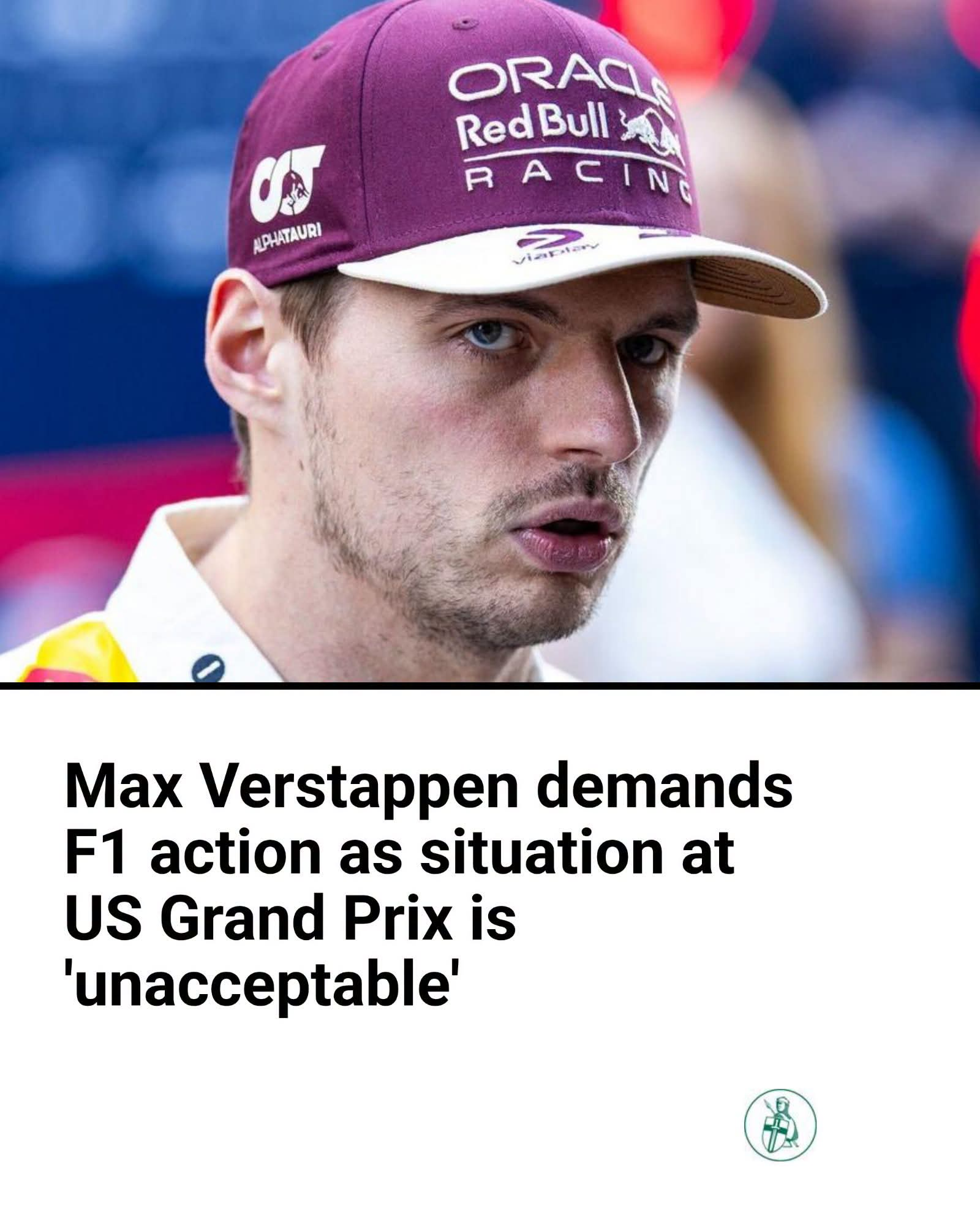
Max Verstappen has called on Formula 1 and the organisers of the United States Grand Prix to take urgent action over the severe bumps at the Circuit of the Americas (COTA), warning that the conditions could have lasting consequences for drivers’ health. The Red Bull driver believes repeated impacts on the circuit have become unacceptable, particularly given the physical demands modern Formula 1 cars place on competitors. His concerns have received support from McLaren’s Lando Norris and Mercedes driver George Russell, increasing pressure on the sport to address a problem that has persisted despite previous resurfacing projects.
Although COTA remains one of the most popular venues on the Formula 1 calendar because of its challenging layout and distinctive corners, its surface has become a major source of frustration. Verstappen has argued that minor repairs and grinding are no longer sufficient, suggesting that a more comprehensive reconstruction is needed to tackle the underlying causes. With the circuit contracted to host the United States Grand Prix through 2034, the debate raises important questions about track maintenance, driver safety and the responsibilities of race promoters.
MAX VERSTAPPEN WARNS OF POTENTIAL LONG-TERM SPINAL DAMAGE
Speaking to reporters in Austin ahead of the United States Grand Prix, Verstappen made it clear that his criticism was not directed at the circuit’s layout or the overall race-weekend experience. Instead, he believes the bumps have reached a level that cannot reasonably be accepted in a sport that places enormous physical demands on its drivers.
The four-time world champion described experiencing vertical impacts exceeding 9G during the previous year’s race weekend, contrasting those forces with the approximately 5–6G drivers can experience through cornering. He also expressed concern about the condition of his lower spine, saying medical checks had given him reasons to take the issue seriously.
Verstappen acknowledged that physical risks are part of motorsport, but argued that avoidable damage caused by persistent track-surface problems should not simply be accepted as an unavoidable consequence of racing.
His comments are particularly significant because drivers already face substantial physical stress from braking forces, high-speed cornering and the vibrations transmitted through their cars. Repeated impacts over a race weekend can add another layer of discomfort, especially when the circuit’s surface remains uneven across multiple sections.
While Verstappen’s personal experience does not establish that COTA’s bumps have caused permanent spinal damage, it highlights a legitimate safety concern that deserves technical assessment rather than being dismissed as a complaint about comfort.
WHY THE CIRCUIT OF THE AMERICAS HAS BECOME SO BUMPY
The problem at COTA is not entirely new. Changes in the ground beneath the circuit have contributed to the development of bumps over time, creating a recurring maintenance challenge for the venue.
A major resurfacing project in 2022 addressed some of the worst areas, but further uneven sections subsequently appeared. Parts of the circuit were reportedly resurfaced again in 2026, yet Verstappen remained dissatisfied with the results after a World Endurance Championship event at the venue the previous month.
The Red Bull driver argued that repeatedly grinding or treating isolated sections only addresses the symptoms rather than the underlying problem. In his view, the circuit needs a more extensive engineering solution that deals with the ground beneath the racing surface.
That approach could involve substantial excavation, ground stabilisation and reconstruction, depending on what detailed engineering investigations reveal. Such work would require significant investment and could force sections of the venue to close while repairs were carried out.
However, Verstappen believes the expense and disruption may be necessary if the circuit is to eliminate the recurring problem rather than continue relying on temporary fixes.
The challenge for COTA is to identify a durable solution that improves the surface without compromising the circuit’s distinctive character. Drivers value its elevation changes and demanding corners, so any reconstruction would need to preserve the features that make the venue popular.
LANDO NORRIS BACKS VERSTAPPEN AND REVEALS THE PHYSICAL TOLL
Norris also supported Verstappen’s criticism, suggesting the problem extends beyond concerns about spinal health.
The McLaren driver explained that the bumps can cause significant discomfort inside the cockpit, with drivers experiencing hard impacts against their headrests as the cars travel over uneven sections at high speed.
Norris revealed that he sometimes needs to take headache medication before going out on track because of the severity of the vibrations and impacts. His comments illustrate how the surface can affect drivers during a weekend in which concentration, physical endurance and precision are essential.
He also pointed to the difference between modern circuit-building standards and the condition of an older venue such as COTA. While existing circuits cannot always be expected to match every requirement imposed on newly constructed tracks, Norris believes the current situation is difficult to justify.
His support is important because it demonstrates that the concerns are not limited to one driver or one team. When competitors from rival organisations report similar difficulties, it becomes harder for the issue to be treated as an isolated grievance.
Nevertheless, the drivers’ comments do not automatically determine the technical solution. Circuit engineers, safety officials and the organisers must establish which sections pose the greatest risks and what interventions would provide lasting improvements.
GEORGE RUSSELL CALLS FOR STRICTER TRACK MAINTENANCE RULES
Russell has also backed the calls for action, suggesting that Formula 1 circuit promoters should face stronger expectations over surface maintenance.
The Mercedes driver proposed that circuits could be required to undergo resurfacing every couple of years to help maintain acceptable standards. Such a policy would aim to prevent venues from allowing surface problems to become severe before major repairs are undertaken.
However, resurfacing every circuit on a fixed schedule could be expensive and might not address every underlying cause of uneven surfaces. Some tracks deteriorate faster than others because of soil movement, weather conditions, drainage and the stresses created by repeated use.
A more effective approach could combine regular inspections, engineering assessments and clear minimum standards, with additional intervention required when a circuit develops dangerous or excessive bumps.
That would also give organisers a clearer framework for planning maintenance budgets instead of waiting until drivers raise serious concerns during a Grand Prix weekend.
The FIA and Formula 1 would need to work with circuit owners to determine how such standards could be introduced, monitored and enforced. Any policy would also need to distinguish between normal surface characteristics and defects that create unacceptable physical or safety risks.
COTA FACES PRESSURE DESPITE ITS LONG-TERM F1 CONTRACT
The Circuit of the Americas is scheduled to remain on the Formula 1 calendar through 2034, meaning the issue is unlikely to disappear simply by moving the race elsewhere.
The venue has become an important part of the championship’s presence in the United States, attracting international attention with its challenging layout and position in Austin, Texas. Its long-term contract provides continuity for Formula 1, but it also increases the importance of maintaining the circuit to an appropriate standard.
For organisers, a full reconstruction would represent a major financial and logistical undertaking. Work could require lengthy planning, coordination with local authorities and careful scheduling to avoid disrupting other events.
However, repeatedly carrying out smaller repairs could also become costly if the underlying ground movement continues to damage the surface. A comprehensive investigation may therefore be necessary to determine whether a larger project would prove more economical over the long term.
The issue also has implications for Formula 1’s wider reputation. The championship promotes increasingly sophisticated cars, strict safety procedures and extensive technical oversight. Allowing a recurring circuit problem to persist without a convincing long-term plan could undermine confidence in those commitments.
WILL FORMULA 1 FORCE COTA TO MAKE MAJOR CHANGES?
Verstappen’s intervention puts pressure on the sport’s governing bodies and COTA’s management to demonstrate that the complaints are being taken seriously. However, a complete relaying of the circuit has not been confirmed as an agreed or scheduled project.
The next steps would likely depend on engineering assessments, discussions between the circuit and the relevant authorities, and a realistic evaluation of the work required beneath the surface.
Formula 1 must also balance driver welfare with the financial and operational realities facing circuit owners. Major reconstruction projects are expensive, but the potential consequences of leaving serious surface problems unresolved make the decision more important than a simple question of cost.
The strongest response would be a transparent maintenance plan that identifies the causes of the bumps, establishes clear targets for improvement and explains how progress will be monitored.
Verstappen, Norris and Russell have made their position clear: the current conditions are unacceptable and need more than repeated temporary repairs. Whether their united criticism leads to a full reconstruction or another engineering solution remains to be seen.
With the United States Grand Prix expected to remain at COTA for years to come, finding a lasting answer could become one of the circuit’s most important priorities. The track’s reputation as a favourite among drivers will mean little if the surface continues to raise serious concerns about the physical toll of racing there.