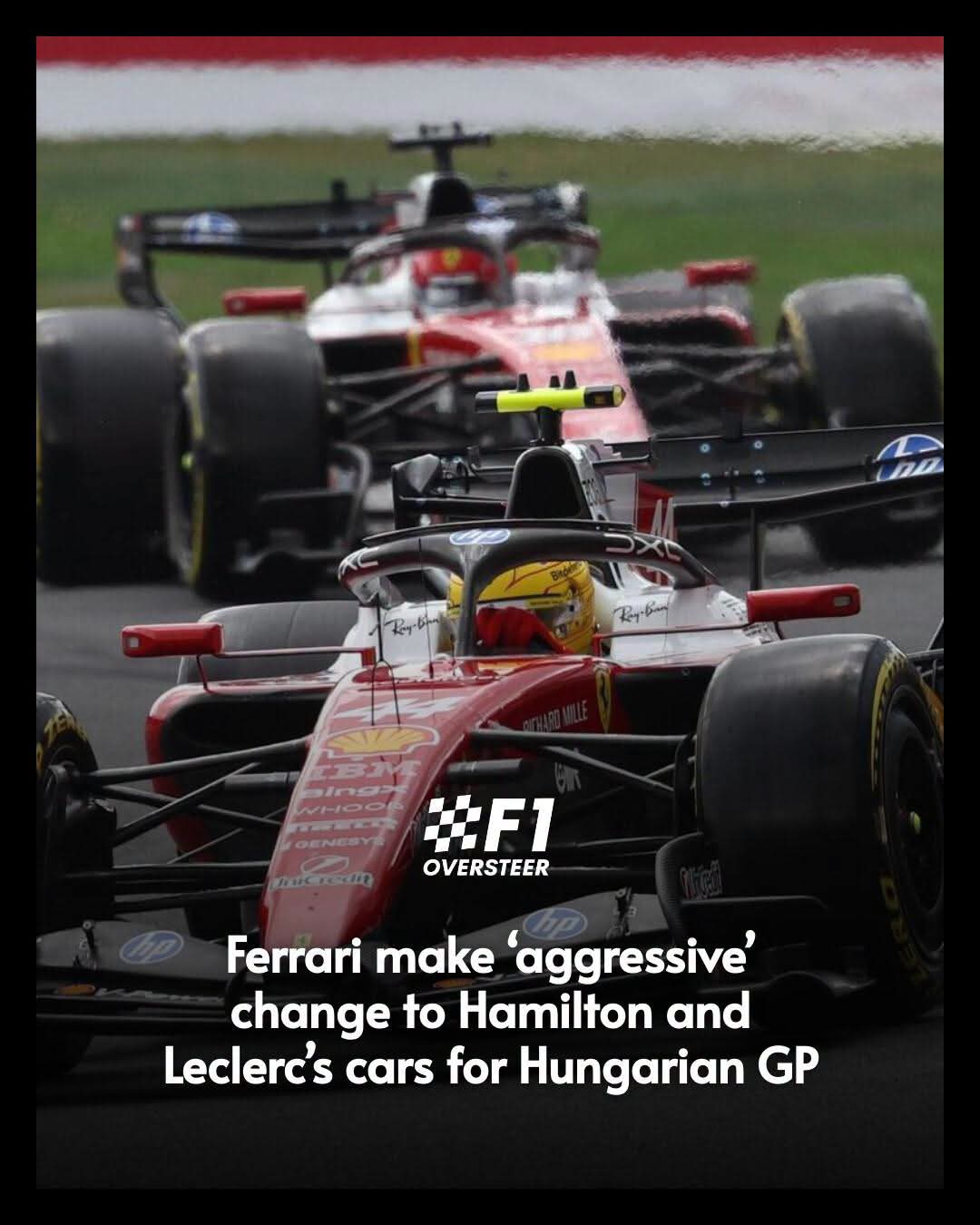
Ferrari has arrived at the 2026 Hungarian Grand Prix with renewed confidence and an upgraded SF-26 designed to capitalize on one of the team’s biggest strengths. As Formula 1 heads into its final race before the summer break, the Scuderia has introduced an aggressive rear-wing update inspired by Mercedes in a bid to close the gap in both the Drivers’ and Constructors’ Championships.
The timing could hardly be more important. Mercedes continues to lead the Constructors’ standings with 358 points, while Ferrari sits second on 285 points. In the Drivers’ Championship, Andrea Kimi Antonelli leads the way with 204 points, followed by Lewis Hamilton on 159 and George Russell on 154. With every point becoming increasingly valuable, Ferrari believes its latest aerodynamic package could provide the edge needed to challenge Mercedes on one of Formula 1’s most technical circuits.
FERRARI TAKES INSPIRATION FROM MERCEDES IN SEARCH OF MORE PERFORMANCE
Innovation has defined the 2026 Formula 1 season, and Ferrari has shown it is willing to learn from its biggest rivals.
Reports indicate that Ferrari has introduced small aerodynamic flaps on the trailing edge of its rear wing, a concept previously seen on Mercedes. While the modification may appear minor, engineers believe it will generate additional downforce through the Hungaroring’s numerous medium-speed corners without creating a significant drag penalty.
Modern Formula 1 development is often decided by microscopic gains rather than dramatic redesigns. If Ferrari’s simulations prove accurate, the revised rear wing could deliver valuable tenths of a second over a qualifying lap and improve tyre management during the race.
WHY THE HUNGARORING COULD PLAY TO FERRARI’S STRENGTHS
Unlike Spa-Francorchamps, where straight-line speed dominates much of the lap, the Hungaroring rewards aerodynamic efficiency, chassis balance, and cornering stability.
Those characteristics have consistently favored Ferrari throughout the 2026 campaign.
The SF-26 has regularly demonstrated impressive grip through medium and high-speed corners, allowing Lewis Hamilton and Charles Leclerc to recover time lost on long straights against Mercedes. Hungary’s layout minimizes that weakness while emphasizing the car’s greatest assets.
This makes Ferrari one of the leading contenders heading into the weekend, particularly if qualifying positions remain closely contested.
HAMILTON AND LECLERC RECEIVE A MORE AGGRESSIVE SF-26
Ferrari has deliberately chosen not to introduce its low-downforce “Macarena” rear wing this weekend.
Instead, engineers have focused entirely on maximizing cornering performance with a more aggressive high-downforce configuration tailored specifically for Budapest.
The team’s low-drag package remains scheduled for its expected debut at Monza later this season, where simulations reportedly suggest an additional top-speed improvement of approximately 4 km/h, building on previous aerodynamic gains.
For Hungary, however, Ferrari’s philosophy is clear: sacrifice nothing in the corners and exploit every opportunity where the SF-26 naturally excels.
That approach could allow Hamilton and Leclerc to challenge Mercedes more consistently over a race distance.
THE CHAMPIONSHIP FIGHT IS ENTERING A CRUCIAL PHASE
The Hungarian Grand Prix represents far more than another race on the calendar.
It is the final opportunity for teams to score points before Formula 1’s four-week summer break, making momentum especially valuable.
Mercedes arrives with confidence after Antonelli’s impressive victory in Belgium, but Ferrari knows a strong weekend could dramatically reduce the Constructors’ Championship deficit while helping Hamilton close the gap to his young Mercedes rival.
Hamilton, who has already secured multiple podiums this season, understands that every race is becoming increasingly important if he hopes to remain in contention for another world title.
Leclerc, meanwhile, continues to show strong pace and has emerged as one of Ferrari’s most consistent performers in recent rounds.
WHY THIS UPGRADE MATTERS BEYOND HUNGARY
Ferrari’s decision to adopt elements from Mercedes highlights how fiercely competitive Formula 1’s development race has become.
No team can afford to ignore successful ideas from rivals, particularly under the highly restrictive 2026 regulations. Even seemingly minor aerodynamic tweaks can produce meaningful gains over a championship campaign.
The update also sends a clear message that Ferrari has no intention of conceding the title fight despite Mercedes’ early advantage.
If the revised rear wing performs as expected in Hungary, Ferrari could carry valuable confidence into the second half of the season, where circuits such as Zandvoort may also favor the SF-26’s high-downforce characteristics.
With Mercedes still holding the championship advantage, Ferrari’s latest upgrade may prove to be one of the defining developments of the 2026 Formula 1 season. If Hamilton and Leclerc can convert improved cornering performance into victories, the battle for both world championships could become far tighter than the standings currently suggest.