In the high-stakes theater of modern MotoGP, narrative arcs rarely stay linear. Just when the paddock began to whisper that the physical toll of a long career was finally catching up to Marc Marquez, the Spaniard delivered a masterclass in defiance at the Balaton Park Circuit. His commanding Sprint victory at the 2026 Hungarian Grand Prix wasn’t just a win; it was a loud, aggressive reminder that as long as the multi-time world champion is on the grid, the championship remains his to dictate.
THE ART OF THE IMPOSSIBLE COMEBACK
Entering this weekend, the chatter surrounding Marquez was fraught with caution. Following shoulder surgery, the Ducati Lenovo rider was vocal about his limitations, playing down expectations for a podium finish. Yet, the stopwatch told a different story.
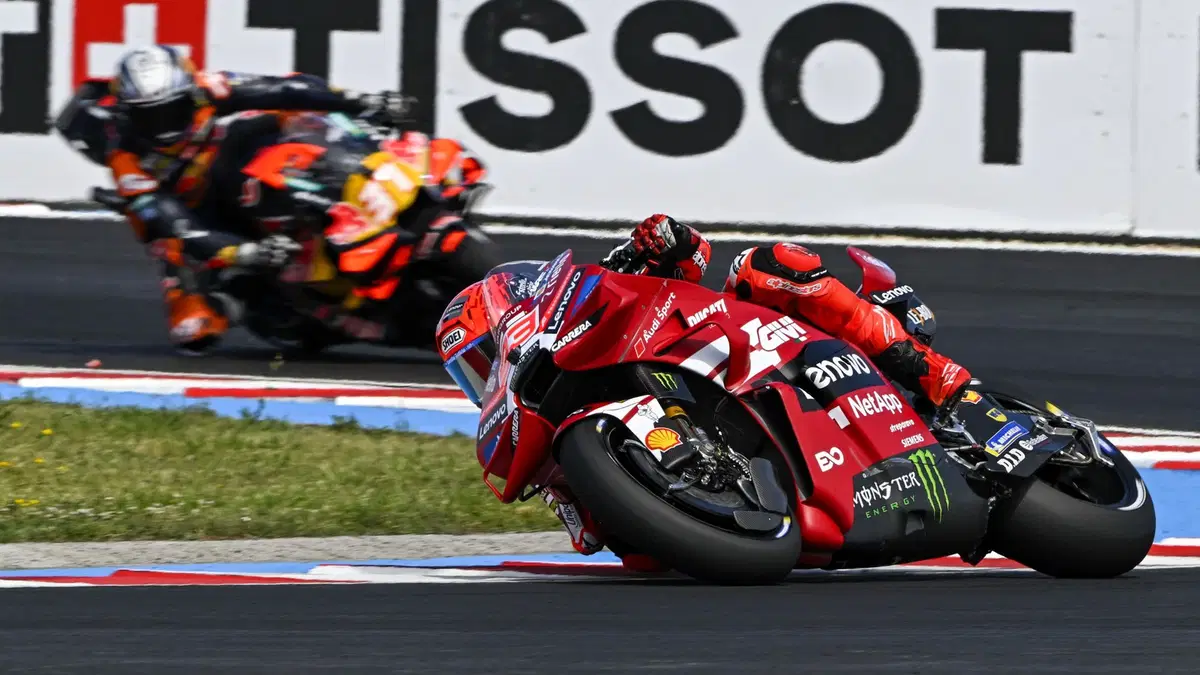
After snatching a gritty pole position—remarkably, after an early fall in qualifying—Marquez’s Sprint performance was surgical. He converted his starting advantage into an immediate lead, neutralizing the threat of KTM’s rising phenom, Pedro Acosta, early on. While many expected tyre degradation to be the ultimate arbiter on the demanding Balaton surface, Marquez’s pace remained relentless. He didn’t just win; he broke the field.
ACOSTA AND BEZZECCHI: THE NEW GUARD UNDER PRESSURE
While Marquez grabbed the headlines, the supporting cast provided a fascinating look at the future of the sport. Pedro Acosta’s second-place finish continues to solidify his status as the primary challenger to the established order. His ability to match Marquez’s intensity in the early laps suggests he is nearing that elusive final step of maturity required to challenge for a world title.
Meanwhile, championship leader Marco Bezzecchi salvaged a critical third place. His race was a testament to “damage limitation” in a sprint format. After a brilliant start from sixth to third at Turn 1, Bezzecchi was forced to defend aggressively against the hard-charging Fermin Aldeguer. Secure in the championship standings, Bezzecchi knows that points are the currency of titles, but he will be undoubtedly concerned by the sheer gap to Marquez’s Ducati at the front.
THE CHAMPIONSHIP IMPLICATIONS
For Jorge Martin, the Sprint was a frustrating exercise in “what-ifs.” His error while attempting to pass Diogo Moreira—forcing him to short-cut a chicane—effectively ended his pursuit of the leaders. Finishing sixth, Martin now faces the stark reality that he cannot afford these unforced errors if he hopes to hunt down Bezzecchi in the overall standings.
The data from Balaton Park is telling. Unlike the tactical tyre-choice variations we saw at Mugello, the entire field opted for the soft rear tyre for this Sprint, signaling that the track temperature and surface characteristics left zero room for long-game strategy. In this “flat-out” environment, Marquez proved that his raw talent—and his ability to extract performance from the GP26—remains the benchmark.
LOOKING AHEAD: CAN THE MOMENTUM HOLD?
The question everyone in the paddock is now asking: Is this a one-off performance, or has Marquez truly turned a corner in his recovery?
If Marquez can replicate this form in Sunday’s full-length Grand Prix, the psychological impact on his rivals will be profound. A win from Sunday’s race would not only validate his physical status but would inject total chaos into the championship hunt. With the gaps at the top of the standings tightening, every point is becoming magnified.
Predicting the outcome of the Sunday race is notoriously difficult at Balaton Park, but one thing is clear: the field is now on notice. We have seen champions fade away before, but Marc Marquez has once again proven that writing him off is a dangerous game. Sunday isn’t just a race anymore; it’s a crucible, and the rest of the grid knows exactly who is setting the pace.