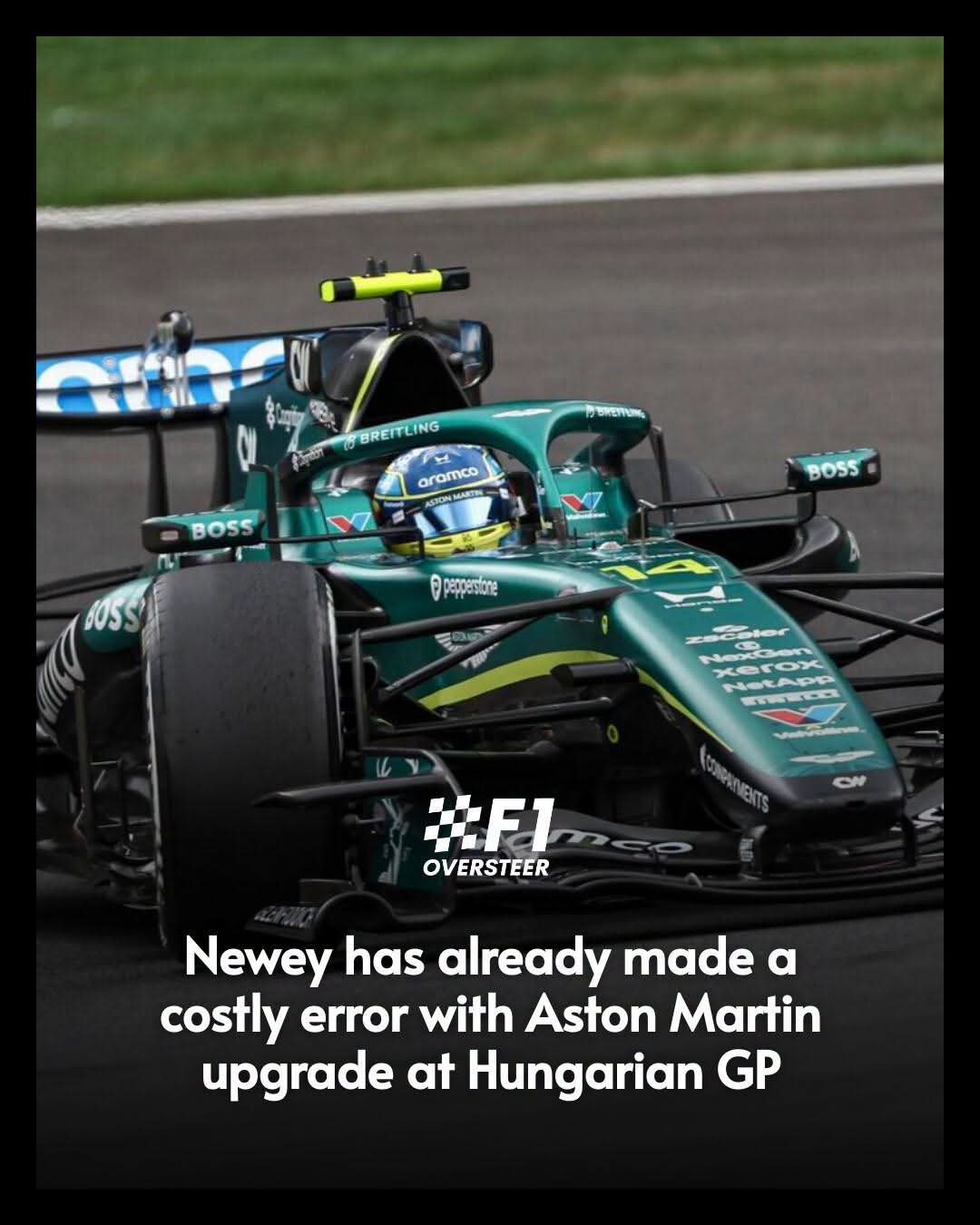
Aston Martin has arrived at the 2026 Hungarian Grand Prix with what many inside the Formula 1 paddock are calling its most important upgrade package in years. After enduring a disastrous start to the season, the Silverstone-based team has pinned its hopes on an extensively revised AMR26 designed under Adrian Newey’s leadership. However, while expectations are high, fresh concerns suggest the team may be repeating the very mistakes that contributed to its difficult campaign.
With Mercedes leading both championships and Ferrari closing the gap, Aston Martin desperately needs a breakthrough. Instead of fighting near the front, the team has spent much of 2026 battling at the back of the field, making the Hungarian Grand Prix a defining moment for Newey’s ambitious rebuilding project.
ASTON MARTIN BRINGS A MAJOR CAR OVERHAUL TO HUNGARY
The updated AMR26 is far more than a routine mid-season development. Aston Martin has introduced significant revisions to several of the car’s key performance areas, including the floor, sidepods, gearbox housing, rear bodywork, and aerodynamic package.
The team is also preparing additional Honda power unit improvements expected after Formula 1’s summer break, hoping to address one of the season’s biggest weaknesses—its lack of straight-line performance.
On paper, the package represents the team’s most aggressive attempt yet to recover from a disappointing first half of the season. Engineers are optimistic the redesign can unlock substantial lap-time gains and finally move Aston Martin closer to the midfield battle.
Yet Formula 1 history shows that ambitious upgrades only succeed if they arrive fully prepared.
RUSHED DEVELOPMENT HAS RAISED SERIOUS QUESTIONS
One of the biggest concerns surrounding Aston Martin’s Hungary package has little to do with the design itself and everything to do with timing.
Reports from the paddock indicate that many of the new components were completed at the last possible moment, leaving logistics crews scrambling to transport parts from the factory to the Hungaroring. Such last-minute preparation leaves little opportunity for extensive validation, quality checks, or contingency planning if problems emerge during practice.
That scenario feels familiar.
Earlier this year, Aston Martin’s pre-season preparations were disrupted by delays that left the team arriving behind schedule. The rushed build was followed by an extremely difficult opening phase of the championship, where the AMR26 struggled with reliability, power delivery, and overall competitiveness.
Repeating that approach with such an extensive upgrade package introduces significant risk, especially under Formula 1’s demanding race weekend schedule.
HONDA’S POWER UNIT REMAINS A MAJOR CHALLENGE
While aerodynamic improvements attract the headlines, Aston Martin’s largest obstacle may still sit behind the driver.
Throughout 2026, Honda’s new power unit has struggled to match the performance of rival manufacturers. Aston Martin has frequently lacked acceleration on long straights, while reliability concerns have limited opportunities to maximize race strategy.
Adding to the challenge, reports suggest engineers are still working through technical issues relating to fuel system compliance and engine optimization. Any unresolved problems could reduce the effectiveness of Newey’s new aerodynamic package, since Formula 1 performance depends on every system working together.
Even the best-designed chassis cannot fully compensate for a significant horsepower deficit.
WHY THE HUNGARIAN GRAND PRIX IS THE PERFECT TEST
Despite those concerns, Hungary offers Aston Martin perhaps its best opportunity of the season.
Unlike Spa-Francorchamps, where engine power dominates performance, the Hungaroring rewards aerodynamic efficiency, mechanical grip, and cornering balance. Drivers spend far less time at maximum speed, making chassis performance considerably more important.
If Newey’s redesign genuinely improves airflow management and cornering stability, the tighter Hungarian circuit should allow Aston Martin to demonstrate measurable progress even before Honda introduces further engine upgrades later this year.
Fernando Alonso’s experience could also prove invaluable, with the two-time world champion renowned for extracting maximum performance from difficult machinery.
THE PRESSURE ON ADRIAN NEWEY CONTINUES TO GROW
Few engineers in Formula 1 history carry Adrian Newey’s reputation. His championship-winning designs transformed Williams, McLaren, and Red Bull into dominant forces across multiple eras.
That pedigree is exactly why expectations at Aston Martin remain so high.
However, Newey also faces one of the toughest rebuilding jobs of his career. The AMR26 was developed under entirely new technical regulations, alongside a fresh Honda partnership that has experienced significant growing pains.
The Hungarian upgrade package is therefore more than a collection of new parts—it represents Aston Martin’s first major statement that its long-term vision is beginning to take shape.
Should the upgrades perform as intended, confidence inside the organization will receive a major boost heading into the second half of the season.
If they fail, questions surrounding development strategy, execution, and the Honda partnership are likely to intensify.
WHAT THIS COULD MEAN FOR THE REST OF THE SEASON
Aston Martin does not necessarily need to challenge Mercedes or Ferrari immediately. Instead, the team needs clear evidence that its development direction is working.
Consistent improvements in qualifying pace, race consistency, and reliability would provide a strong platform before the next round of power unit upgrades arrives after Formula 1’s summer break.
With Newey continuing to reshape the organization and Honda working to close the performance gap, the Hungarian Grand Prix could become the first true indicator of whether Aston Martin’s ambitious project is finally moving in the right direction—or whether more difficult months still lie ahead.