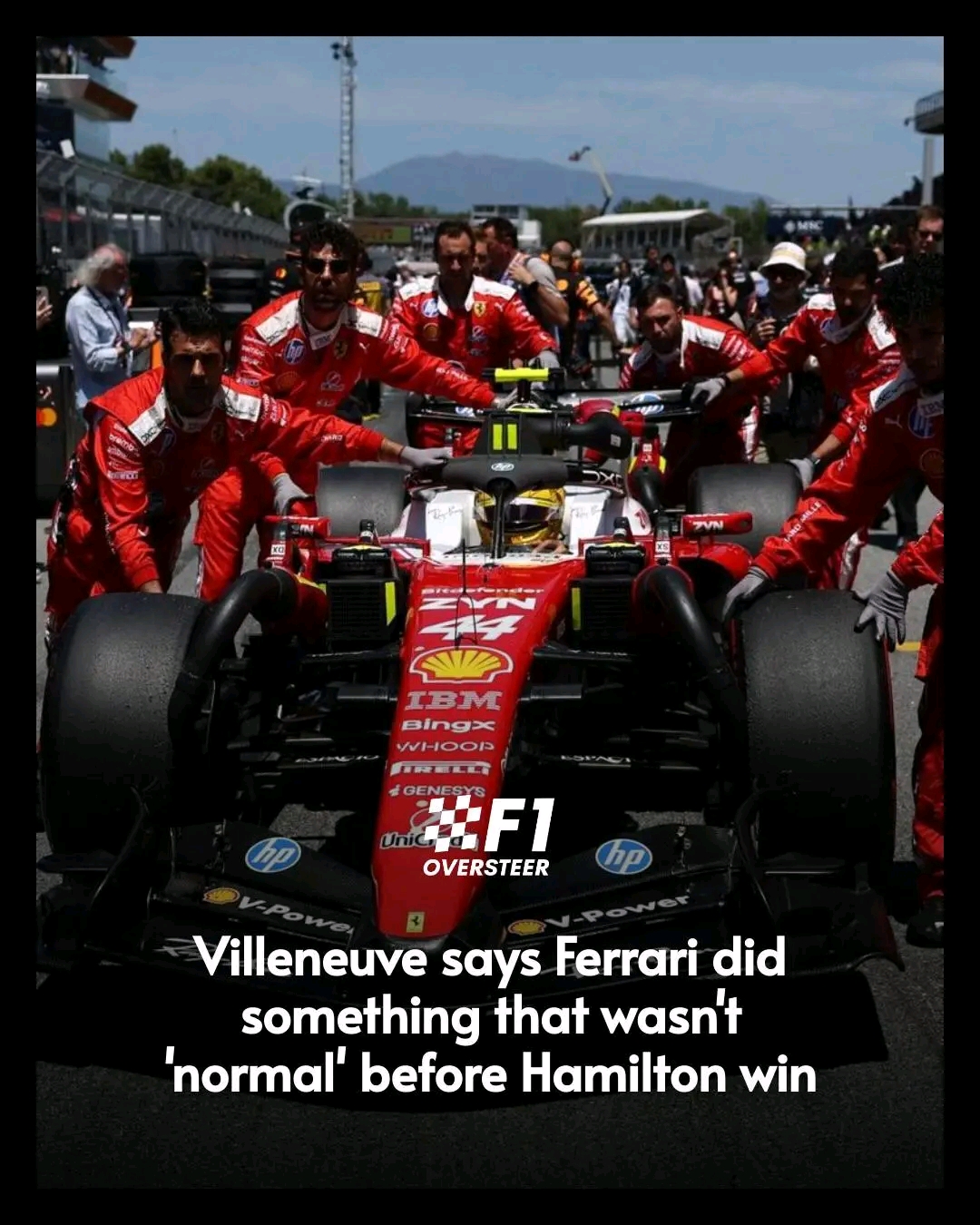
Jacques Villeneuve has sparked fresh debate in the Formula 1 paddock after suggesting that Ferrari made an unusual strategic or operational decision prior to Lewis Hamilton’s recent breakthrough victory. The comments have quickly gained attention because they touch on Ferrari’s long-standing reputation for internal rigidity, pressure-heavy decision-making, and race-day unpredictability.
While Villeneuve did not accuse Ferrari of wrongdoing, his remarks highlight something that has long fascinated F1 observers: when Ferrari deviates from its “normal” way of operating, it often coincides with moments of either breakthrough performance or unexpected instability.
WHY VILLENEUVE’S COMMENTS MATTER IN MODERN F1 CONTEXT
Jacques Villeneuve, the 1997 Formula 1 World Champion, is known for blunt and often controversial opinions. When he comments on Ferrari, it tends to attract attention because of the team’s historical sensitivity to criticism and its global importance in the sport.
His suggestion that Ferrari did something “not normal” before Hamilton’s win raises questions about whether the team is evolving its race operations or simply reacting differently under pressure in 2026.
In modern Formula 1, even small strategic shifts can have massive consequences due to how tightly packed the field is. A single tyre decision, undercut timing, or communication change can be the difference between winning and finishing off the podium.
FERRARI’S TRADITIONAL WEAKNESS: STRATEGIC INCONSISTENCY
Ferrari’s reputation in Formula 1 has always been shaped by two extremes: brilliance in raw performance and inconsistency in execution.
Over the years, the team has been criticised for:
Inflexible race strategies
Overcomplicated decision-making structures
Delayed responses to changing race conditions
Internal pressure influencing on-track calls
Because of this history, any deviation from their usual operational style is immediately noticed by analysts and former drivers.
Villeneuve’s comments suggest that Ferrari may have done something outside their normal pattern—potentially a more aggressive or simplified strategic approach that contributed to Hamilton’s success.
THE HAMILTON FACTOR: EXPERIENCE MEETS FERRARI EVOLUTION
Lewis Hamilton’s move to Ferrari has been one of the most closely watched transitions in recent Formula 1 history. After years of success at Mercedes, his adaptation period at Ferrari has been a major storyline across the paddock.
His recent win has already been interpreted as a turning point, not just for him, but for Ferrari’s operational confidence.
Experienced drivers like Hamilton often bring more than speed—they bring feedback systems, race management expectations, and strategic discipline shaped by years in title-winning environments.
If Ferrari adjusted even slightly to accommodate a more structured or simplified approach influenced by Hamilton, it could explain Villeneuve’s “not normal” remark.
WHAT COULD “NOT NORMAL” ACTUALLY MEAN?
Without direct confirmation from Ferrari, Villeneuve’s comment remains open to interpretation. However, in Formula 1 terms, “not normal” could refer to several strategic changes:
Faster decision-making on pit stops
Reduced internal debate during race execution
Prioritising driver input more heavily than usual
A more aggressive tyre strategy approach
Clearer number-one driver support in key phases
Any of these changes could represent a departure from Ferrari’s historically complex race structure.
In a tightly contested modern F1 field, simplifying decisions can often unlock performance gains that raw car upgrades alone cannot deliver.
WHY THIS MATTERS FOR THE 2026 CHAMPIONSHIP
Ferrari’s ability to compete consistently at the front is critical not just for race wins, but for the overall championship narrative.
If the team has genuinely improved its race execution process, Hamilton becomes an even more dangerous contender in the title fight. A well-managed Ferrari is significantly more threatening than a fast but inconsistent one.
For Mercedes, Red Bull, and McLaren, this development is important because it signals that Ferrari may finally be reducing one of its biggest historical weaknesses.
That shifts the competitive balance in subtle but important ways:
Fewer strategic errors from Ferrari
More consistent points scoring
Stronger support for Hamilton in close races
Increased pressure on rival teams to match execution quality
TEAM DYNAMICS AND INTERNAL PRESSURE AT FERRARI
Ferrari is unique in Formula 1 because of the scale of attention it receives from Italian media, global fans, and internal stakeholders. This often creates intense pressure during race weekends.
If Ferrari has changed its internal race communication or strategy approval process, it could indicate a response to that pressure.
Hamilton’s presence may also be influencing the culture. A driver with his experience typically demands clarity and precision rather than layered or delayed decision-making.
Over time, that influence can reshape how a team operates at every level, from engineers to strategists.
WHAT THIS COULD MEAN GOING FORWARD
If Ferrari truly has adjusted its operational approach, even partially, it could have long-term consequences for the 2026 season and beyond.
Potential outcomes include:
More race wins for Hamilton if execution remains sharp
Stronger championship consistency from Ferrari
Reduced internal strategy errors under pressure
Increased competition with Mercedes and Red Bull in tight races
However, there is also a risk. If “not normal” means overreaction or short-term tactical changes, Ferrari could still fall into inconsistency under pressure at critical moments.
CONCLUSION: SMALL CHANGES, BIG IMPLICATIONS FOR FERRARI AND F1
Jacques Villeneuve’s remarks may sound simple on the surface, but they highlight a deeper truth about Formula 1: the smallest strategic changes inside a top team can reshape an entire championship fight.
Whether Ferrari has genuinely broken from tradition or simply adapted under pressure, the result is the same—Lewis Hamilton’s win has triggered renewed scrutiny of how the team operates at the highest level.
In a sport where milliseconds matter, sometimes the most important transformation is not in the car, but in the decisions made behind the scenes.