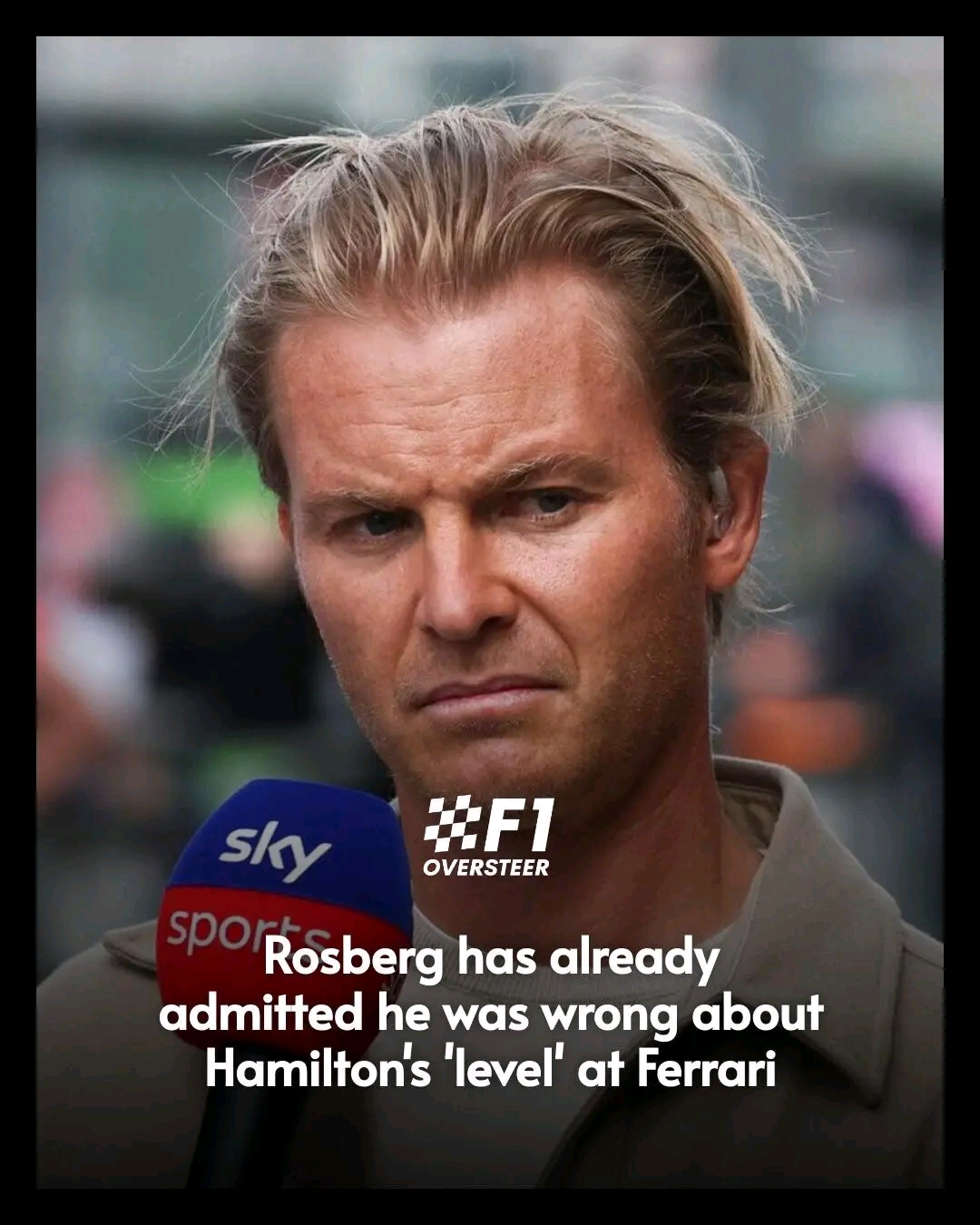
Formula 1 debates often age poorly, but few take a sharper twist than predictions about Lewis Hamilton’s move to Ferrari. Former world champion Nico Rosberg has already softened his earlier stance after initially questioning how competitive Hamilton would be at Maranello, effectively admitting he may have underestimated the scale of the challenge and Hamilton’s ability to handle it.
The change of tone is more than just a headline moment. It reflects how quickly perceptions in Formula 1 can shift once reality, data, and early performances start to reshape expectations.
ROSBERG’S ORIGINAL DOUBT AND WHY IT MATTERED
When Hamilton’s Ferrari switch became public, Rosberg was among those who raised concerns about whether the seven-time world champion could immediately adapt to a completely new environment after more than a decade with Mercedes.
His initial skepticism was rooted in three key ideas:
Ferrari’s historically complex car philosophy
The difficulty of adapting after a long-term team relationship
The intense pressure that comes with driving for Ferrari
These are not unfounded concerns. Many elite drivers have struggled when switching top teams late in their careers, especially when moving into a high-pressure environment like Ferrari.
THE U-TURN: WHY ROSBERG HAS SHIFTED HIS VIEW
Rosberg’s revised stance suggests a growing belief that Hamilton’s level may have been underestimated in the early predictions. Rather than struggling to adapt, Hamilton’s reputation, preparation, and technical understanding are already reshaping expectations internally and externally.
This kind of reversal is not unusual in Formula 1. Early predictions are often built on assumptions, while real performance quickly exposes the truth.
What likely triggered the shift:
Hamilton’s immediate integration into Ferrari’s technical environment
Strong early feedback from engineers and paddock insiders
His proven ability to adapt across regulation eras and car concepts
The realization that elite drivers often elevate struggling projects faster than expected
WHY HAMILTON AT FERRARI IS SUCH A UNIQUE CASE
This is not a standard driver transfer. It is one of the most high-profile moves in modern F1 history.
Hamilton is joining Ferrari at a time when:
The team is still chasing a return to consistent championship-winning form
Internal pressure is extremely high from fans and media
The 2026 regulation shift is approaching, reshaping long-term strategy
Unlike many driver changes, this is not just about short-term results. It is about legacy, brand identity, and the final chapter of a historic career.
IMPACT ON FERRARI’S TITLE HOPES
Ferrari’s championship ambitions are always under scrutiny, but Hamilton’s arrival changes the narrative in several ways.
TECHNICAL DEVELOPMENT BOOST
Hamilton brings decades of feedback experience from a championship-winning system at Mercedes. That input can influence:
Car balance direction
Setup philosophy
Race weekend execution
Even small improvements in these areas can translate into significant performance gains over a full season.
MENTAL EDGE AND PRESSURE MANAGEMENT
Ferrari is known for emotional intensity. Hamilton’s presence introduces a different dynamic: calm under pressure and proven race management skills in title fights.
That could be a stabilizing factor in high-stakes weekends where Ferrari has historically made costly errors.
WHAT THIS MEANS FOR LECLERC AND TEAM DYNAMICS
The biggest internal storyline remains Charles Leclerc’s position within the team.
With Hamilton in the garage, Ferrari effectively has:
A long-term project driver in Leclerc
A proven multi-title champion in Hamilton
This creates a fascinating dynamic where data comparison, strategy calls, and qualifying margins will be under constant spotlight.
If Hamilton adapts quickly, internal pressure on Leclerc could intensify, especially in race execution consistency.
WHY ROSBERG’S CHANGE OF TONE IS SIGNIFICANT
Rosberg is not just a commentator; he is a former world champion who understands elite-level performance psychology and team dynamics.
His adjustment signals something important:
The paddock may be realizing that Hamilton’s Ferrari chapter is not a decline phase, but potentially a late-career reinvention.
In Formula 1, perception often moves ahead of reality, but once insiders start changing their tone, it usually reflects underlying performance signals.
COULD HAMILTON ACTUALLY THREATEN A TITLE RUN?
This is the biggest question emerging from the discussion.
There are three possible scenarios:
1. RAPID ADAPTATION AND TITLE CHALLENGE
If Ferrari delivers a competitive car, Hamilton could immediately become a title contender due to his racecraft and experience.
2. GRADUAL BUILD-UP TOWARD 2026 RULES
Hamilton uses 2025 as adaptation, with Ferrari focusing on long-term competitiveness under new regulations.
3. INTERNAL BALANCE WITH LECLERC DOMINANCE
Leclerc remains the benchmark, while Hamilton’s role becomes more developmental and strategic.
At this stage, scenario one cannot be ruled out, especially given Hamilton’s history of quick adaptation to regulation changes.
FINAL THOUGHT
Rosberg’s quick U-turn is more than just a change of opinion. It highlights how unpredictable elite Formula 1 transitions can be, especially when a driver of Lewis Hamilton’s caliber is involved.
Ferrari’s project is now under even more scrutiny, not just because of expectations, but because early paddock reactions suggest that Hamilton may be defying the usual transition curve for drivers at this stage of their careers.
If that trend continues, this could become one of the most significant driver-team partnerships of the modern F1 era.