Formula 1 has never been short of talented drivers, but securing a seat at a championship-winning team requires more than raw speed. Team chemistry, personality, leadership and the ability to work under pressure can be just as important as performance on the track.
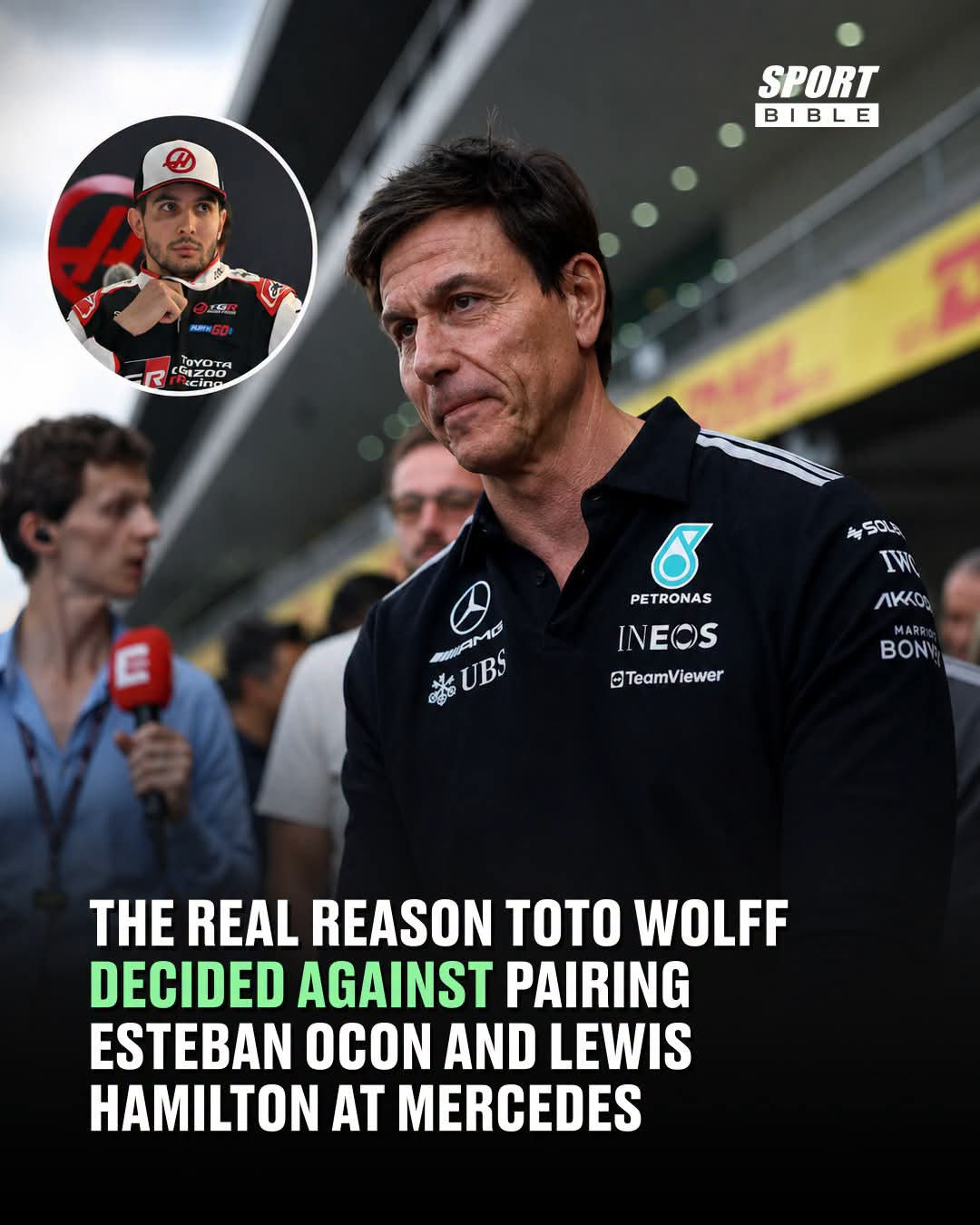
One decision made by Mercedes team principal Toto Wolff several years ago is now attracting renewed attention following Esteban Ocon’s latest controversy at Haas. The Frenchman was once seriously considered for a potential Mercedes race seat alongside Lewis Hamilton, but concerns about how the two drivers might work together reportedly played a significant role in the decision to look elsewhere.
With Ocon now facing an uncertain future after being dropped by Haas for the remainder of the 2026 season, that old Mercedes decision looks particularly significant.
THE MERCEDES DECISION THAT COULD HAVE CREATED A DIFFERENT DRIVER LINE-UP
Ocon was already regarded as one of the most promising young drivers in Formula 1 when Mercedes brought him into its reserve driver programme in 2019.
The Frenchman had previously competed for Force India before losing his full-time seat at the end of the 2018 campaign. Despite being left without a race seat, his performances had convinced Mercedes that he possessed the ability to become a major figure in the sport.
Wolff was publicly supportive of Ocon’s potential and even suggested that the youngster could eventually win races and championships with Mercedes.
However, there was an important question surrounding his possible promotion: would he be compatible with Hamilton?
According to BBC Sport’s Andrew Benson, Mercedes had concerns that the personalities of the two drivers could clash, potentially creating an explosive relationship inside the garage.
That reportedly influenced the team’s decision not to put them together.
Mercedes instead retained Valtteri Bottas for the 2020 season, while George Russell continued developing at Williams before eventually earning his opportunity with the Silver Arrows.
It was a decision that demonstrated how carefully Mercedes approached its driver strategy. The team was not simply searching for the fastest available replacement. It wanted someone capable of operating within its competitive environment without creating unnecessary internal problems.
WHY OCON’S TEAMMATE HISTORY BECAME A CONCERN
Ocon’s reputation for difficult teammate relationships has followed him throughout his Formula 1 career.
His clashes with Sergio Perez during their Force India days attracted considerable attention, with both drivers involved in incidents that damaged the team’s results. Their rivalry became so uncomfortable that the team eventually had to intervene to manage the situation.
His relationship with Pierre Gasly at Alpine also produced several difficult moments.
The most notable incident came at the 2024 Monaco Grand Prix, when Ocon attempted an aggressive move on his teammate and the two Alpine cars collided. The incident created another difficult situation for the team, with then-team principal Bruno Famin publicly criticising Ocon’s attack as being completely out of context.
These incidents do not automatically mean Ocon is incapable of being a good teammate. Formula 1 is an intensely competitive environment, and drivers are naturally reluctant to surrender positions or opportunities.
However, repeated disagreements can become a serious problem when they begin affecting team performance, internal relationships and the ability of engineers to manage both sides of a garage.
For a team competing for championships, those risks can be difficult to justify.
WHY LEWIS HAMILTON WAS A PARTICULARLY IMPORTANT FACTOR
Hamilton’s position at Mercedes made the potential pairing especially complicated.
By 2019, the British driver had already established himself as one of the biggest names in Formula 1. He was a multiple world champion, the central figure in Mercedes’ championship project and an experienced leader within the team.
Any young driver joining alongside him would have needed to understand the competitive hierarchy while still having the freedom to pursue personal success.
That balance is not always easy.
Hamilton had previously experienced intense teammate rivalries, particularly during his first season at McLaren alongside Fernando Alonso and later during his championship battles with Nico Rosberg at Mercedes.
Those relationships demonstrated how quickly internal competition can become a major distraction, even when both drivers are delivering outstanding results.
Mercedes had already experienced the consequences of allowing a teammate rivalry to become too intense. It was therefore understandable that Wolff would be cautious about introducing another potentially combustible partnership.
The concern was not necessarily whether Ocon had enough speed. It was whether the combination would deliver the stability Mercedes needed.
GEORGE RUSSELL EVENTUALLY BECAME THE ANSWER
While Ocon remained part of Mercedes’ wider plans, Russell was steadily building his reputation at Williams.
The British driver impressed during difficult seasons with the Grove-based team, frequently extracting strong performances from machinery that was rarely capable of competing near the front.
His performance at the 2020 Sakhir Grand Prix, when he temporarily replaced Hamilton, further strengthened his reputation.
Russell came extremely close to winning the race before a series of unfortunate circumstances denied him the opportunity.
Mercedes already had access to extensive information about both drivers, and the team ultimately viewed Russell as its preferred long-term option.
That decision eventually became reality when Russell joined Mercedes as a full-time driver in 2022.
His partnership with Hamilton provided the team with two highly competitive drivers, although it was not without disagreements and difficult moments.
Russell eventually became a central part of Mercedes’ future plans, while Ocon continued building his career elsewhere.
Looking back, the decision illustrates how important timing and internal evaluations can be in Formula 1. A driver can possess the necessary talent but still miss out because a team believes another candidate offers a better overall fit.
HAAS CONTROVERSY BRINGS OLD CONCERNS BACK INTO FOCUS
Ocon’s latest difficulties at Haas have brought renewed attention to the concerns surrounding his personality and relationships within teams.
Following the Mexican Grand Prix weekend, Haas confirmed that Ocon would not compete for the team for the remainder of the 2026 season.
Ryo Hirakawa had already stepped in during the Mexican Grand Prix, while Ferrari junior Rafael Camara was subsequently announced as Ocon’s replacement for the Sao Paulo Grand Prix.
Reports surrounding the situation included claims of a physical altercation between Ocon and team principal Ayao Komatsu. Ocon denied being involved in a physical confrontation, so those allegations should not be treated as established fact.
What is clear from the available reporting is that tensions had developed, and the team ultimately decided to make a significant change to its driver line-up.
The situation is particularly interesting because Komatsu had previously defended his decision to sign Ocon, highlighting the Frenchman’s work ethic and racing ability.
That support showed that Haas initially believed Ocon was the right choice despite concerns that had followed him from previous teams.
However, Formula 1 relationships can change quickly when expectations, results and internal disagreements begin moving in different directions.
WAS TOTO WOLFF RIGHT TO AVOID THE PARTNERSHIP?
Mercedes’ decision deserves another look because the team was operating in an environment where even minor internal problems could have serious championship consequences.
Hamilton was already delivering world championship performances, and Mercedes needed a teammate capable of contributing to the team’s success without creating unnecessary distractions.
Ocon undoubtedly had the ability to compete at a high level. His subsequent performances in Formula 1 demonstrated that he was more than capable of racing against established names.
But talent alone does not guarantee compatibility.
A driver can be aggressive on the track, determined to win and unwilling to surrender opportunities while still maintaining a productive relationship with teammates. The difficulty comes when those competitive instincts repeatedly produce damaging situations.
Wolff’s reported concerns suggest Mercedes wanted to avoid taking that risk.
There is also an important distinction between rejecting a driver because of ability and deciding that another candidate is better suited to the team’s long-term project.
Russell eventually received the opportunity, and Mercedes’ subsequent decision to promote him demonstrated that the team had a clear development strategy.
Whether Ocon would have performed better or worse alongside Hamilton will remain one of Formula 1’s unanswered questions.
OCON NOW FACES ONE OF THE MOST IMPORTANT MOMENTS OF HIS CAREER
At 30, Ocon is approaching a crucial stage in his Formula 1 journey.
He has experience, race-winning potential and years of knowledge from competing for several teams. However, his latest situation at Haas could make securing another opportunity considerably more difficult.
Formula 1 teams do not evaluate drivers solely on qualifying speed, race pace or championship points. They also examine how drivers communicate with engineers, handle pressure, respond to criticism and contribute to the overall working environment.
For Ocon, rebuilding confidence among team principals could become just as important as demonstrating his speed.
A future opportunity might still emerge, particularly if teams require an experienced driver who can provide technical feedback and deliver consistent performances.
But his next move will need to be carefully considered.
The biggest challenge may be convincing another team that his experience and competitive qualities outweigh the concerns that have repeatedly followed him.
MERCEDES’ OLD WARNING NOW LOOKS MORE SIGNIFICANT
Wolff’s reported decision not to pair Ocon with Hamilton is an example of how Formula 1 teams sometimes make choices that become more understandable years later.
Mercedes had a promising young driver available, but concerns about the potential relationship inside the garage reportedly influenced its thinking.
The team eventually chose a different path, promoting Russell and maintaining a driver structure that helped shape its future.
Ocon’s latest difficulties at Haas do not prove that Mercedes would have been right about every aspect of the proposed partnership. Nor do they establish that the Frenchman cannot succeed in another competitive environment.
However, they have brought an old question back into the conversation: how much should a Formula 1 team consider a driver’s personality when deciding who deserves a seat?
In a sport where championships can be decided by the smallest margins, the answer could be just as important as outright speed.