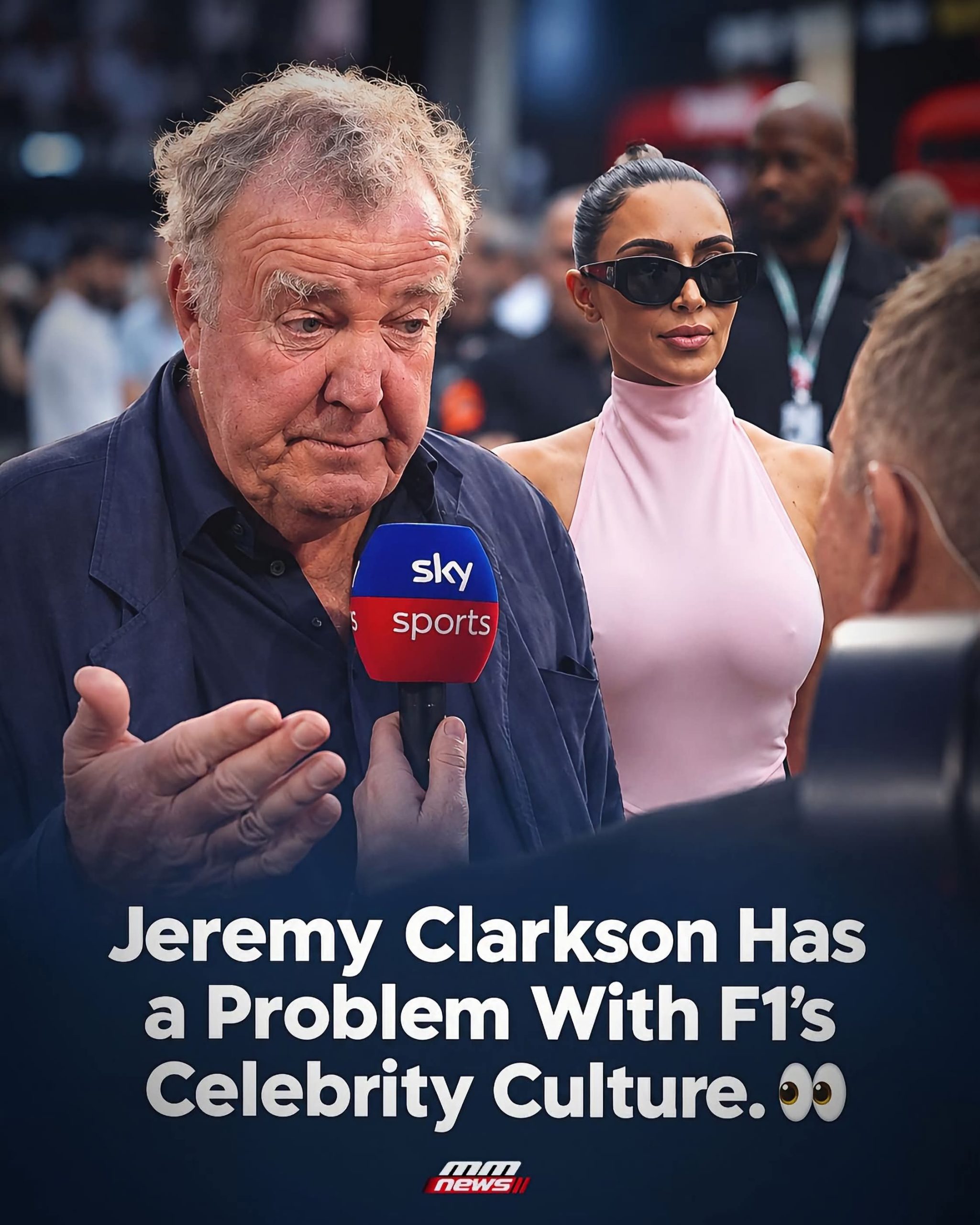
Jeremy Clarkson has reignited the conversation about celebrity influence in Formula 1 after using a live Sky Sports interview at the United States Grand Prix to make his feelings clear. The broadcaster and long-time motorsport fan stated that he was in Austin to watch the racing, not Kim Kardashian, questioning the growing amount of attention given to non-racing figures in the paddock.
His remarks have touched a nerve among fans and observers who continue to debate whether Formula 1’s expanding celebrity appeal is strengthening the sport or slowly diluting its core identity.
### CLARKSON DRAWS A CLEAR LINE
Clarkson has never been one to soften his opinions for the sake of diplomacy. During his appearance in the Circuit of the Americas paddock, he expressed frustration at the volume of coverage and conversation surrounding celebrities rather than the on-track action. The specific reference to Kim Kardashian, who has been a visible presence at recent races in connection with Lewis Hamilton, framed a wider point about priorities.
For Clarkson, the spectacle of Formula 1 should remain rooted in the competition between drivers and teams. The increasing presence of A-list visitors, fashion moments and social-media driven narratives appears, in his view, to risk shifting the focus away from what happens between the lights and the chequered flag.
### THE OTHER SIDE OF THE ARGUMENT
Formula 1’s growth in recent years has been closely linked to its ability to attract new audiences. The Netflix series, expanded races in the United States, and a more open approach to entertainment and lifestyle coverage have brought in fans who might never have engaged with the sport through traditional channels. Celebrities walking the grid, attending races and sharing content on social media have played a visible role in that expansion.
From a commercial perspective, the strategy has delivered. Higher global attention, stronger sponsorship interest and packed grandstands at new venues suggest that the broader cultural appeal is working. For a sport that spent years trying to break into the American mainstream, the current level of visibility represents significant progress.
### FANS REMAIN DIVIDED
The reaction to Clarkson’s comments reflects a familiar split within the Formula 1 community. Long-time supporters often express concern that the racing is being packaged as secondary entertainment, with driver rivalries, technical detail and sporting integrity sometimes losing space to red-carpet style coverage. Newer fans, meanwhile, frequently see the celebrity presence as part of what makes modern Formula 1 exciting and accessible.
Both perspectives contain valid points. A sport that becomes too insular risks stagnation. A sport that chases cultural relevance too aggressively risks losing the authenticity that made it compelling in the first place.
### A QUESTION OF BALANCE
The real issue is not whether celebrities should attend Grands Prix. High-profile visitors have been part of Formula 1 for decades. The question is one of proportion and editorial focus. When coverage begins to treat the paddock as a lifestyle event first and a championship second, the balance has shifted too far. When the racing remains central and the wider cultural interest serves as an entry point rather than the main attraction, the sport can benefit from both worlds.
Clarkson’s intervention serves as a blunt reminder of that tension. Whether one agrees with his tone or not, the underlying concern resonates with a significant portion of the audience.
### WHAT IT MEANS GOING FORWARD
Formula 1 is unlikely to reverse its embrace of mainstream culture. The commercial incentives are too strong and the global growth has been too tangible. At the same time, the sport’s long-term health depends on protecting the primacy of the competition itself.
The most successful path will be one that welcomes new fans without alienating those who come primarily for the racing. Achieving that balance requires careful judgment from teams, promoters, broadcasters and the championship’s leadership.
Clarkson has stated his position in characteristically direct fashion. The debate he has helped intensify is one Formula 1 will continue to navigate as it evolves. The racing remains the product. Everything else, ultimately, should support it rather than compete with it for attention.