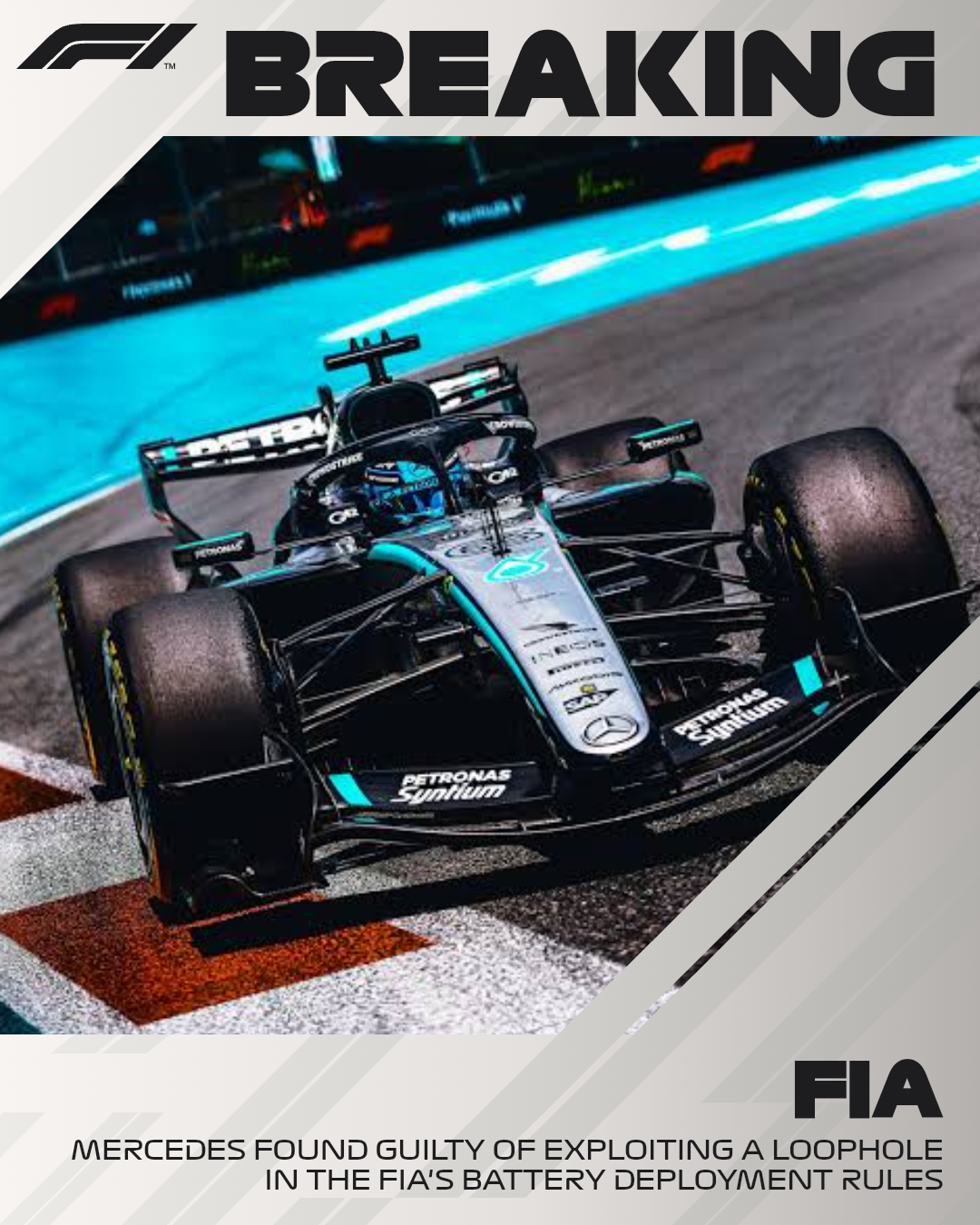
Formula 1 has been thrown into turmoil after reports claimed that Mercedes has been found guilty of exploiting a loophole in the FIA’s battery deployment regulations. The alleged breach centers on the complex hybrid energy recovery system, one of the most tightly regulated aspects of modern Formula 1 power units. If confirmed by the FIA, the case could become one of the defining technical controversies of the 2026 season, with major implications for Mercedes’ championship ambitions and the future interpretation of Formula 1’s hybrid regulations.
THE ALLEGED LOOPHOLE CENTERS ON HYBRID ENERGY DEPLOYMENT
Battery deployment has become one of Formula 1’s biggest performance differentiators under the current hybrid era. Every manufacturer carefully manages how electrical energy is harvested, stored, and released throughout each lap to maximize acceleration without exceeding FIA limits.
According to the reports, Mercedes is alleged to have discovered a regulatory loophole that allowed its power unit to deploy stored electrical energy in a manner not originally anticipated by the FIA’s technical regulations. Rather than exceeding the official energy limits outright, the system reportedly exploited wording within the rulebook to gain a performance advantage while remaining difficult to detect through routine monitoring.
Such cases often highlight the extraordinary ingenuity of Formula 1 engineers, who constantly search for innovative interpretations of the regulations to gain even the smallest competitive edge.
WHY BATTERY DEPLOYMENT IS SO CRITICAL IN MODERN FORMULA 1
The hybrid systems introduced over the past decade have transformed Formula 1 into one of the world’s most technologically advanced motorsports. Electrical deployment now plays a vital role in overtaking, defending positions, qualifying performance, and race strategy.
Even a slight improvement in how electrical power is delivered can translate into valuable tenths of a second over a lap. Across an entire Grand Prix, those fractions often determine podium finishes, race victories, and ultimately world championships.
Because of this, the FIA maintains extremely detailed regulations governing every aspect of hybrid performance. Any interpretation that provides an unintended advantage inevitably attracts close scrutiny from technical delegates and rival teams.
THE CHAMPIONSHIP IMPLICATIONS COULD BE SIGNIFICANT
Should Mercedes officially be found in breach of the technical regulations, the consequences could extend far beyond a single race weekend.
Depending on the severity of the infringement and when it allegedly occurred, potential penalties could include race disqualifications, loss of championship points, financial sanctions, or mandatory technical modifications for future events.
For Mercedes, any such outcome would represent a major setback during a season in which every point has become increasingly valuable. Rival manufacturers would undoubtedly welcome any opportunity to reduce Mercedes’ competitive advantage as the championship battle intensifies.
At the same time, Formula 1’s technical controversies have historically sparked rapid rule clarifications designed to prevent similar interpretations in the future.
FORMULA 1 HAS A LONG HISTORY OF TECHNICAL INNOVATION
Cases like this are not uncommon in Formula 1 history. Many of the sport’s greatest engineering breakthroughs have originated from teams discovering creative interpretations of regulations before governing bodies stepped in to clarify the rules.
Double diffusers, blown exhausts, DAS steering systems, flexible wings, FRIC suspension, and numerous aerodynamic concepts all emerged through teams identifying gray areas within the rulebook.
Some innovations were eventually legalized, while others were banned after regulators determined they conflicted with the intended spirit of the regulations.
This constant battle between engineering creativity and regulatory oversight remains one of Formula 1’s defining characteristics.
THE FIA MAY RESPOND WITH IMMEDIATE RULE CLARIFICATIONS
If the reported findings are confirmed, the FIA is likely to issue revised technical directives to close any identified loophole before it can be replicated by rival teams.
Formula 1’s governing body has increasingly relied on technical directives during recent seasons to quickly address emerging interpretations without waiting for complete regulation rewrites.
Such action would aim to preserve competitive fairness while maintaining confidence in the championship’s technical integrity.
Manufacturers would then be required to adapt their software, power unit mapping, or hybrid deployment strategies to comply with the updated interpretation.
A REMINDER OF FORMULA 1’S RELENTLESS TECHNICAL ARMS RACE
Whether this reported controversy results in severe penalties or simply a clarification of existing regulations, it demonstrates once again how Formula 1 extends far beyond what fans see on race day.
The fiercest competition often takes place inside engineering departments, simulation centers, and technical meetings long before the cars reach the starting grid.
As teams continue searching for every possible advantage under increasingly sophisticated regulations, similar technical battles are almost inevitable.
If the FIA formally confirms these allegations, the Mercedes battery deployment investigation could become one of the most influential technical stories of the 2026 Formula 1 season, potentially shaping both the championship fight and the future evolution of Formula 1’s hybrid rulebook.