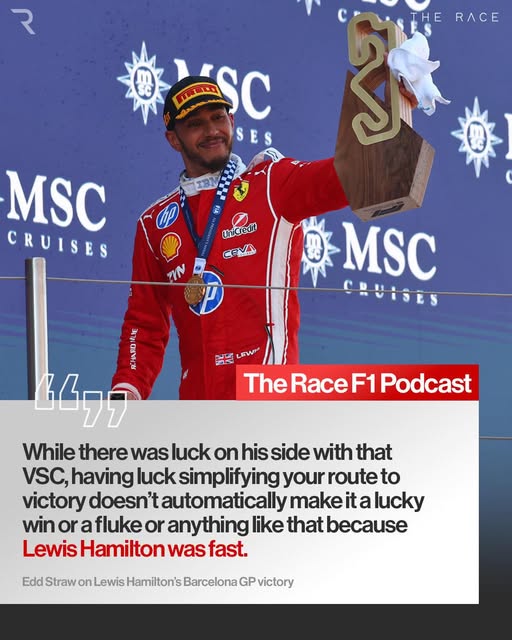
Lewis Hamilton’s long-awaited first Formula 1 victory with Ferrari at the Spanish Grand Prix has sparked a familiar debate across the paddock. Was the seven-time world champion genuinely the fastest driver on the day, or did a perfectly timed Virtual Safety Car hand him the win?
While some critics have pointed to the race-changing intervention as the decisive factor, a growing number of analysts believe Hamilton’s triumph was built on much more than fortunate timing. The Barcelona Grand Prix may ultimately be remembered as the race that confirmed Ferrari’s resurgence and reignited Hamilton’s championship ambitions.
THE VIRTUAL SAFETY CAR THAT CHANGED THE NARRATIVE
The defining moment of the race came when Fernando Alonso’s Aston Martin suffered a mechanical failure, triggering a Virtual Safety Car period.
At the time, Hamilton was executing an aggressive three-stop strategy that looked risky compared to the two-stop plans being used by Mercedes drivers Kimi Antonelli and George Russell. The timing of the VSC allowed Ferrari to bring Hamilton into the pits at a significantly reduced time loss, helping him emerge ahead of his main rivals.
Immediately, questions began to surface.
Would Hamilton have reached the front without the interruption?
It is a fair question, but one that risks overlooking everything that happened before and after the VSC appeared.
HAMILTON WAS ALREADY BUILDING A WINNING RACE
Long before Alonso’s retirement created the opportunity, Hamilton was putting together one of his strongest race performances in years.
Ferrari’s strategy relied heavily on tire life, and Hamilton was consistently extracting more pace from his compounds than those around him. His lap times remained competitive deep into each stint, allowing him to attack while rivals were increasingly forced into tire management.
The data throughout the race suggested Ferrari had found a sweet spot with its setup. Hamilton was able to maintain speed through long runs while preserving enough tire performance to launch attacks when necessary.
That advantage did not suddenly appear because of the Virtual Safety Car.
It was there throughout the race.
WHY MANY INSIDE THE PADDOCK BELIEVE HE WOULD HAVE WON ANYWAY
One of the strongest arguments supporting Hamilton’s victory comes from the race pace itself.
After benefiting from the VSC and moving into the lead, Hamilton did not merely defend his position. Instead, he pulled away from the field and finished almost 20 seconds ahead of George Russell.
That margin is difficult to ignore.
If the Ferrari had only gained track position through luck, the expectation would have been for Mercedes to challenge aggressively in the closing stages. Instead, Hamilton controlled the race comfortably and extended his advantage lap after lap.
Several analysts have pointed out that while overtaking Russell and Antonelli on track would not have been easy, Hamilton’s pace advantage suggested he was heading toward a race-winning opportunity regardless of the safety car timing.
The VSC may have simplified the process, but it did not create Ferrari’s speed.
FERRARI’S DEVELOPMENT IS FINALLY DELIVERING RESULTS
Hamilton’s victory was also a reward for Ferrari’s relentless development efforts throughout the opening phase of the 2026 season.
After a disappointing 2025 campaign that produced more frustration than success, Ferrari entered the new regulation era determined to close the gap to Mercedes. Early signs suggested progress, but Barcelona was the first race where everything came together.
The SF-26 looked balanced, predictable, and extremely competitive across all tire compounds.
Perhaps more importantly, Hamilton appears increasingly comfortable with the car.
That growing confidence is translating directly into performance. The hesitation that sometimes appeared during his first season with Ferrari has been replaced by the aggressive racecraft and strategic awareness that defined the most successful years of his career.
THE PSYCHOLOGICAL BOOST FERRARI NEEDED
Victories matter for more than just points.
For Ferrari, Barcelona delivered something equally valuable: belief.
The team has spent years chasing Mercedes, Red Bull, and McLaren in various championship battles. Despite flashes of brilliance, consistency has often been missing.
Hamilton’s victory changes the atmosphere inside Maranello.
Winning validates the direction of development, strengthens trust between driver and team, and provides momentum that can carry through the remainder of the season.
It also reinforces Hamilton’s growing influence within the organization. The veteran has spent months working closely with engineers, helping shape the evolution of the SF-26, and the results are beginning to show.
WHAT THIS MEANS FOR THE CHAMPIONSHIP FIGHT
The 2026 championship battle suddenly looks far more interesting.
Kimi Antonelli still leads the standings and has established himself as one of Formula 1’s biggest revelations. Mercedes remains an extremely strong package, and George Russell continues to deliver consistent results.
However, Ferrari’s Barcelona breakthrough suggests the competitive order may be shifting.
If Hamilton can replicate this level of performance at circuits that suit Ferrari’s strengths, the championship battle could become a genuine three-team fight.
Momentum in Formula 1 can change quickly. One victory often leads to increased confidence, more aggressive development, and stronger performances across the board.
Ferrari now has evidence that its package can beat Mercedes on merit.
That realization alone could transform the remainder of the season.
WHY THE “LUCKY WIN” LABEL FEELS UNFAIR
Every Formula 1 victory contains an element of circumstance.
Championship-winning teams capitalize on safety cars, changing weather conditions, strategic opportunities, and rival mistakes. The difference between winners and losers is often the ability to react when those moments arrive.
Ferrari did exactly that in Barcelona.
The team recognized the opportunity presented by the Virtual Safety Car and executed flawlessly. Hamilton delivered the pace required to make the strategy work, managed his tires expertly, and controlled the race once he reached the front.
Calling the victory lucky oversimplifies what was a highly calculated and exceptionally well-executed performance.
THE BIGGER PICTURE FOR HAMILTON
Perhaps the most significant takeaway from Barcelona is what it says about Hamilton himself.
For much of the last two years, questions surrounded his future. Critics wondered whether age was catching up with him and whether his move to Ferrari would ever produce the success both sides envisioned.
Barcelona provided a powerful answer.
Hamilton remains capable of leading races, managing complex strategies, and delivering elite-level performances under pressure.
His first Ferrari victory was not simply a sentimental milestone. It was a statement that he remains a genuine force in Formula 1.
A WARNING TO THE REST OF THE GRID
The most dangerous version of Lewis Hamilton has always been the one operating with confidence.
Barcelona showed signs of that driver returning.
Ferrari appears to have found a competitive platform. Hamilton is increasingly comfortable within the team. The development path looks promising, and the championship remains open enough to create opportunities.
Whether the Virtual Safety Car accelerated his path to victory or not, one thing became clear in Spain: Lewis Hamilton did not just benefit from good timing.
He drove like a champion.
And if Ferrari continues moving in this direction, Barcelona may be remembered not as a lucky victory, but as the race that launched a genuine title challenge.