The Belgian Grand Prix burst into controversy within moments of the lights going out as Lewis Hamilton was handed a five-second time penalty following a dramatic first-lap collision with Mercedes driver George Russell. The incident not only altered the complexion of the race but also dealt a significant blow to Russell’s championship ambitions, leaving Ferrari and Mercedes at the center of another heated Formula 1 debate.
With the 2026 title fight becoming increasingly intense, every point matters, making the FIA’s decision one of the most consequential rulings of the season. While Hamilton remained in the race after serving his penalty, Russell’s afternoon ended prematurely, dramatically shifting the championship picture in favor of Mercedes teammate Kimi Antonelli.
OPENING LAP DRAMA CHANGES THE ENTIRE RACE
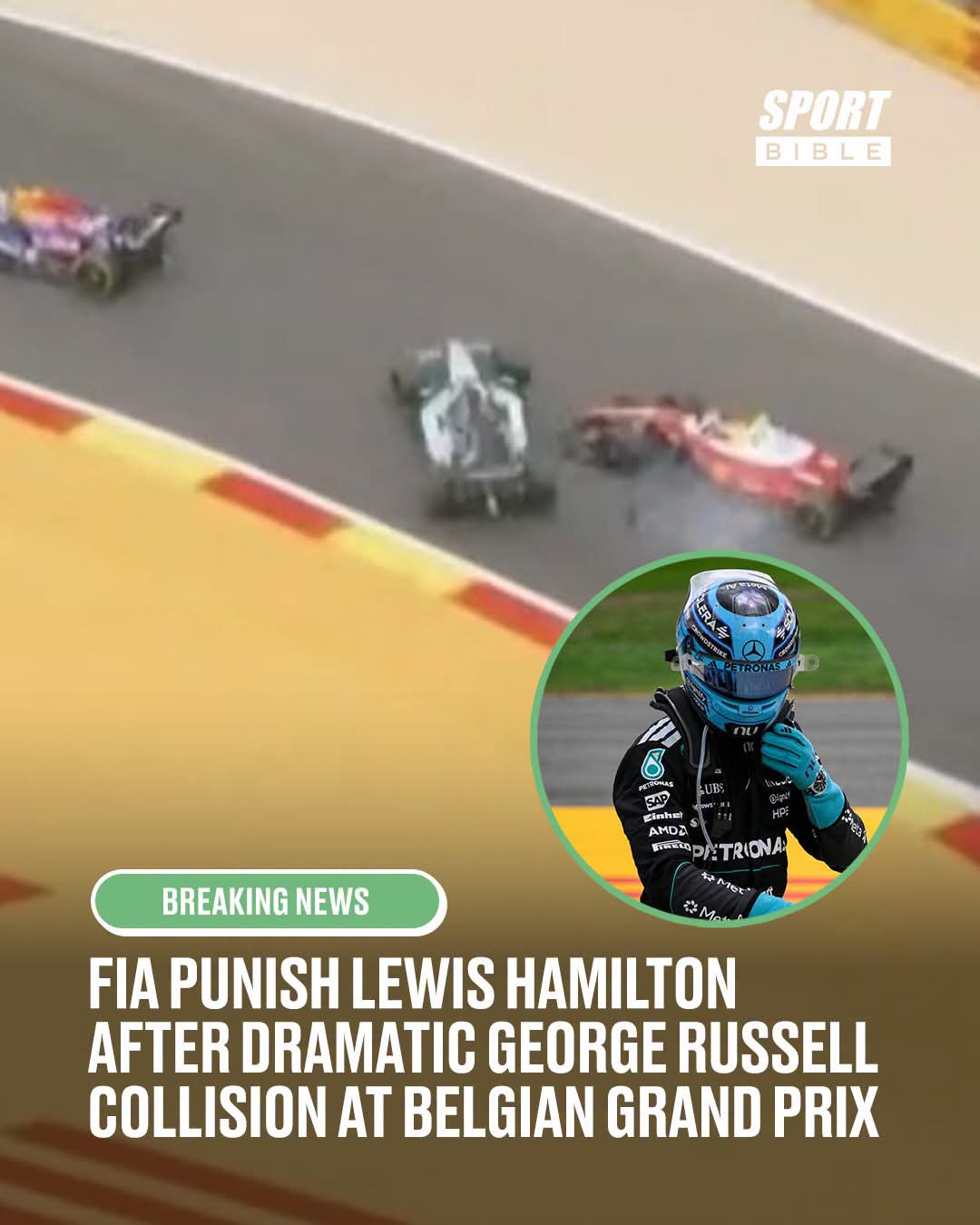
The collision occurred during the frantic opening exchanges at Spa-Francorchamps, where drivers battled for position through one of Formula 1’s fastest opening sectors.
Hamilton attempted to navigate heavy traffic while running close behind another car before making contact with Russell. The impact forced the Mercedes driver out of contention and ultimately into retirement, ending any chance of scoring valuable championship points.
After reviewing the incident, FIA stewards concluded Hamilton was predominantly responsible and issued the Ferrari driver a five-second time penalty for causing the collision.
The punishment had to be served during Hamilton’s pit stop, preventing Ferrari’s mechanics from touching the car until the mandatory five seconds had elapsed.
HAMILTON IMMEDIATELY DEFENDED HIS ACTIONS
Hamilton wasted little time explaining his version of events over Ferrari team radio.
According to the seven-time world champion, visibility and dirty air played a significant role in what unfolded.
> “The car crossed over in front of me. I was right behind another car, so I had no front end.”
Hamilton’s comments suggest he believed reduced aerodynamic grip left him with little opportunity to avoid the contact once the cars converged.
Such explanations are common in modern Formula 1, where turbulent airflow can dramatically reduce front-end grip when drivers follow closely through high-speed corners.
Nevertheless, the FIA determined that Hamilton’s actions warranted a sporting penalty.
RUSSELL’S CHAMPIONSHIP SUFFERS A MAJOR SETBACK
For George Russell, the collision could prove extremely costly beyond a single race result.
Entering the Belgian Grand Prix, Russell trailed teammate Kimi Antonelli by just 25 points in the Drivers’ Championship. His retirement guarantees a scoreless weekend while Antonelli remains in position to extend his advantage.
Speaking after returning to the paddock, Russell expressed frustration not only about the incident itself but also about the pace deficit he experienced before the collision.
“I just got totally swallowed up down the straight,” Russell explained.
He admitted the incident could perhaps have been avoided from both sides but suggested the circumstances leading into the corner had already compromised his race.
The retirement leaves Mercedes relying solely on Antonelli to maximize its championship advantage during one of the most important weekends before the summer break.
CONSISTENCY OF FIA DECISIONS WILL AGAIN COME UNDER SCRUTINY
One of the biggest talking points following the incident is likely to be consistency in FIA stewarding.
Later in the race, Charles Leclerc became involved in contact with McLaren’s Oscar Piastri at the same section of the circuit. Despite the collision allowing Leclerc to continue ahead, no penalty followed.
That contrast will inevitably fuel debate among fans and analysts over whether similar incidents are being judged using identical standards.
Formula 1 has repeatedly faced criticism over steward consistency, particularly during intense championship battles where even a five-second penalty can dramatically alter race outcomes.
As always, interpretation remains one of the sport’s most controversial elements.
FERRARI MUST NOW LIMIT THE DAMAGE
Although Hamilton remained competitive despite the penalty, Ferrari’s strategy immediately became more complicated.
Serving a time penalty disrupts pit-stop timing, compromises race strategy, and often places drivers into additional traffic after rejoining the circuit.
The Scuderia now faces the difficult task of recovering as many points as possible while minimizing the damage caused by the opening-lap incident.
With Mercedes and Ferrari locked in a fierce Constructors’ Championship battle, every position gained—or lost—could influence the outcome of the season.
THE TITLE RACE MAY HAVE REACHED ANOTHER TURNING POINT
The Belgian Grand Prix may ultimately be remembered as one of the defining races of the 2026 championship.
Russell’s retirement strengthens Antonelli’s position at the top of the standings, while Hamilton’s penalty limits Ferrari’s opportunity to capitalize on Mercedes’ misfortune.
As Formula 1 heads deeper into the second half of the campaign, aggressive racing will only become more common as drivers fight for every available point.
The opening-lap collision at Spa serves as another reminder that championship battles are often decided not only by outright speed but also by split-second decisions under immense pressure.
With several races still remaining, both Hamilton and Russell will undoubtedly have opportunities to respond—but after Belgium, the championship landscape may already look very different.