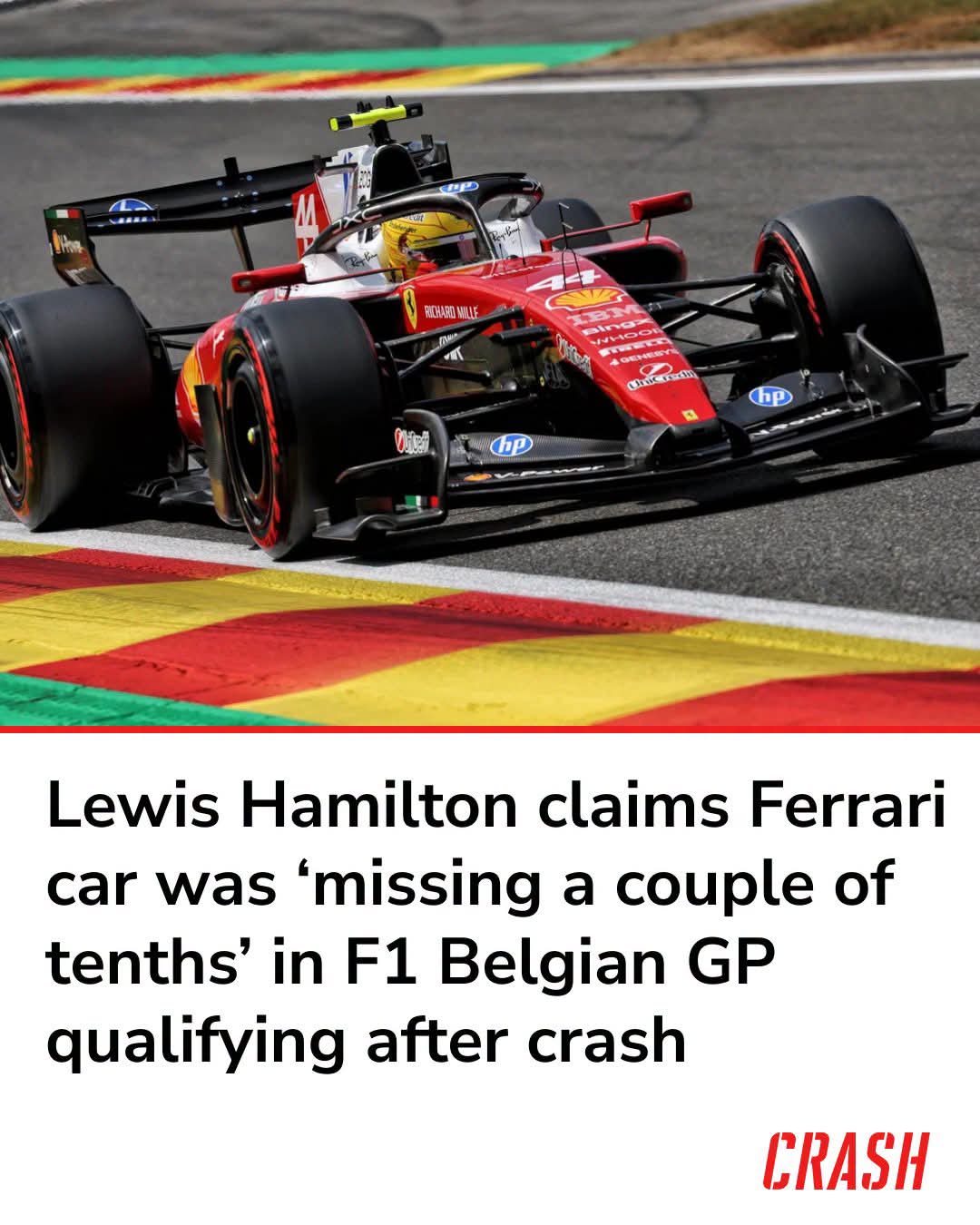
Lewis Hamilton believes Ferrari could have challenged much higher on the grid at the Belgian Grand Prix if not for the damage sustained in a dramatic final practice crash. Although Ferrari’s mechanics completed an impressive rebuild in time for qualifying, the seven-time Formula 1 World Champion insists the SF-26 never felt quite the same afterward, leaving him convinced he was “missing a couple of tenths” during one of the most important sessions of the weekend.
Hamilton ultimately qualified sixth at Spa-Francorchamps, just 0.002 seconds behind teammate Charles Leclerc, but the narrow margin only reinforced his belief that the repaired car lacked the balance and confidence it had shown earlier in the day. With Mercedes setting the benchmark throughout qualifying, Hamilton believes Ferrari missed a valuable opportunity to fight closer to the front.
MAJOR REBUILD KEPT HAMILTON IN THE FIGHT
Hamilton’s weekend took a worrying turn during the final practice session when he ran wide exiting the Fagnes Chicane and clipped the barrier with the rear of his Ferrari. The impact caused extensive damage, forcing Ferrari’s mechanics into a race against time before qualifying.
The team replaced multiple major components, including the suspension, rear wing, floor, and gearbox, completing an impressive rebuild just before the session began. While Hamilton praised the crew for their remarkable effort, he admitted the car’s handling changed after the repairs.
According to the British driver, the Ferrari that felt perfectly balanced in final practice was no longer identical by the time qualifying started. He suggested the rear suspension characteristics had changed enough to affect the overall balance, making it harder to extract maximum performance over a single lap.
HAMILTON BELIEVES FERRARI HAD MORE SPEED THAN THE RESULTS SHOWED
Before the crash, Hamilton believed Ferrari was capable of fighting near the front of the grid. Although he acknowledged Mercedes looked exceptionally strong throughout the Belgian weekend, he felt a top-three qualifying position was realistically within reach had the car remained unchanged.
Instead, the altered balance forced him to adapt during qualifying rather than attack every corner with complete confidence. In modern Formula 1, where thousandths of a second regularly separate teammates, even a slight loss of rear stability can have a significant impact across an entire lap.
Missing just a couple of tenths may sound insignificant, but at Spa-Francorchamps it can mean the difference between challenging for the front row and starting several positions further back.
MERCEDES APPEARS TO HOLD THE ADVANTAGE AT SPA
Hamilton was quick to acknowledge Mercedes’ impressive pace throughout the Belgian Grand Prix weekend. Championship leader Kimi Antonelli continued his outstanding 2026 campaign by securing another pole position, while George Russell also remained among the fastest despite dealing with his own technical concerns.
Hamilton identified the final sector as Ferrari’s biggest weakness, particularly on the long straights where Mercedes appeared to enjoy superior power and efficiency. Spa’s layout places enormous emphasis on straight-line speed and energy deployment, making it one of the most demanding circuits for teams trying to maximize overall performance.
Ferrari has introduced several upgrades throughout the season, but Belgium exposed areas where further improvements may still be required, especially if the team hopes to consistently challenge Mercedes over both qualifying and race distance.
WHY THIS WEEKEND COULD STILL END POSITIVELY FOR FERRARI
Despite the qualifying setback, Hamilton remains optimistic about Sunday’s race. With Lando Norris serving a grid penalty, the Ferrari driver moves up to fifth on the starting grid, placing him within striking distance of the podium if strategy and tyre management work in his favor.
Spa-Francorchamps is famous for unpredictable weather, safety cars, and overtaking opportunities, meaning qualifying position is only part of the equation. Ferrari has often demonstrated stronger race pace than qualifying speed this season, and Hamilton’s experience could prove invaluable if conditions become chaotic.
If Ferrari can maximize tyre life and capitalize on race strategy, Hamilton has every chance of fighting with the leading group even if outright pace slightly favors Mercedes.
FERRARI’S CHAMPIONSHIP CHALLENGE DEPENDS ON FINDING CONSISTENCY
Hamilton’s comments also highlight one of Ferrari’s biggest challenges in 2026: consistency. The team has shown flashes of race-winning speed, but converting that potential into complete race weekends has proven difficult. Mechanical setbacks, qualifying compromises, and small performance losses have repeatedly prevented Ferrari from fully exploiting its package.
The Belgian Grand Prix serves as another reminder that success in Formula 1 depends not only on designing a fast car but also on maintaining that performance under pressure. Ferrari’s rapid rebuild showcased the team’s resilience and technical expertise, but Hamilton’s feedback suggests there is still work to do before the SF-26 can consistently challenge Mercedes at every circuit.
As the championship enters a crucial phase, Ferrari will hope Belgium becomes a story of recovery rather than missed opportunity. If Hamilton can transform his fifth-place start into a podium finish, it could provide valuable momentum heading into the next stretch of the Formula 1 season and keep Ferrari firmly in the fight against an increasingly dominant Mercedes outfit.