- Lando Norris has taken a step back from his furious post-race reaction to the Azerbaijan Grand Prix, apologising directly to Franco Colapinto after calling for the Alpine driver to receive a race ban.
The reigning Formula 1 world champion was one of three drivers eliminated in a dramatic incident at Turn 1 following a Safety Car restart in Baku. Colapinto locked up under braking, hit his Alpine teammate Pierre Gasly and sent Gasly’s car into Norris.
All three drivers retired.
Norris was visibly frustrated after losing another potentially valuable championship result and initially argued that Colapinto’s driving deserved much stronger punishment.
But after having time to reflect, Norris acknowledged that his comments had gone too far.
NORRIS ADMITS HIS COMMENTS WERE WRONG
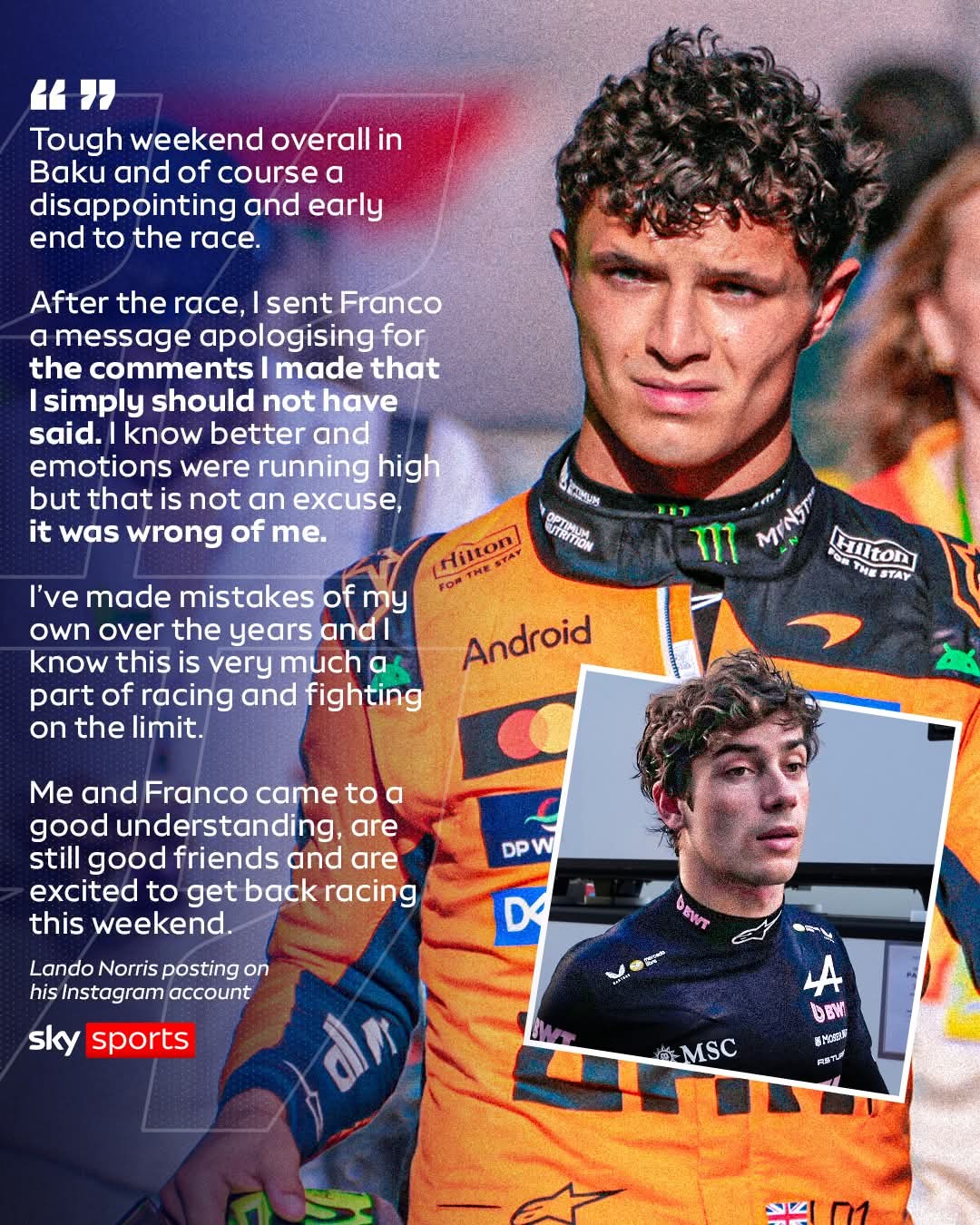
On Monday, Norris addressed the situation publicly through social media.
He revealed that he had contacted Colapinto privately after the race and apologised for what he had said.
Norris acknowledged that his emotions were running high after losing his race, but made clear that frustration was not an excuse for his comments.
That is a significant change from his immediate post-race position.
Norris had previously suggested that Colapinto should be banned and questioned whether some drivers belonged in Formula 1 after incidents of that nature.
His latest message effectively draws a line under those remarks.
COLAPINTO HAD ALREADY ACCEPTED RESPONSIBILITY
Colapinto did not attempt to avoid responsibility for the crash.
Immediately after the race, the Alpine driver apologised to Gasly, Norris and his team, describing the incident as a major mistake.
He explained that he had locked up while the tyres and brakes were cold and lost control of the car heading into Turn 1.
The circumstances made the incident particularly costly for Alpine.
Gasly and Colapinto had been running in positions that offered the team a realistic opportunity to score heavily, but both cars were eliminated.
Norris also lost his race, turning what had already been a difficult weekend into another major disappointment for McLaren.
THE FIA HAS ALREADY DELIVERED ITS PUNISHMENT
Norris’ apology does not change the official sporting consequences.
The FIA stewards gave Colapinto a 10-second penalty for causing the collision.
Because he retired and could not serve the penalty during the race, it was converted into a five-place grid penalty for the next Grand Prix.
That distinction is important.
Norris can apologise for his comments while still believing that the crash deserved punishment.
Likewise, Colapinto can apologise for causing the accident while accepting the FIA’s decision.
The personal disagreement and the regulatory process are separate matters.
NORRIS NOW ACKNOWLEDGES THAT MISTAKES ARE PART OF RACING
One of the most important parts of Norris’ latest statement was his acknowledgement that he has made mistakes himself.
That changes the tone of the story.
Rather than continuing to argue about whether Colapinto deserved a ban, Norris recognised that Formula 1 drivers operate at the limit and that mistakes are inevitably part of racing.
That does not make the Baku collision harmless.
Three drivers lost their races and Alpine lost a potentially valuable double-points opportunity.
But it does provide a more measured perspective on what happened.
MAX VERSTAPPEN HAD ALREADY DISAGREED WITH THE BAN IDEA
Norris’ original comments had already produced disagreement within the F1 paddock.
Max Verstappen, who finished second in Baku, said a race ban would be excessive if a driver understood the mistake and apologised.
George Russell also questioned whether such a severe punishment was appropriate for what he viewed as an error during difficult Safety Car restart conditions.
That made Norris’ subsequent apology even more significant.
The reigning champion has now moved closer to the more measured position expressed by several of his rivals.
THE TIMING OF THE CRASH MADE EVERYTHING WORSE
The incident occurred during a particularly difficult moment of the race.
The Safety Car had bunched the field together, meaning drivers had to prepare for a restart while managing tyre and brake temperatures.
Colapinto approached Turn 1 and locked up, leaving him unable to control the car properly.
The resulting chain reaction was immediate.
His Alpine struck Gasly, and Gasly’s car then collected Norris.
There was very little opportunity for Norris to react.
For the McLaren driver, that made the retirement particularly frustrating because the incident was not caused by a mistake of his own.
ALPINE ALSO SPOKE OUT AFTER THE CRASH
The controversy did not remain limited to the drivers.
Alpine subsequently condemned online hate and abuse directed toward Colapinto and others following the incident.
The team stressed that mistakes can happen when drivers compete at the limit and that criticism of sporting incidents should not turn into personal abuse.
That development is important because Norris’ original comments were made in the immediate aftermath of the crash, when emotions were high.
The online reaction that followed became a separate issue altogether.
Norris’ apology now helps draw a clear distinction between criticising an incident and attacking the person responsible.
NORRIS AND COLAPINTO HAVE PUT THE PERSONAL ISSUE BEHIND THEM
According to Norris’ statement, he and Colapinto reached an understanding after the apology.
Norris indicated that they remain friends and are both looking forward to getting back on track.
That is probably the most important development from a sporting perspective.
Formula 1 drivers compete against each other at extraordinary speeds, often making decisions within fractions of a second.
Collisions will happen.
What happens after those collisions can be just as important for relationships inside the paddock.
Colapinto accepted responsibility.
Norris recognised that his emotional reaction went too far.
The two drivers can now move forward.
THE BAKU INCIDENT WILL STILL HAVE CHAMPIONSHIP CONSEQUENCES
Even though the personal dispute appears to have been resolved, the sporting consequences remain.
Norris lost a race that could have contributed valuable points to his championship campaign.
The 2026 title fight is already extremely competitive, meaning every retirement can have a significant effect on the standings.
George Russell’s victory in Baku also changed the championship picture, while Kimi Antonelli strengthened his position at the top after recovering to finish fifth.
For Norris, therefore, the crash was not simply an emotional disappointment.
It had genuine championship implications.
THE BIGGER LESSON FROM NORRIS’ APOLOGY
The most interesting part of this story may ultimately be Norris’ willingness to admit that he got his reaction wrong.
Immediately after a retirement, especially one caused by another driver, emotions can overwhelm rational judgment.
Norris was angry because his race had ended through no fault of his own.
But after stepping away from the immediate aftermath, he reconsidered his comments and contacted the person he had criticised.
That is an important distinction.
Apologising does not mean Norris believes the crash was acceptable.
It means he recognised that his response went beyond what he should have said.
WHAT HAPPENS WHEN THEY MEET AGAIN?
The next time Norris and Colapinto share a circuit, the Baku incident will inevitably be remembered.
But there is no reason for it to define their relationship.
Colapinto has already accepted responsibility.
Norris has apologised.
The FIA has delivered its sporting punishment.
Now the only thing left is to race.
That could make their next on-track encounter one of the more interesting subplots of the upcoming Grand Prix.
Will they race each other aggressively?
Almost certainly.
But after Baku, both drivers now have an opportunity to show that the incident is behind them.
FINAL TAKEAWAY
Lando Norris’ Azerbaijan Grand Prix ended in frustration, but his response several days later tells a very different story.
He initially demanded a race ban for Franco Colapinto after the Alpine driver’s mistake eliminated both Norris and Pierre Gasly.
After reflecting on the incident, however, Norris admitted that his comments were wrong and personally apologised to Colapinto.
Colapinto’s FIA penalty remains in place, but the personal dispute appears to have been resolved.
The episode is ultimately a reminder that Formula 1 is contested by human beings, not machines.
Drivers make mistakes on track.
They can also make mistakes with their words away from it.
In Baku, Colapinto accepted responsibility for the first mistake.
Now Norris has accepted responsibility for the second.
And with both drivers preparing to return to the track, the best way to close the chapter may be exactly what they both want: get back racing.