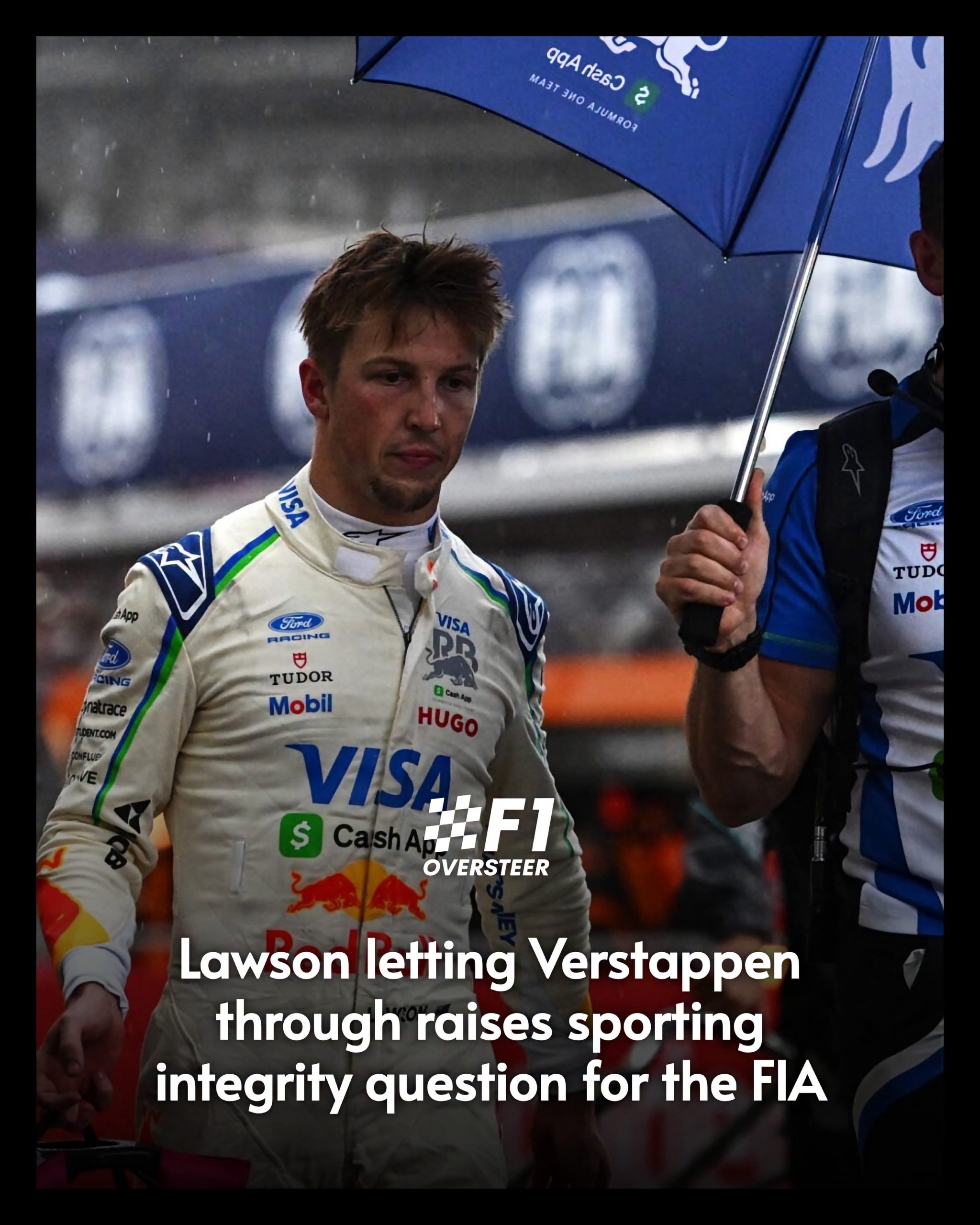
Liam Lawson’s Brazilian Grand Prix performance has sparked a fresh Formula 1 controversy after the Racing Bulls driver appeared to move aside without resistance when Max Verstappen caught him at Interlagos. While the incident may have looked like a straightforward overtake, former F1 driver Karun Chandhok believes Lawson deliberately avoided fighting the four-time world champion, raising questions about the relationship between Red Bull Racing and its sister team. The moment has also reignited discussions about Lawson’s future and the independence of Racing Bulls.
KARUN CHANDHOK QUESTIONS LAWSON’S DECISION TO MOVE ASIDE
Chandhok believes Lawson’s approach when Verstappen arrived behind him was noticeably different from the aggressive resistance he has shown in previous encounters.
Speaking on Sky Sports F1, Chandhok reflected on the history between the two drivers, particularly their clashes in Miami and Malaysia, before highlighting the Brazilian GP incident.
According to the former driver, Lawson appeared to lift off down the straight and allow Verstappen through rather than attempting to defend his position.
Chandhok described the manoeuvre as being like “candy from a baby,” suggesting Verstappen encountered virtually no resistance from the Racing Bulls driver.
The observation immediately attracted attention because Lawson has previously demonstrated that he is willing to challenge Verstappen on track, even when the consequences could be significant.
VERSTAPPEN’S INCREDIBLE BRAZILIAN GP RECOVERY
Verstappen entered the São Paulo Grand Prix facing a difficult challenge after engine-related penalties pushed him to the back of the starting order.
However, the Red Bull driver quickly demonstrated why he remains one of Formula 1’s most dangerous competitors in race conditions.
His rapid progress through the field put him among the leading contenders despite starting from the rear, creating a difficult situation for drivers who found themselves directly ahead of him.
Lawson, meanwhile, had started third following the penalties affecting several established frontrunners.
Although his starting position offered an opportunity for a potentially memorable result, the Racing Bulls driver gradually lost ground as faster cars worked their way forward.
When Verstappen eventually caught him, Lawson’s decision not to defend became one of the most discussed moments of the race.
WHY LAWSON’S PREVIOUS CLASHES WITH VERSTAPPEN MATTER
The controversy cannot be separated from the growing tension between Lawson and Verstappen during the 2026 season.
Their relationship attracted attention following a minor collision in Miami, while another confrontation occurred during practice at the Mexican Grand Prix.
The Mexico incident became particularly significant because both drivers received one-place grid penalties after their collision.
Verstappen subsequently criticised Lawson’s approach, suggesting the New Zealander needed to exercise better judgment while his Formula 1 future remained uncertain.
Lawson apologised for the Mexico incident, but the episode intensified scrutiny surrounding his relationship with Red Bull’s leading driver.
Consequently, his decision to move aside in Brazil has been interpreted differently by observers.
Some believe it demonstrated sensible race management, while others wonder whether Lawson was determined to avoid another confrontation with Verstappen.
DOES RACING BULLS HAVE THE FREEDOM TO FIGHT RED BULL?
The incident has reopened a long-running debate about the independence of Racing Bulls within the wider Red Bull Formula 1 structure.
Although Racing Bulls operates as a separate constructor, its close relationship with Red Bull Racing has repeatedly attracted attention from rival teams.
McLaren CEO Zak Brown has previously questioned aspects of the relationship between the two organisations, particularly concerning their competitive independence.
Lawson’s Brazilian GP manoeuvre has therefore become another moment for critics to examine.
However, there is an important distinction between questioning the relationship and establishing that an instruction was issued.
There is currently no confirmed evidence that Lawson was ordered to let Verstappen pass in Brazil.
The overtake could simply have been a strategic decision by Lawson, who may have recognised that defending against a much faster car would cost both drivers valuable time.
In Formula 1, drivers frequently choose not to fight when the competitive circumstances make resistance unnecessary or potentially damaging.
That possibility should not be overlooked when evaluating the incident.
SPORTING INTEGRITY QUESTIONS EMERGE AFTER INTERLAGOS
The discussion surrounding Lawson’s decision also raises broader questions about sporting integrity in Formula 1.
The FIA must ensure that every competitor has the opportunity to race fairly, regardless of team relationships, driver contracts or championship ambitions.
However, allowing a faster car to pass is not automatically a sporting infringement.
Drivers regularly make tactical decisions to protect their tyres, preserve race pace or avoid unnecessary collisions.
For an integrity concern to become a formal regulatory issue, there would need to be evidence of conduct violating the sporting regulations rather than simply an interpretation of a driver’s on-track behaviour.
Lawson’s manoeuvre alone does not establish wrongdoing by Racing Bulls, Red Bull or either driver.
Nevertheless, the incident highlights why Formula 1’s team relationships remain a sensitive subject whenever drivers from closely connected organisations compete against each other.
LAWSON’S 2027 FUTURE ADDS ANOTHER LAYER TO THE CONTROVERSY
The timing of the Brazilian GP incident is particularly significant because Lawson’s future remains uncertain.
Racing Bulls has yet to provide definitive confirmation of its 2027 driver line-up, leaving the New Zealander under pressure to demonstrate that he deserves another season.
Red Bull junior Nikola Tsolov has emerged as a potential alternative, adding further uncertainty to Lawson’s position.
Martin Brundle has already argued that it would be pathetic for Racing Bulls to use Lawson’s Mexico collision with Verstappen as justification for dropping him.
That defence reflects the growing belief that Lawson’s performances deserve serious consideration, regardless of his disagreements with Verstappen.
His Brazilian GP result also offered another opportunity to demonstrate his capabilities under difficult circumstances.
The question now is whether Racing Bulls will judge Lawson primarily on his overall performance or allow the controversies surrounding Verstappen to influence its decision.
WHAT THE BRAZILIAN GP INCIDENT MEANS FOR FORMULA 1
Lawson’s decision to move aside may ultimately prove to be an ordinary racing moment that became controversial because of the drivers involved.
However, it has once again exposed the uncomfortable questions surrounding Red Bull’s two-team structure.
For Lawson, avoiding another confrontation with Verstappen may have been the most practical decision available during the race.
For Racing Bulls, the incident creates another opportunity to demonstrate that its drivers are evaluated independently and that competitive decisions remain firmly in its own hands.
For Formula 1, the broader lesson is that even a routine overtake can generate significant controversy when team relationships and driver futures are involved.
Until further evidence emerges, accusations of compromised sporting integrity remain speculation rather than established fact.
But one thing is certain: Liam Lawson’s relationship with Max Verstappen has become one of the most fascinating storylines surrounding the Red Bull driver programme, and the Brazilian Grand Prix has ensured that the debate is far from over.