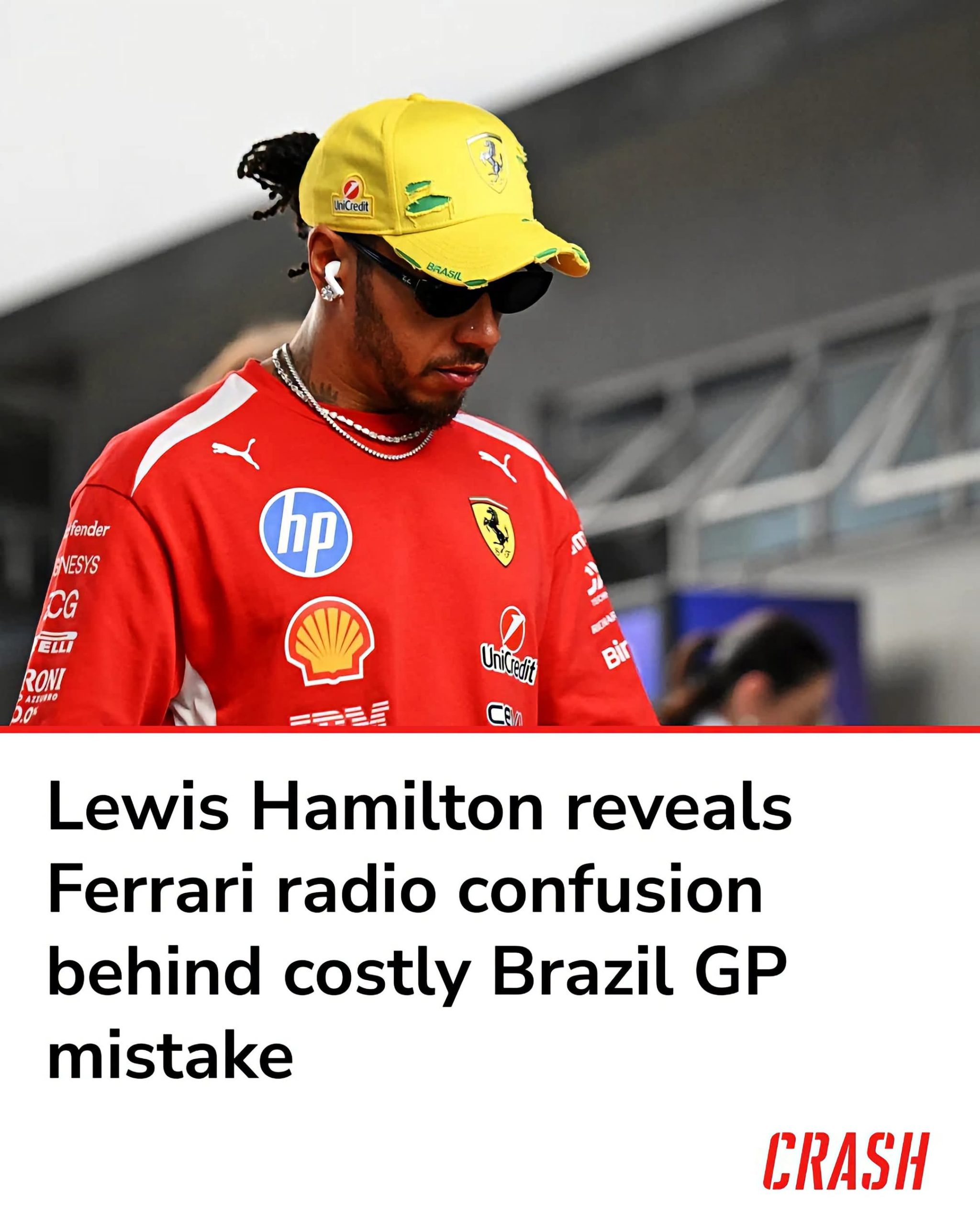
Lewis Hamilton has revealed how a crucial misunderstanding over worsening weather conditions contributed to another frustrating Formula 1 weekend for Ferrari at the 2026 Brazilian Grand Prix. Despite an impressive recovery from 20th on the starting grid, the seven-time world champion believes communication problems during the closing stages cost him valuable positions at Interlagos. His explanation has also raised fresh questions about Ferrari’s race management as the team continues searching for consistency.
HAMILTON EXPLAINS FERRARI’S COSTLY WEATHER MISCOMMUNICATION
Hamilton’s Brazilian Grand Prix ended with a frustrating ninth-place finish, although his recovery from the back of the grid initially appeared considerably more promising.
The Ferrari driver revealed that a crucial radio message from the pit wall indicated that the rain would remain light, leaving him believing that continuing on slick tyres was the correct strategy.
However, conditions were deteriorating more rapidly than he understood.
Hamilton explained that he had not received information indicating that heavier rain was affecting the first sector. By the time he approached Turn 1 after passing the pit entry, the track had become significantly wetter.
The missed opportunity ultimately cost him positions during a race in which every strategic decision carried considerable importance.
Hamilton described the experience as another difficult moment in an already challenging weekend for Ferrari, although he acknowledged the team’s efforts throughout the event.
FROM 20TH ON THE GRID TO THE POINTS
Hamilton’s Brazilian GP recovery was particularly impressive considering the circumstances surrounding his starting position.
An engine-related penalty forced him to begin the race from 20th, leaving the British driver with an enormous challenge if he wanted to reach the points-paying positions.
Nevertheless, Hamilton delivered an aggressive opening lap, climbing into ninth place and immediately placing himself in contention for a respectable result.
His early progress demonstrated that Ferrari possessed enough race pace to recover from the difficult starting position.
Unfortunately, his momentum was interrupted when the rear tyres began overheating in the drying conditions.
The problem affected his ability to maintain consistent pace, forcing Hamilton to reconsider his strategy as the track continued changing.
The Ferrari driver eventually pushed for a switch to slick tyres, believing that the conditions had become suitable for a different compound.
Although the decision initially appeared promising, subsequent complications prevented him from building the recovery he had hoped for.
TYRE OVERHEATING COMPLICATES FERRARI’S STRATEGY
Hamilton’s early tyre problems became another major factor in his difficult afternoon.
The intermediate rear tyres began overheating as the circuit dried, creating a situation in which maintaining performance became increasingly challenging.
Such conditions can be particularly difficult for Formula 1 drivers because intermediate tyres lose effectiveness when the track becomes too dry.
Excessive overheating can also reduce grip and make it difficult to control the car consistently, especially when drivers are pushing aggressively.
Hamilton’s decision to move onto slick tyres was therefore understandable, given the conditions he was experiencing.
However, changing weather at Interlagos created a complicated strategic environment for Ferrari.
The circuit can experience rapidly shifting conditions, with one section becoming wet while another remains relatively dry.
That makes accurate communication between the driver and the pit wall essential.
Ferrari’s difficulties demonstrated how quickly a promising recovery can unravel when tyre performance and weather information fail to align.
THE RADIO MESSAGE THAT COST HAMILTON VALUABLE POSITIONS
The most significant moment of Hamilton’s race came during the final stages, when Ferrari’s weather information influenced his decision to remain on track.
Hamilton said the last message he received suggested that the rain would continue as a drizzle.
He consequently believed that he could maintain his pace on slick tyres without immediately returning to the pit lane.
However, the rainfall had intensified in the first sector, creating conditions that were considerably more difficult than he expected.
By the time he reached Turn 1, Hamilton realised that the track had become wet enough to compromise his position.
The missed pit entry left him vulnerable, and he subsequently lost several places.
Hamilton explained that he had not heard the information about heavier rain affecting the opening sector before passing the pit lane.
Although the incident was not necessarily the result of one individual’s mistake, it highlighted the importance of delivering accurate and timely information during changing weather conditions.
In a sport where decisions are frequently made within seconds, even a small communication breakdown can have a significant impact on the final result.
CHARLES LECLERC AGAIN FINISHES AHEAD OF HAMILTON
Despite Hamilton’s difficult race, Ferrari teammate Charles Leclerc managed to finish seventh, giving the Italian team a better result than its other driver.
The difference between the two finishes will inevitably attract attention because Ferrari continues to evaluate its competitive position against the leading teams.
Hamilton’s ninth-place result represented a recovery from the back of the grid, but it also demonstrated how much more the team could potentially have achieved without its strategic complications.
Leclerc’s advantage does not automatically establish that he had a superior race in every respect.
The two drivers encountered different circumstances, and Hamilton’s engine penalty placed him at a disadvantage before the race even began.
Nevertheless, finishing behind Leclerc will add another layer to Hamilton’s ongoing challenge to establish himself consistently at Ferrari.
FERRARI’S RACE MANAGEMENT UNDER FRESH SCRUTINY
Hamilton’s explanation provides another example of how Ferrari’s operational decisions can influence its results.
The team has demonstrated considerable technical ability, but its race management remains under scrutiny whenever strategic complications affect its drivers.
At Interlagos, Ferrari had to manage engine penalties, changing weather conditions, tyre overheating and the pressure of recovering positions.
These factors made the race particularly difficult, but they also created opportunities for strategic decisions to make a difference.
The communication issue involving Hamilton is especially important because it highlights an area where improvements could potentially deliver immediate benefits.
Better coordination between the pit wall and drivers could help Ferrari react more effectively to changing conditions.
However, it would be unfair to judge the entire race strategy solely through the final incident, especially considering the complicated circumstances surrounding the event.
WHAT HAMILTON’S BRAZILIAN GP MEANS FOR FERRARI
Hamilton’s ninth-place finish leaves Ferrari with another weekend of mixed emotions.
His recovery from 20th demonstrated determination and competitive ability, but the final stages exposed how easily a promising result can be compromised.
For Hamilton, the experience will likely reinforce the importance of reliable communication as he continues adapting to Ferrari’s race operations.
For the team, the Brazilian GP offers valuable lessons about weather monitoring, pit-wall coordination and decision-making under pressure.
The bigger concern is whether Ferrari can consistently convert its potential into stronger results against increasingly competitive opposition.
Hamilton’s explanation does not suggest that Ferrari deliberately compromised his race, but it does underline how important every detail has become in modern Formula 1.
At Interlagos, a promising recovery was ultimately overshadowed by a costly misunderstanding.
And for a driver chasing stronger results with Ferrari, that is precisely the kind of frustration the team will need to eliminate if it wants to compete consistently at the front.