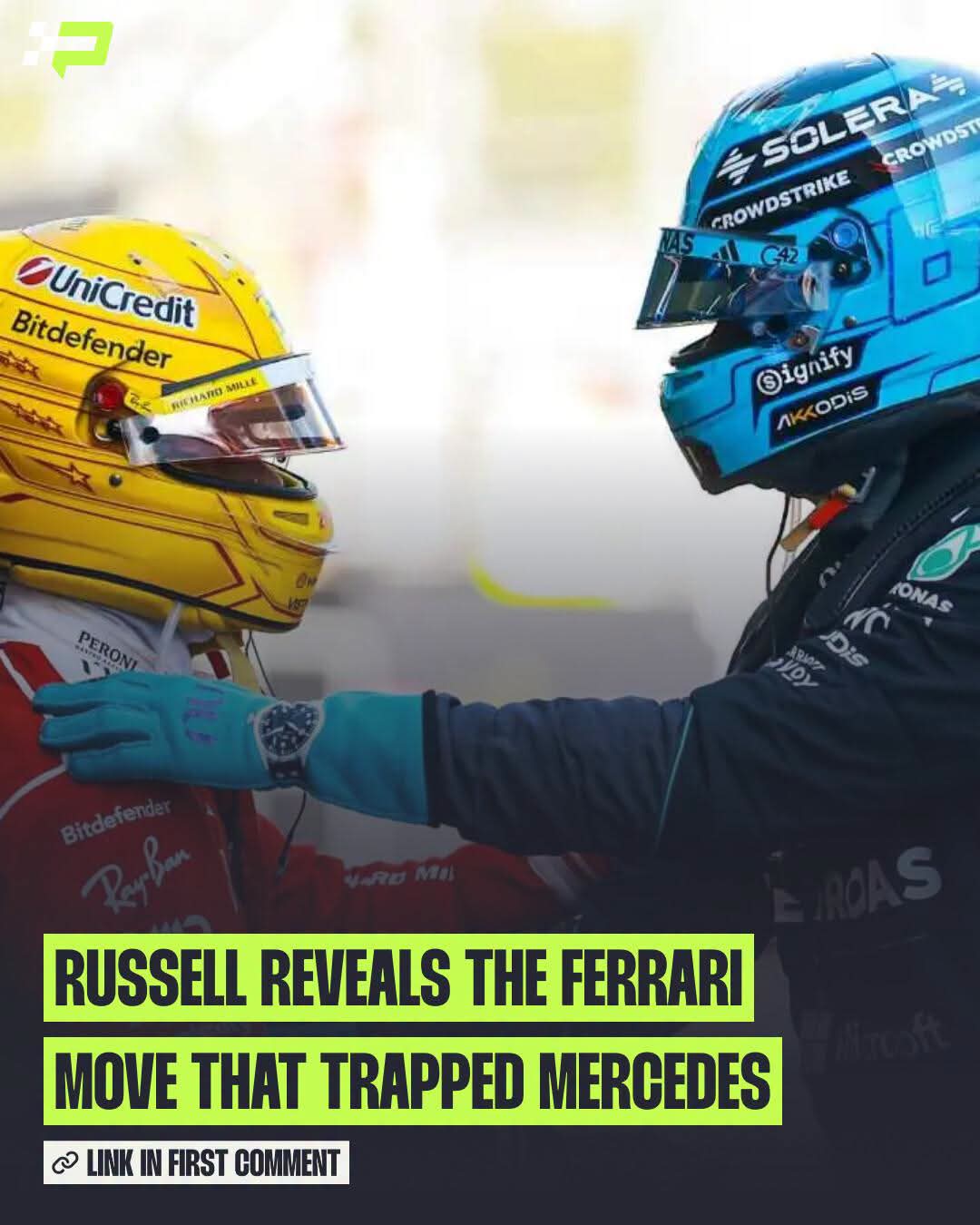
Lewis Hamilton’s breakthrough victory for Ferrari at the Spanish Grand Prix was celebrated as a landmark moment in Formula 1, but behind the emotional scenes and historic headlines was a strategic battle that ultimately decided the race. According to George Russell, Ferrari’s aggressive approach forced Mercedes into a difficult position long before Hamilton crossed the finish line first.
The seven-time world champion secured his first victory in Ferrari colors in Barcelona, ending months of speculation about whether the partnership could truly challenge for wins. Yet Russell believes the foundation of Hamilton’s success was laid through Ferrari’s willingness to gamble early and put Mercedes under immediate pressure.
FERRARI’S EARLY STRATEGY CHANGED THE ENTIRE RACE
One of the biggest talking points from the Barcelona Grand Prix was Ferrari’s decision to commit Hamilton to a three-stop strategy much earlier than expected. While many teams favored a more conservative approach, Ferrari recognized that track position alone would not be enough to defeat Mercedes.
Hamilton’s first pit stop came significantly earlier than his rivals, immediately forcing Mercedes to react. Russell admitted Ferrari’s move left the Silver Arrows with few options. If Mercedes ignored the strategy, Hamilton risked gaining track position through fresher tires. If they responded, they would compromise their own race plan.
In the end, Mercedes chose to cover Ferrari’s move, but doing so locked them into a race strategy that became increasingly difficult to manage as the event unfolded.
RUSSELL ADMITS MERCEDES FOUND THEMSELVES TRAPPED
Russell openly acknowledged that Ferrari’s tactical aggression placed Mercedes in a strategic corner. Once Hamilton’s pace became evident during his second stint, Mercedes could no longer comfortably switch strategies without exposing themselves to additional risks.
The dilemma became even more complicated because Andrea Kimi Antonelli was running strongly behind. Mercedes had to consider not only Hamilton’s threat but also the possibility of losing position within their own team if they altered Russell’s strategy too aggressively.
That balancing act ultimately worked in Ferrari’s favor. While Mercedes attempted to defend against multiple scenarios, Ferrari remained focused on maximizing Hamilton’s race.
The result was a victory that looked increasingly inevitable as the laps ticked down.
THE VIRTUAL SAFETY CAR HELPED, BUT IT WASN’T THE WHOLE STORY
Much attention has been given to the Virtual Safety Car period that allowed Hamilton to make a relatively inexpensive final pit stop. Critics have suggested that without that intervention, the outcome may have been different.
However, even Russell admitted Hamilton’s pace throughout the race was exceptional. The Ferrari driver consistently looked faster than the Mercedes duo, particularly during the middle phase of the Grand Prix.
Had Hamilton emerged behind the Mercedes cars after his final stop, he likely would have faced a tougher challenge. But based on the tire advantage Ferrari had created and the speed Hamilton demonstrated, many in the paddock believe he still had a realistic chance of fighting his way to the front.
The Virtual Safety Car may have accelerated the process, but it did not create Ferrari’s advantage from nothing.
WHY THIS WIN IS A MAJOR TURNING POINT FOR FERRARI
For Ferrari, Barcelona represented far more than a single race victory. The team showed a level of strategic confidence that has often been questioned in recent seasons.
In the past, Ferrari has faced criticism for conservative decisions, slow reactions, and missed opportunities. In Spain, the opposite happened. The team attacked the race aggressively, committed to a bold strategy, and executed it flawlessly.
That sends an important message to the rest of the grid.
Ferrari is no longer simply relying on Hamilton’s experience or Charles Leclerc’s speed. The team appears increasingly capable of making race-winning decisions under pressure, something that will be essential if they are to sustain a championship challenge.
WHAT THIS MEANS FOR THE 2026 TITLE FIGHT
Hamilton’s victory dramatically reshaped the championship conversation. While Kimi Antonelli remains the leader, his late retirement allowed Hamilton to significantly reduce the gap in the standings.
The momentum now appears to be shifting.
Mercedes still possesses one of the strongest overall packages, but Ferrari’s rapid development and improving race execution are turning the championship into a genuine fight. Russell remains firmly in contention as well, creating a fascinating three-way battle within the sport’s two biggest teams.
If Ferrari can continue producing strategic masterclasses like the one seen in Barcelona, Hamilton’s dream of securing an eighth world championship suddenly looks far more realistic than it did just a few races ago.
THE BIGGER LESSON FROM BARCELONA
Barcelona proved that Formula 1 victories are rarely decided by raw speed alone. Strategy, timing, adaptability, and bold decision-making often separate winners from the rest of the field.
Ferrari understood that. Mercedes reacted to it.
Russell’s honest assessment reveals just how influential Ferrari’s early decisions were in shaping the race. By forcing Mercedes onto the defensive, Ferrari dictated the rhythm of the Grand Prix and created the conditions that allowed Hamilton to secure one of the most emotional victories of his legendary career.
With Austria next on the calendar, rivals will undoubtedly study Ferrari’s approach closely. The question now is whether they can stop Hamilton and Ferrari from building on this momentum—or whether Barcelona was merely the beginning of a much bigger championship comeback story.