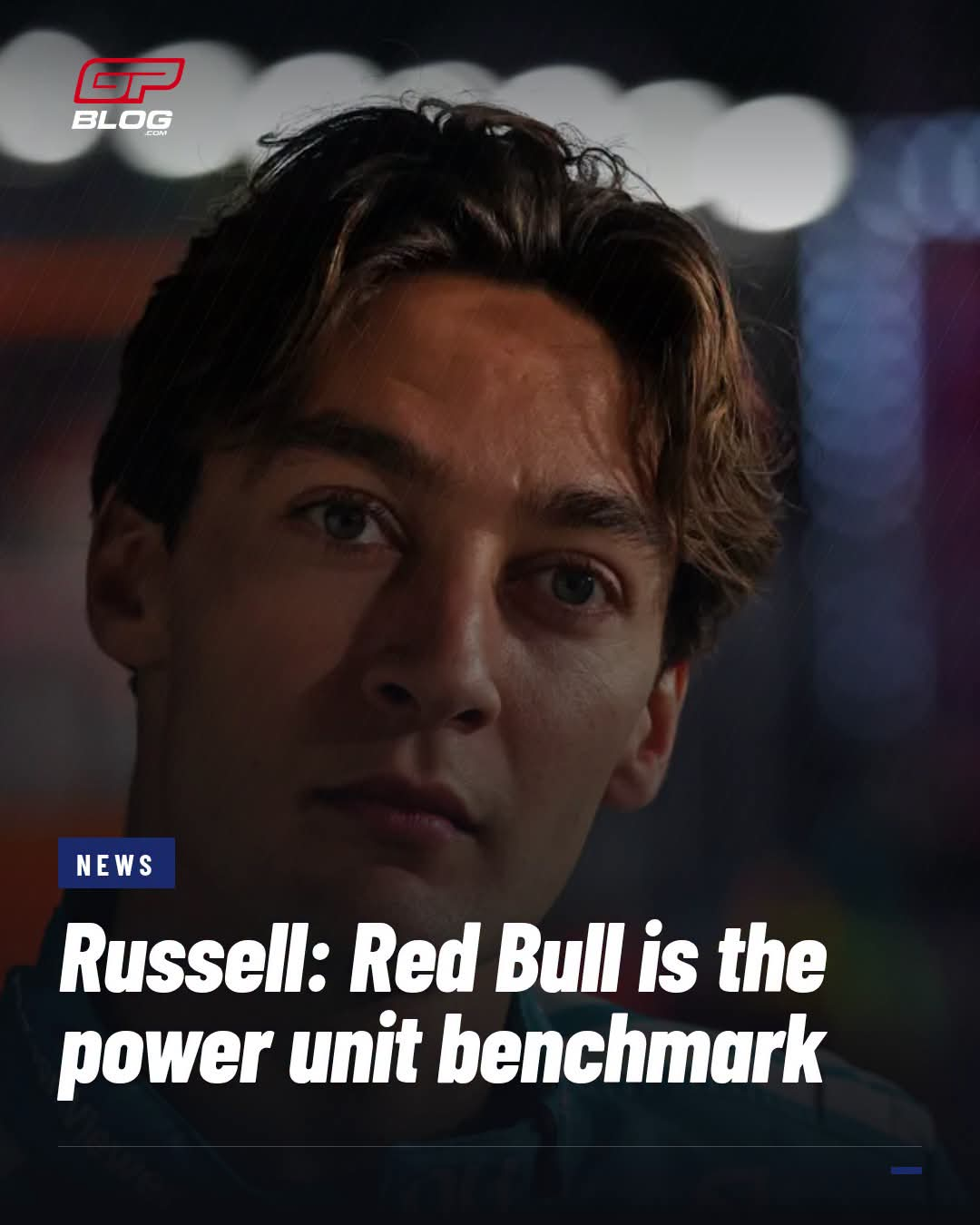
George Russell is a Mercedes driver through and through. He races in silver, collects points for the Silver Arrows, and has helped deliver both the Drivers’ and Constructors’ championships in 2026. Yet even as the team prepares for the Las Vegas Grand Prix with an upgraded power unit component available, Russell is openly saying that Red Bull currently fields the stronger overall power unit package.
That honesty is rare in Formula 1 and worth examining closely. It is not a throwaway line or a moment of frustration. It is a measured assessment from a driver who has lived the season from the cockpit and understands exactly how the new 2026 regulations reward integration rather than isolated peak performance.
WHY RUSSELL’S COMMENTS CARRY REAL WEIGHT
Russell has been careful with his wording. He believes Mercedes still leads in electrical energy management efficiency. The way the hybrid system harvests, stores, and deploys energy remains a strength for the Brixworth power unit. However, he refuses to separate the internal combustion engine from the battery and deployment strategy. Over a full lap, he says, Red Bull’s complete package is the one to beat.
This distinction matters. Under the 2026 rules, power units are more electrically focused than ever, with greater emphasis on energy recovery and sustained deployment. Teams cannot simply chase maximum horsepower from the ICE without considering how that power interacts with aerodynamics, cooling, and battery strategy. Russell pointed out that Mercedes could extract more pure power from its engine, but only by accepting aerodynamic compromises that would hurt elsewhere. Red Bull, in his view, has struck a better overall balance.
The comment also arrives at a revealing moment. Mercedes has already locked up both titles, with Andrea Kimi Antonelli emerging as champion. The pressure of the championship fight is gone, which often allows drivers to speak more freely. Russell’s willingness to credit a rival while still competing for race wins shows confidence rather than insecurity.
THE 2026 POWER UNIT BATTLE HAS BEEN MORE COMPLEX THAN EXPECTED
Few predicted the 2026 power unit landscape would unfold this way. Mercedes entered the new era as the established hybrid specialists. Red Bull Powertrains, working with Ford, was a new manufacturer. Early testing and the opening races suggested Mercedes held advantages in certain areas, particularly energy management on tracks where electrical deployment is critical.
Yet the FIA’s Additional Development and Upgrade Opportunities system ranked Red Bull’s ICE as the benchmark. That designation granted other manufacturers, including Mercedes, limited upgrade paths during the season. Mercedes has used that opportunity, bringing a revised turbo specification to Las Vegas. Antonelli will run the updated part. Russell will not, choosing to avoid a grid penalty after already exceeding his allocation of certain components earlier in the year.
Russell described the expected performance gain from the turbo update as relatively small, more of a developmental step than a game-changer. He preferred a clean grid position in Las Vegas, a circuit where he has historically performed well, over a minor power unit gain that would force him to start near the back.
This choice highlights another layer of the story. Even with both titles secured, Mercedes continues to develop and learn for the remainder of the season and beyond. The team is not resting. At the same time, Russell’s assessment suggests Red Bull has closed any early gaps and, in the holistic view that matters most, moved ahead on the power unit side.
WHAT THIS MEANS FOR THE TEAMS AND THE WIDER GRID
For Mercedes, the comments serve as useful internal feedback. Acknowledging where a rival is stronger forces engineers to examine the entire system rather than defending individual metrics. Electrical efficiency is valuable, but if the overall lap time contribution from the power unit trails, then packaging, cooling, or aero-power trade-offs need further attention heading into 2027.
Red Bull will take quiet satisfaction from the public recognition. Building a competitive power unit from a standing start in a highly regulated environment is an enormous achievement. The fact that a Mercedes driver ranks it as the current benchmark validates the work done at Red Bull Powertrains and the collaboration with Ford. It also reinforces that chassis and power unit development cannot be treated as separate projects. The best results come when both are designed as one system.
Customer teams and other manufacturers are watching closely. Williams, Alpine, and others running Mercedes power units benefit from the strong electrical side Russell described. Racing Bulls and any other Red Bull-powered entries gain from the overall package strength. The performance spread between works and customer cars has always been a talking point; Russell’s remarks add nuance about where the real advantages lie.
LAS VEGAS AND THE FINAL RACES OFFER A LIVE TEST
The Las Vegas street circuit, with its long straights and unique energy demands, will provide an immediate proving ground. Max Verstappen and Red Bull will look to convert their power unit balance into strong results. Mercedes, with one car on the upgraded turbo and Russell prioritizing grid position, will try to extract maximum performance from what they have.
Russell’s decision not to take the penalty shows he still believes the current Mercedes package is competitive enough to fight at the front on this track. That belief is important. It prevents the narrative from becoming purely about Red Bull superiority and keeps the focus on execution, setup, and race craft in the remaining rounds.
Looking further ahead, these late-season insights will influence 2027 development priorities. Power unit regulations evolve slowly, but the lessons about integration, compromise, and holistic performance travel with the teams. Russell’s willingness to speak plainly may also encourage more open technical discussion in the paddock, something Formula 1 often lacks when championships are still alive.
THE VALUE OF HONEST ASSESSMENT IN A HIGH-STAKES SPORT
Formula 1 rewards results above all else. Mercedes has the 2026 titles. That is the ultimate measure of a season. Yet progress is continuous, and the best drivers and teams constantly recalibrate their understanding of where performance comes from. Russell’s comments demonstrate that mindset. He is not diminishing his own team’s achievements. He is simply refusing to pretend the competitive picture is simpler than it is.
In an era of complex hybrid power units, new aerodynamic tools, and tight regulations, the ability to see the whole car rather than isolated components is a genuine advantage. Russell has articulated that clearly. Red Bull currently leads on the power unit side when everything is considered together. Mercedes retains strengths in electrical management and has the championship silverware. Both realities can be true at the same time.
As the 2026 season heads into its final races, that honest ranking from a Mercedes driver adds an intriguing subplot. It raises the level of the technical conversation and gives fans a clearer window into how the new generation of cars actually perform. In a sport that thrives on both rivalry and respect, Russell’s assessment is exactly the kind of insight that makes the story richer.