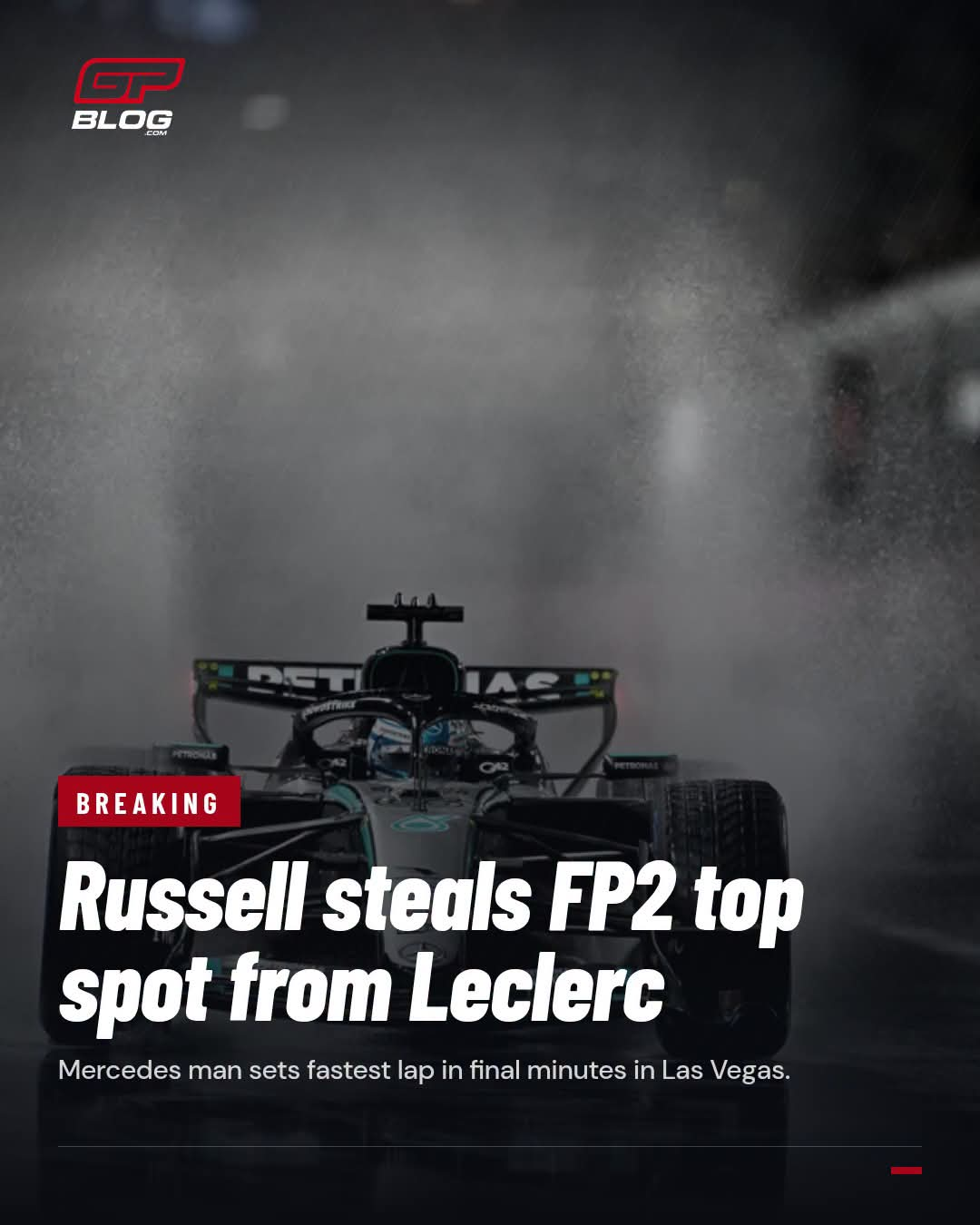
Under the dazzling lights of the Las Vegas Strip, George Russell delivered a late masterclass that turned a damp, disrupted second free practice on its head. The Mercedes driver produced a 1:47.272 on intermediate tyres right as the chequered flag approached, seizing the top spot from a session that Charles Leclerc had controlled for long stretches. Pierre Gasly almost spoiled the party with a strong late effort of his own, finishing just 0.071 seconds adrift, while Leclerc slipped to third.
It was the kind of dramatic end that Vegas loves. After a completely washed-out FP1 in which heavy rain prevented any driver from setting a timed lap, teams finally got meaningful running in FP2. The track remained slippery, conditions evolved rapidly, and a late red flag for debris only heightened the tension. When the green lights returned with limited time left, Russell seized the moment.
WHY RUSSELL’S LATE CHARGE MATTERS MORE THAN A SIMPLE PRACTICE RESULT
Free practice times rarely decide weekends, yet this one carries weight. The Las Vegas Street Circuit rewards precision and confidence on a surface that can change character quickly once rubber is laid down and moisture evaporates. Russell’s ability to extract a clean, fast lap when the track was at its best showed Mercedes still has the tools to fight at the sharp end even as the 2026 season enters its final stretch.
For Russell personally, the result is a timely confidence boost. Consistency has defined his campaign, but high-profile nights under the lights often amplify both success and struggle. Delivering when the pressure of limited remaining track time was highest reinforces his reputation as a driver who thrives in the decisive moments.
Leclerc’s earlier dominance told a different story. The Ferrari looked composed as the track improved, and the Monegasque repeatedly lowered the benchmark. Dropping to third by the end does not erase that underlying pace. It simply underlines how quickly the order can shuffle when intermediates are the weapon of choice and every driver is hunting the same evolving grip window.
ALPINE’S SURPRISE AND THE BROADER MIDFIELD PICTURE
Pierre Gasly’s second place was one of the genuine shocks of the session. Alpine has shown flashes of speed this year, yet regularly converting that into genuine top-three contention remains rare. Gasly’s late lap, completed with a noticeable slide through one of the final corners, demonstrated both the car’s potential and the Frenchman’s willingness to push the limit when the opportunity appears. For a team fighting for every championship point in the constructors’ battle, nights like this matter.
Further back, Isack Hadjar impressed in fourth for Red Bull, while Oscar Piastri and Lewis Hamilton completed a competitive top six. The McLaren pair of Piastri and Lando Norris, along with Kimi Antonelli in the second Mercedes, all found themselves within striking distance of the leaders at various points. The spread of competitive cars suggests the race itself could be wide open if conditions remain changeable.
Max Verstappen’s session was less straightforward. The Red Bull driver spent significant time in the garage and only returned late, ending the session well down the order. Engine concerns that had surfaced previously appeared to linger, limiting his ability to gather the data the team desperately needs on a circuit that punishes small setup errors.
THE IMPACT ON TEAMS AND THE CHAMPIONSHIP PICTURE
Mercedes will take quiet satisfaction from Russell’s performance. With the constructors’ championship still very much alive in the closing rounds, every strong showing helps maintain pressure on rivals. Ferrari will note that Leclerc’s underlying pace was genuine and that Hamilton also featured prominently. The Scuderia has the ingredients for a strong weekend if they can refine their approach for qualifying and race conditions.
Alpine’s result will energise the Enstone squad. Strong practice form does not always translate, yet it provides a platform and, more importantly, belief. In a midfield that has been tightly contested all season, such moments can shift momentum heading into the final races.
The broader industry context is equally relevant. Las Vegas remains one of Formula 1’s highest-profile venues. A dramatic practice session that ends with a last-gasp top time generates headlines, social media engagement, and viewer interest heading into qualifying. For a sport that continues to expand its global footprint, these narrative-friendly nights are valuable.
WHAT TO WATCH AS THE WEEKEND UNFOLDS
Qualifying on the Las Vegas Strip is rarely straightforward. Track evolution, temperature swings, and the constant risk of yellow flags or debris can scramble the order. Russell has shown he can deliver when it counts. Leclerc has shown the Ferrari has genuine speed. Gasly has reminded everyone that Alpine cannot be dismissed.
The key questions now centre on tyre behaviour over longer runs, how teams balance low-fuel qualifying pace against race simulations, and whether Verstappen and Red Bull can resolve their issues in time to feature at the front. The wet FP1 and damp FP2 have already forced teams to adapt on limited information. Those who extract the most from the remaining sessions will hold the advantage.
Russell’s late flyer was more than a single fast lap. It was a statement that Mercedes remains competitive on a circuit that rewards precision and nerve. Leclerc’s earlier control proved Ferrari’s potential. Gasly’s near-miss highlighted the depth of the field. As the lights of Las Vegas continue to shine, the stage is set for a qualifying session and race that could deliver more of the same drama.
In a season defined by fine margins, nights like this remind everyone why Formula 1 under the neon still captivates. The top spot may have changed hands in the dying seconds, but the real battle is only just beginning.