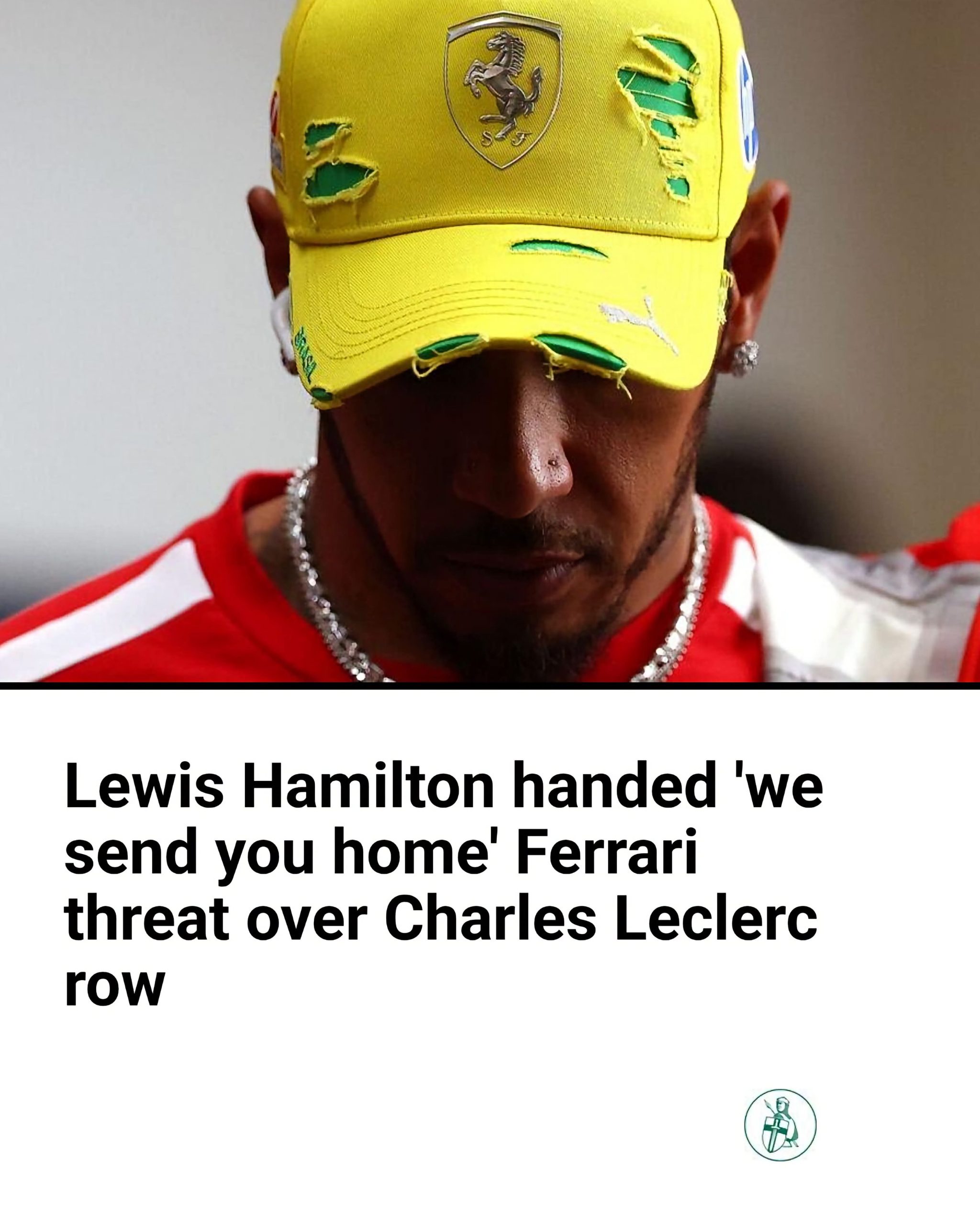
Ferrari’s growing internal tension has taken a dramatic turn after former Haas team principal Guenther Steiner suggested that Lewis Hamilton and Charles Leclerc could eventually face an extraordinary ultimatum from team principal Frederic Vasseur. Following the controversial Mexican Grand Prix, Steiner believes Ferrari may have to threaten sending both drivers home if they continue prioritising personal victories over the team’s collective ambitions.
The warning comes after Ferrari squandered what appeared to be a golden opportunity to secure a memorable one-two finish in Mexico City. With Hamilton starting from pole position and Leclerc immediately moving into second place, the Italian team seemed perfectly positioned to dominate the opening stages. However, the battle between its two superstar drivers quickly transformed a promising afternoon into another frustrating Ferrari controversy.
FERRARI’S MEXICO CITY DISASTER EXPOSES A DEEPER PROBLEM
Ferrari entered the Mexican Grand Prix with genuine reasons to believe it could challenge for victory. Hamilton had secured his first pole position since joining the Scuderia, while Leclerc demonstrated impressive speed to move ahead of George Russell during the opening exchanges.
The combination appeared capable of delivering a commanding Ferrari result. Yet the situation became complicated when Leclerc attempted to challenge Hamilton for the lead.
The resulting confrontation forced Leclerc to cut a chicane to avoid contact, subsequently earning him a five-second penalty. More importantly, the incident created an opportunity for Max Verstappen to capitalise on the confusion and move between the Ferrari drivers.
Verstappen ultimately inherited the lead and converted it into victory, while Hamilton finished second and Leclerc dropped to fourth after serving his penalty.
For Ferrari, the disappointment extended beyond losing a race. The team had possessed the pace and strategic opportunity to secure a result that could have significantly strengthened its championship ambitions.
Instead, the Mexican Grand Prix became another reminder of how quickly Ferrari’s internal competition can threaten its wider objectives.
GUENTHER STEINER DELIVERS A BRUTAL WARNING TO FERRARI
Steiner believes Vasseur faces an uncomfortable situation because Ferrari possesses two drivers capable of winning races, but their competitive instincts could become a serious disadvantage.
Speaking about the situation, the former Haas boss described Ferrari’s driver lineup as both a blessing and a headache.
His argument is straightforward: having two exceptionally talented drivers is an advantage until their individual ambitions begin interfering with the team’s performance.
Steiner questioned whether Ferrari would genuinely prefer a weaker driver lineup simply to avoid internal competition. His position was that Ferrari should remain grateful for having two race-winning talents, while recognising that the management must establish clear boundaries.
However, Steiner does not believe the Mexico controversy will automatically disappear.
He expects similar situations to emerge again because both Hamilton and Leclerc remain determined to win races and establish themselves as Ferrari’s leading driver.
That prediction makes his subsequent warning particularly significant.
‘WE SEND YOU HOME’: THE ULTIMATUM THAT COULD CHANGE FERRARI FOREVER
Steiner suggested that Vasseur might eventually reach a breaking point and deliver a remarkably direct message to his drivers.
“If you don’t work for the team, we send you home,” Steiner imagined the Ferrari team principal telling them.
The statement was not an announcement of Ferrari’s actual plans. It was Steiner’s prediction of how Vasseur might respond if the drivers repeatedly undermine the team’s objectives.
Nevertheless, the message highlights the potential consequences of Ferrari allowing its internal competition to continue without effective intervention.
Sending either Hamilton or Leclerc home would represent an extraordinary decision, given their importance to Ferrari’s sporting ambitions, commercial profile and worldwide popularity.
Both drivers possess the experience, speed and reputation required to lead a championship-winning campaign. Removing either would create an immediate sporting challenge, while removing both would potentially destabilise the entire organisation.
But Steiner’s point is that even the biggest names cannot be allowed to become more important than the team itself.
Ferrari’s management must therefore find a way to protect its investment in two elite drivers without allowing their rivalry to damage its results.
NICO ROSBERG ALSO DEMANDS ACTION FROM FREDERIC VASSEUR
Steiner is not the only former Formula 1 figure questioning Ferrari’s approach.
Nico Rosberg, who experienced an intense championship rivalry with Hamilton during their Mercedes partnership, believes Vasseur must establish clearer racing guidelines between his drivers.
Rosberg argued that Ferrari needs to communicate precisely what behaviour is acceptable and what crosses the line.
According to the former world champion, the situation becomes particularly dangerous when drivers disregard previously established discussions and attempt to resolve disagreements independently on the circuit.
That concern is especially relevant to Ferrari because the Mexican incident demonstrated how quickly a battle between teammates can create opportunities for rival teams.
Rosberg believes the absence of sufficiently clear instructions could allow similar confrontations to continue.
His criticism places responsibility firmly on Vasseur, whose leadership will increasingly be judged by Ferrari’s ability to manage its driver rivalry.
LEWIS HAMILTON AND CHARLES LECLERC BOTH HAVE SOMETHING TO LOSE
Hamilton and Leclerc are not simply fighting for individual victories. Their rivalry also carries implications for their standing within Ferrari and their respective championship ambitions.
Hamilton arrived at Ferrari hoping to add another defining chapter to his remarkable Formula 1 career. Winning with the Italian team would represent one of the most significant achievements of his professional journey.
Leclerc, meanwhile, has spent years developing into Ferrari’s leading figure and has repeatedly demonstrated his ability to compete at the highest level.
Neither driver is likely to willingly surrender opportunities to win races without a compelling reason.
That creates a difficult management challenge.
If Ferrari favours Hamilton, Leclerc could feel his opportunities are being restricted. If the team prioritises Leclerc, Hamilton could question whether Ferrari is providing him with the support necessary to achieve his ambitions.
The alternative is allowing both drivers to compete freely, but Mexico demonstrated that unrestricted competition can carry serious consequences.
Ferrari therefore needs a system that protects both drivers’ opportunities while preventing another costly confrontation.
FERRARI’S TEAM ORDERS DEBATE COULD BECOME EVEN MORE INTENSE
One of the biggest questions surrounding Ferrari is whether Vasseur will introduce more decisive team orders when circumstances demand them.
Mercedes has demonstrated that its management can intervene when necessary to protect strategic objectives. Ferrari, however, has repeatedly faced criticism over situations in which its drivers appear to receive opportunities to fight without sufficiently clear boundaries.
The controversy surrounding Hamilton and Leclerc is not entirely new.
Earlier incidents, including the Dutch Grand Prix, raised questions about Ferrari’s ability to manage its drivers effectively when their individual strategies conflict.
Mexico has now intensified those concerns.
A stronger team-orders policy could help Ferrari prevent unnecessary battles, particularly when one driver has a realistic opportunity to challenge for victory or when a championship position is at stake.
However, implementing such a policy would also create risks.
Drivers who believe they are being unfairly restricted could become frustrated, while fans might accuse Ferrari of sacrificing sporting competition for administrative convenience.
Vasseur must therefore strike a difficult balance between maintaining competitive freedom and protecting the team’s interests.
FERRARI CANNOT AFFORD ANOTHER EXPENSIVE DRIVER CONFRONTATION
The consequences of Ferrari’s internal tensions could extend far beyond individual race results.
Every lost victory represents an opportunity missed in the constructors’ championship, while unnecessary penalties and damaged race strategies can also affect the drivers’ positions in the standings.
More importantly, repeated controversies risk damaging Ferrari’s confidence and operational stability.
The team’s engineers, strategists and mechanics work collectively to produce a competitive car. When that effort is undermined by disagreements between drivers, frustration can spread throughout the organisation.
Vasseur’s challenge is therefore not simply to control two personalities.
He must establish a competitive environment in which Hamilton and Leclerc understand that their individual ambitions remain important, but cannot consistently override Ferrari’s objectives.
If he fails, Steiner’s warning could become an increasingly realistic possibility, even if the exact threat of sending drivers home remains hypothetical.
FREDERIC VASSEUR FACES A DEFINING TEST OF HIS FERRARI LEADERSHIP
Ferrari’s Mexican Grand Prix controversy has created another important test for Vasseur.
The team principal must decide whether to continue relying on discussions and informal agreements or introduce a more authoritative approach to managing his drivers.
Hamilton and Leclerc remain among the most talented competitors on the Formula 1 grid. Their presence gives Ferrari enormous potential, but that potential can only be fully realised if the team operates with discipline.
Steiner’s warning should not be mistaken for confirmation that Ferrari intends to punish either driver. Nevertheless, it reflects a growing concern among experienced Formula 1 figures that the Scuderia cannot continue allowing internal battles to threaten its results.
The next time Hamilton and Leclerc find themselves fighting for the same position, Ferrari’s response could determine whether Mexico was an isolated mistake or the beginning of a much larger problem.
For Vasseur, the message is becoming increasingly difficult to ignore: Ferrari has the drivers to win races, but it must also demonstrate that it has the leadership to keep them working together.
And if another confrontation costs the team a victory, the pressure for a much tougher intervention could become impossible to contain.