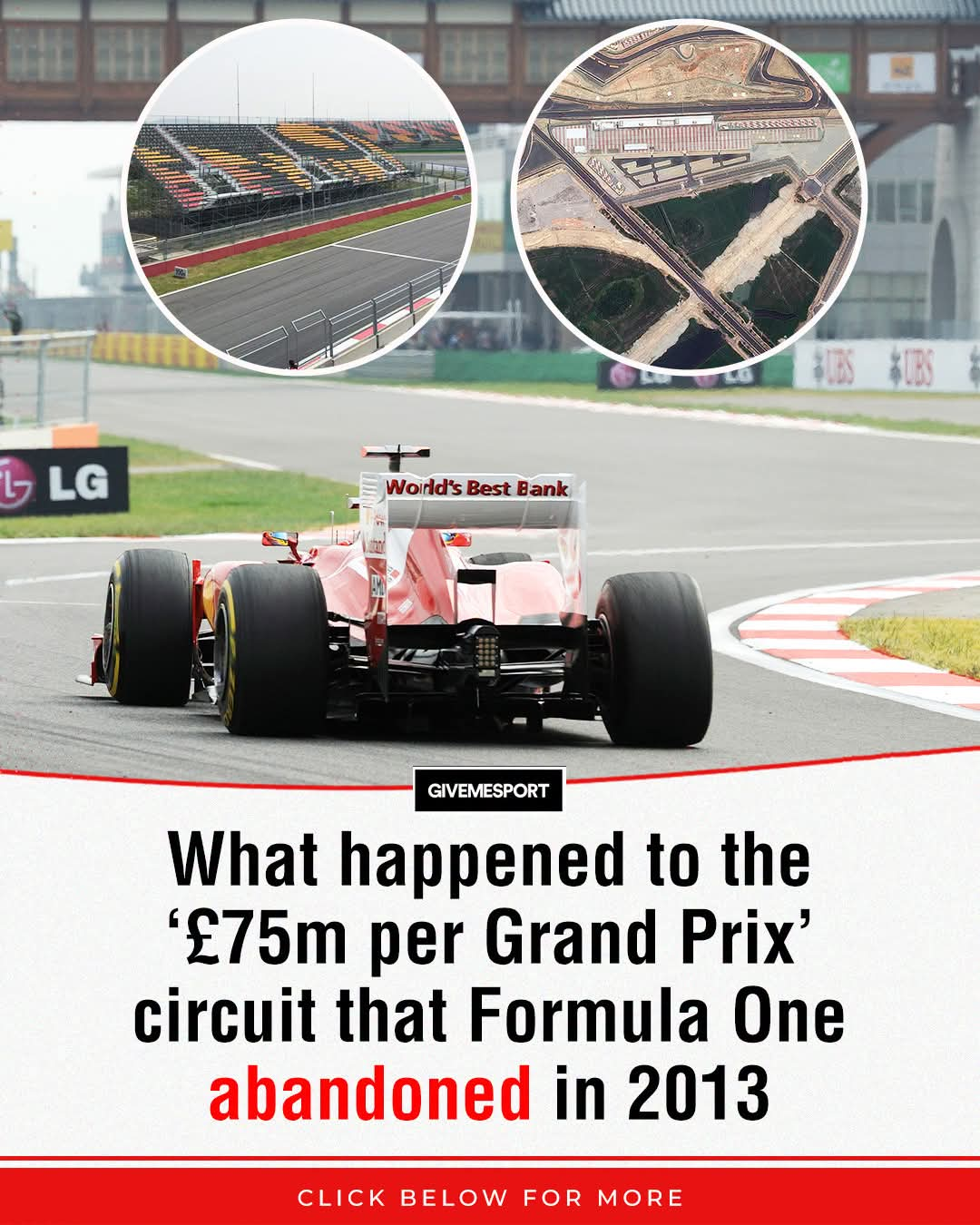
Formula 1 has visited some of the world’s most iconic racing venues, from Silverstone and Monza to Suzuka. Yet not every ambitious addition to the championship calendar has enjoyed the same success. One of the most striking examples is South Korea’s Korea International Circuit, a venue reportedly built at a cost of approximately £300 million that lost its place on the F1 calendar after hosting just four Grands Prix.
Located in Yeongam, in South Jeolla Province, the circuit was designed to establish South Korea as a major destination for international motorsport. It made its Formula 1 debut in 2010, attracting some of the biggest names in racing and delivering memorable championship battles.
However, the project struggled to generate sufficient local enthusiasm and faced significant logistical challenges. The Korean Grand Prix disappeared from the calendar after the 2013 season, leaving behind an expensive racing facility whose original ambitions had not been realised.
More than a decade later, the circuit has not become completely abandoned. Instead, it has developed a different role within South Korean motorsport, hosting smaller racing events, motorcycle competitions, driving experiences and public activities.
THE AMBITIOUS PROJECT THAT BROUGHT FORMULA 1 TO SOUTH KOREA
The Korea International Circuit was created as part of an ambitious effort to bring Formula 1 to South Korea and establish the country as a destination for major international sporting events.
Its first Grand Prix took place in October 2010, but the preparations were far from straightforward. Construction delays, including problems caused by rainfall, meant the circuit received final FIA approval only around 10 days before the inaugural race.
Despite those difficulties, the venue welcomed Formula 1’s leading teams and drivers. The circuit’s layout combined long straights with technical corners, offering opportunities for overtaking while testing drivers’ ability to manage tyre wear and maintain consistent pace.
The facility was designed with substantial spectator capacity, reportedly accommodating up to 120,000 people. On paper, it had the infrastructure needed to support a major international sporting event.
The bigger challenge, however, was ensuring that the investment could be sustained beyond the excitement of its first race.
WHY THE KOREAN GRAND PRIX DISAPPEARED AFTER FOUR SEASONS
The Korean Grand Prix appeared on the Formula 1 calendar from 2010 through 2013, but the event struggled to establish itself as a long-term fixture.
One major problem was its location. The circuit was situated roughly 200 miles from Seoul, South Korea’s capital and largest metropolitan centre. That distance made the journey more complicated for international visitors and spectators travelling from the country’s main population hub.
The event also struggled to attract the level of domestic interest needed to support its enormous costs. While Formula 1 enjoys passionate followings in several Asian markets, the Korean Grand Prix failed to develop a sufficiently strong local audience during its short time on the calendar.
Hosting a Formula 1 race requires far more than building a circuit. Promoters must cover event operations, infrastructure, logistics and the financial obligations associated with securing a place on the championship schedule.
When attendance and commercial returns fail to meet expectations, the financial pressure can become difficult to manage.
The circuit’s difficulties were serious enough that South Jeolla Province official Park Bong-soon reportedly described the project as a “spectacular flop.”
After the 2013 race, the Korean Grand Prix was removed from the calendar, and the planned return never materialised.
FERNANDO ALONSO AND SEBASTIAN VETTEL MADE HISTORY AT YEONGAM
Although the Korean Grand Prix struggled commercially, its four editions produced important moments in Formula 1 history.
Fernando Alonso won the inaugural race in 2010 while driving for Ferrari. His victory came during a fiercely contested championship season in which several drivers remained in contention for the title deep into the campaign.
Sebastian Vettel then established himself as the dominant force at the circuit, winning the Korean Grand Prix in 2011, 2012 and 2013.
Those victories reflected Vettel’s remarkable run with Red Bull during an era when the team combined strong aerodynamic performance with excellent race execution.
His three consecutive wins also gave the Korean venue a clear place in the championship’s recent history, even though the event itself could not survive beyond its fourth edition.
The circuit demonstrated that a venue can deliver competitive racing without necessarily becoming a sustainable commercial success. On-track excitement and long-term financial viability are two very different challenges.
IS THE £300 MILLION CIRCUIT REALLY ABANDONED?
Despite headlines describing the venue as an abandoned F1 circuit, the Korea International Circuit continues to serve motorsport and other activities.
According to the report, the venue hosts the KIC Challenge Race, which features categories including touring cars, prototypes and time-trial competitions. Some events use the original Formula 1 configuration, allowing competitors to race on parts of the layout that once hosted the world’s leading drivers.
Motorcycle racing is another important part of the circuit’s current programme. Events include the All Korea Road Race Championship and activities associated with the Korean World Bike Festival.
The facility also accommodates karting, private track days and opportunities for motorcyclists to ride on a shorter permanent layout. These activities allow enthusiasts to experience the venue without requiring a full-scale Formula 1 event.
Driving and riding instruction provide another source of use. Training programmes can help aspiring competitors and ordinary motorists develop skills involving braking, vehicle control and circuit safety.
The circuit has therefore moved away from its original role as a Formula 1 Grand Prix venue, but it has not simply been left to deteriorate without purpose.
Its current activities may not generate the international attention associated with F1, yet they provide a way to keep the facility operating and connected to the wider motorsport community.
WHY SOUTH KOREA STRUGGLED TO MAKE FORMULA 1 WORK
The Korean Grand Prix’s short lifespan offers an important lesson for countries hoping to attract Formula 1.
A modern circuit can provide excellent facilities, impressive architecture and a challenging layout, but those features alone cannot guarantee success. The surrounding infrastructure, accessibility, local fan interest and commercial partnerships are equally important.
South Korea’s experience illustrates the risks of building an expensive venue before establishing whether the event can attract enough spectators and revenue to justify its ongoing costs.
A circuit located far from major population centres may face additional difficulties with transport, accommodation and visitor spending. These challenges can be overcome, but they require long-term planning and a clear strategy for attracting audiences beyond the immediate region.
The Korean Grand Prix also highlights the difference between hosting a successful race and creating a sustainable motorsport destination. Formula 1’s global reach can generate international attention, but maintaining that attention after the first few events is a separate challenge.
For future host countries, the lesson is clear: the business model must work long after the opening ceremony and inaugural race have ended.
FORMULA 1’S FUTURE IN ASIA AND THE RETURN OF AFRICA
Formula 1 continues to seek opportunities to expand its international footprint, but its calendar has become increasingly competitive as countries and promoters pursue hosting agreements.
South Korea’s experience provides a useful contrast with markets where motorsport already has an established audience and strong commercial support.
Meanwhile, the sport’s reported plans for an African Grand Prix in Rwanda during the early 2030s would represent a significant development for a continent that has not hosted a Formula 1 world championship race since the 1993 South African Grand Prix.
The success of any new venue will depend on more than the excitement surrounding its announcement. Organisers will need to demonstrate that the necessary infrastructure, funding, accessibility and audience demand can support the event over the long term.
The Korean circuit shows what can happen when the ambition of hosting Formula 1 outpaces the commercial realities of maintaining a race.
A COSTLY REMINDER THAT NOT EVERY F1 DREAM LASTS
The Korea International Circuit was built to put South Korea on the Formula 1 map, and for four seasons it did exactly that. It welcomed world champions, hosted competitive racing and became part of the championship’s international story.
But the combination of high costs, a challenging location and limited local enthusiasm ultimately prevented the Korean Grand Prix from becoming a permanent fixture.
Today, the venue’s continued use for racing, training and public activities means its story is more complicated than that of a completely deserted sports facility. It remains a functioning motorsport venue, even though Formula 1 has not returned.
Its legacy is both impressive and cautionary. Building a world-class circuit can bring a country international recognition, but keeping Formula 1 there requires a sustainable plan that extends far beyond the track itself.
For South Korea, the dream of hosting a Grand Prix produced four years of racing history. The challenge was turning that achievement into a lasting business success.