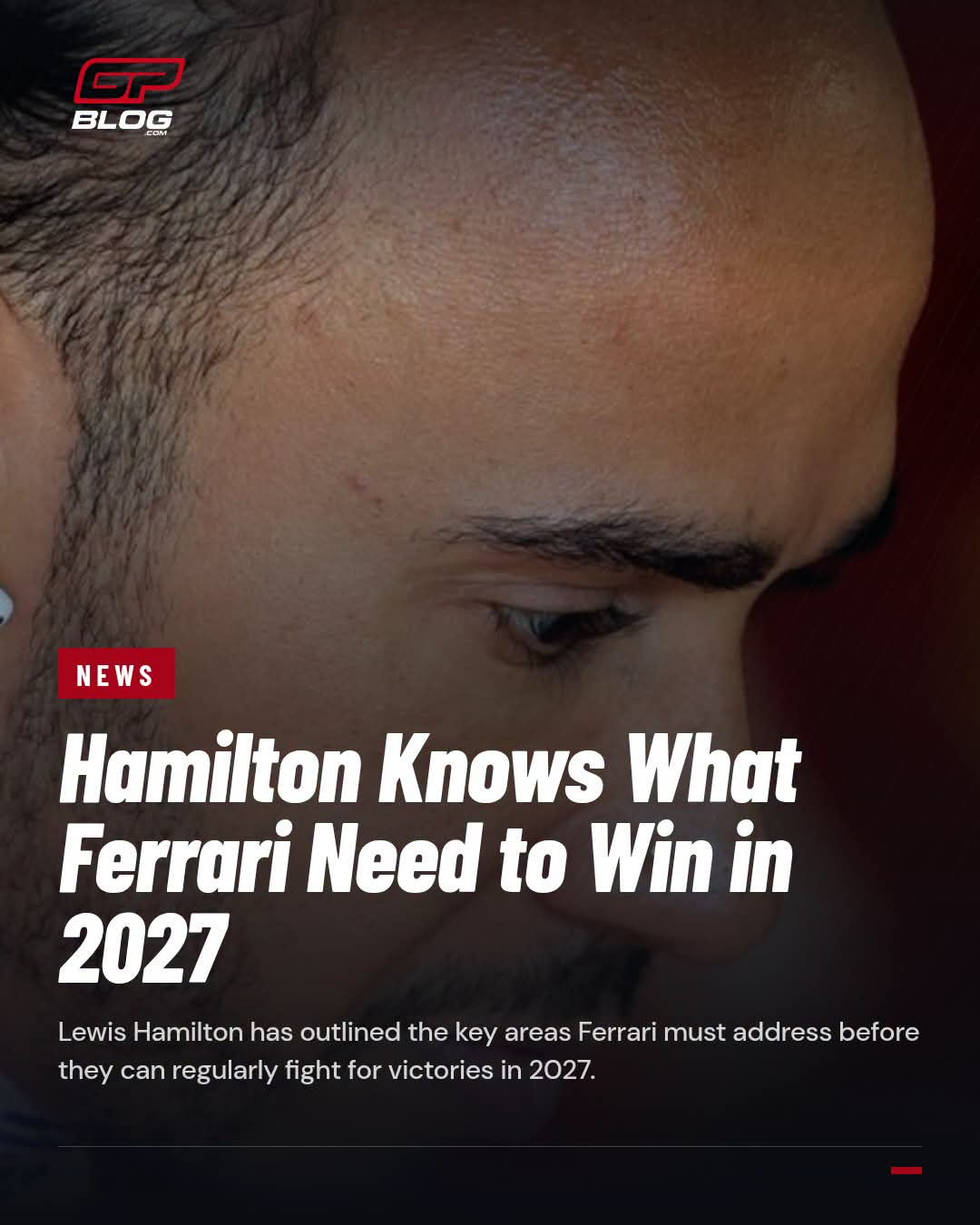
Lewis Hamilton is already playing a crucial role in Ferrari’s preparations for the 2027 Formula 1 season, with the seven-time world champion working closely with the team’s engineers to address the weaknesses preventing the Scuderia from regularly fighting for victories.
Following the United States Grand Prix, Hamilton explained that his focus extends beyond extracting performance from the current car. The British driver is contributing feedback on next year’s chassis and aerodynamic package while highlighting the importance of reducing Ferrari’s engine performance deficit against its main rivals.
Ferrari showed encouraging pace at the Circuit of the Americas, where Charles Leclerc finished second behind Mercedes driver Kimi Antonelli, while Hamilton crossed the line in fourth. However, the result also highlighted the difference between being competitive and having a car capable of consistently winning races.
With the 2026 championship entering its final stages, Hamilton appears determined to help Ferrari turn its potential into a stronger package for next season.
HAMILTON TAKES AN ACTIVE ROLE IN FERRARI’S 2027 DEVELOPMENT
Hamilton has made it clear that his contribution to Ferrari’s future extends beyond his performance during race weekends. He has been involved in discussions about next year’s car, providing feedback intended to guide the engineers responsible for designing new components.
The British driver believes Ferrari is making progress, but he recognises that important decisions must be taken now if the team wants to challenge more consistently at the front in 2027.
Hamilton explained that his work includes identifying improvements needed in the chassis and aerodynamic package. His experience across multiple championship-winning campaigns gives him a valuable perspective on how a competitive car should behave and what drivers need to extract its maximum potential.
“I think also, in the background, I’m working on this pivotal moment in terms of steering the car in the right direction for next year,” Hamilton said.
He also emphasised that discussions with Ferrari’s engineers would continue over the coming race weekends, allowing his observations from the current season to inform the development process.
For Ferrari, the challenge will be translating that feedback into practical improvements. A driver can identify problems with balance, grip and handling, but engineers must determine how to address those issues without creating new weaknesses elsewhere in the car.
FERRARI’S ENGINE DEFICIT COULD BE THE KEY TO FIGHTING FOR WINS
Although Hamilton sees opportunities to improve the chassis and aerodynamics, he has also highlighted the power unit as a crucial factor in Ferrari’s pursuit of greater competitiveness.
Throughout the 2026 season, Ferrari has struggled to match the straight-line performance of Mercedes and Red Bull in certain circumstances. Hamilton has previously indicated that Ferrari can compete through the corners but loses valuable time on the straights.
That difference becomes particularly important during qualifying, when fractions of a second can separate the leading teams. It can also influence race strategy, overtaking opportunities and a driver’s ability to defend a position.
Hamilton believes reducing the engine deficit could allow Ferrari to compete for victories more frequently.
“They’re working hard to improve our engine for next year,” he explained. “I think if we’re able to somehow get closer to these guys with the engine, then obviously we’re going to be fighting for wins in these races.”
The statement highlights Ferrari’s priorities. Improving the chassis alone may not be enough if the team continues to lose substantial time on the straights. Equally, a stronger power unit would have limited impact if the car could not deliver competitive performance through the corners.
Ferrari therefore needs a balanced development programme that improves the entire package rather than relying on a single breakthrough.
THE UNITED STATES GRAND PRIX SHOWED FERRARI’S POTENTIAL
Ferrari’s result in Austin provided evidence that the team can still challenge for major results, even when it does not possess the fastest overall package.
Leclerc secured second place, while Hamilton finished fourth. The result gave Ferrari valuable points, but Antonelli’s victory demonstrated the advantage Mercedes could extract when everything came together.
The contrast also reflects Ferrari’s wider challenge during the season. The team has shown flashes of strong performance, yet converting those moments into regular victories remains difficult.
Hamilton’s fourth-place finish was another opportunity to gather information about the current car, particularly in areas where Ferrari loses ground to its rivals. That feedback could prove useful as the engineers work on next year’s design.
The team must also examine qualifying performance, race execution and strategy. Even a car with improved speed can lose opportunities through poor positioning, tyre-management difficulties or decisions that fail to account for changing race conditions.
Ferrari’s second-place finish in Austin was encouraging, but the team will know that consistent championship contention requires more than occasional podiums.
CAN HAMILTON HELP FERRARI RETURN TO THE TOP?
Hamilton’s arrival at Ferrari created enormous expectations, with supporters hoping his experience and championship-winning background would help the Italian team return to the front of Formula 1.
However, transforming a team’s fortunes takes more than signing a successful driver. Ferrari must ensure that its technical direction, development decisions and race operations all support the same objective.
Hamilton’s willingness to contribute to the 2027 project could be important because his feedback comes from years of competing against the sport’s strongest teams. He understands the difference between a car that can produce an impressive lap and one that can maintain its performance across a full race weekend.
Still, the ultimate test will be whether Ferrari can implement the necessary changes. Development programmes are complex, and improvements in one area can sometimes compromise another. The team must find the right balance between aerodynamic efficiency, mechanical grip, power delivery and tyre management.
There is also pressure to make progress before the next season begins. With Mercedes currently leading the championship, Ferrari cannot assume its rivals will remain stationary while Maranello works to close the gap.
FERRARI MUST ADDRESS MORE THAN ONE PROBLEM FOR 2027
Hamilton’s comments suggest that Ferrari understands the scale of the task ahead. The team needs a more competitive power unit, a stronger overall chassis and an aerodynamic package capable of delivering consistent performance across different circuits.
However, technical development alone will not guarantee success. Ferrari must also ensure its strategy decisions, qualifying preparation and race execution allow its drivers to capitalise on the car’s potential.
The United States Grand Prix showed both sides of the picture. Leclerc’s second-place finish demonstrated that Ferrari can compete near the front, but Antonelli’s victory highlighted the challenge of consistently beating Mercedes.
Hamilton’s involvement could help Ferrari identify where the largest gains are possible, particularly as engineers work towards next year’s design. His experience may be valuable in connecting the driver’s perspective with the technical decisions that ultimately determine performance.
For the British champion, the ambition is clear: he wants a Ferrari capable of fighting for victories rather than simply collecting podiums when circumstances allow.
Whether the team can deliver that transformation in 2027 remains uncertain. But with Hamilton actively contributing to the development process and Ferrari focusing on its chassis, aerodynamics and engine, the groundwork for a more competitive campaign is already underway.
The real measure of progress will come when the next car reaches the track. Until then, Ferrari’s challenge is to turn Hamilton’s feedback into measurable performance gains and ensure that next season begins with a package capable of challenging Formula 1’s leading teams.