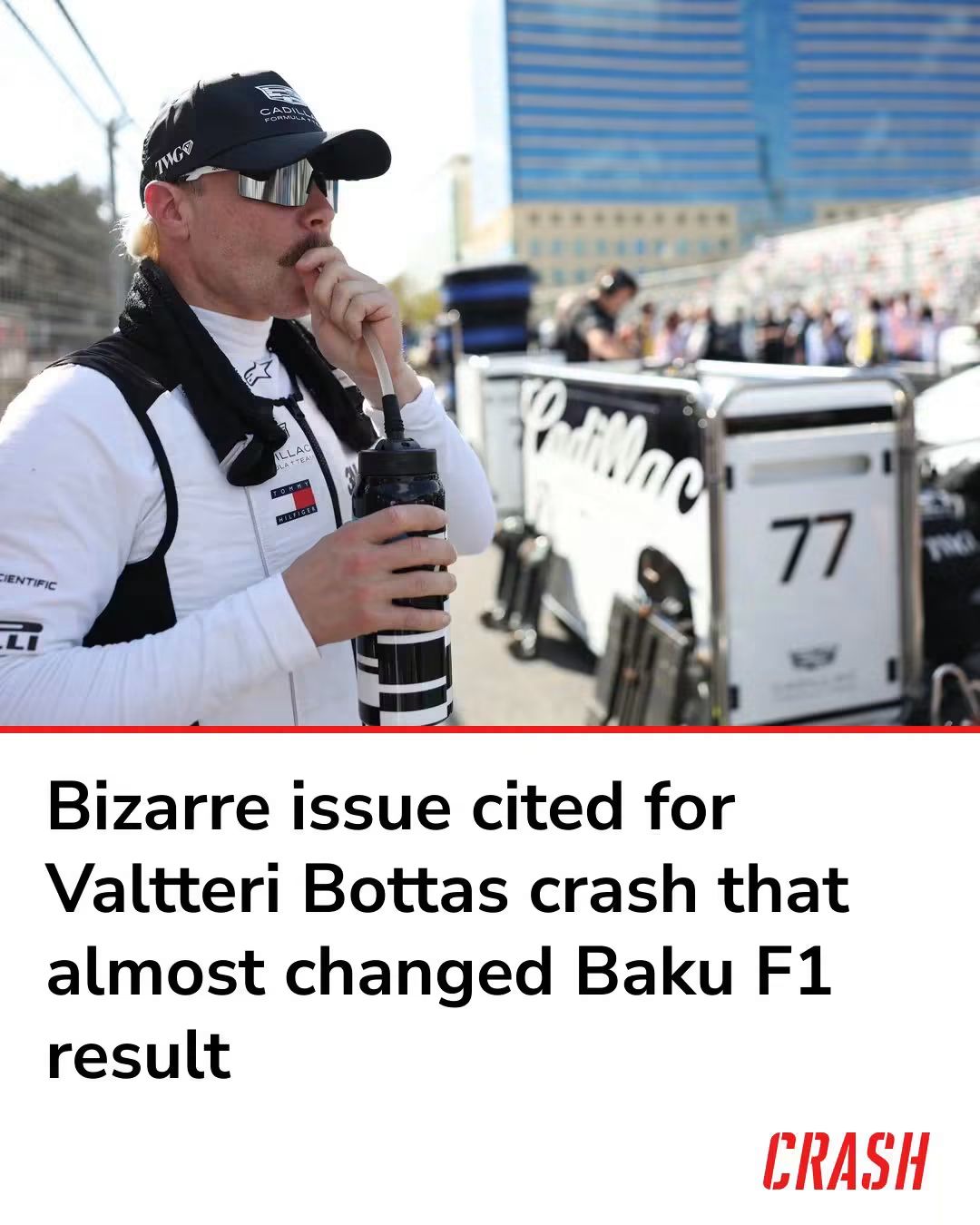
Valtteri Bottas did not simply make a late-race mistake in Baku. The Cadillac driver’s barrier contact at Turn 15 on the penultimate lap of the 2026 Azerbaijan Grand Prix appears to have stemmed from a far stranger problem: the car’s sophisticated energy-management systems becoming confused by a few extra metres of track.
What looked like a routine lock-up and recovery turned into a cascade of electronic quirks that left Bottas with almost no rear braking. The incident, which happened while he was already running near the back, nearly forced a Safety Car that would have rewritten the thrilling fight between George Russell and Max Verstappen. Instead, it has opened a wider conversation about how the new generation of Formula 1 power units behave when the real world refuses to follow the map.
WHAT ACTUALLY HAPPENED ON THE FINAL LAPS IN BAKU
Bottas was having a difficult afternoon. The Cadillac lacked pace, leaving him fighting mainly with the Aston Martins at the rear of the field. On the lap in question he locked up into Turn 1, ran wide, and rejoined after covering additional distance.
Later on the same lap, approaching Turn 15, he experienced what he described as a “huge superclip.” When he hit the brakes, only the fronts responded properly. The rears felt as though energy harvesting had simply stopped working. The car went into the barrier.
Bottas later explained: “First of all, on the same lap I had a lockup into Turn 1, I went wide. Then I think the systems got a bit confused because of the extra distance. I had a huge superclip into [Turn] 15 and then, when I hit the brakes, only the front brakes worked. It was almost like I wasn’t harvesting anymore with the rears, so something got a bit confused there. We need to have a look at what happened, but it was an odd one because it felt like I lost the rear brakes.”
After climbing out, he stayed near the car long enough to inspect the rear, which led to a stewards investigation. They took no further action, accepting his explanation and his commitment to move to safety more quickly in future.
Race control kept the race green under double waved yellows. The low-speed nature of Turn 15 and the option for drivers to cut the apex allowed the leaders to race to the flag. Russell held off Verstappen in one of the closest finishes of the season.
HOW 2026 POWER UNITS MAKE THIS KIND OF GLITCH POSSIBLE
The 2026 regulations delivered a major shift in hybrid architecture. Energy recovery and deployment are more aggressive, brake-by-wire systems are more deeply integrated with the power unit, and learning algorithms continuously adjust brake balance and harvesting based on remaining energy, track position, and predicted distance.
When a car leaves the racing line and covers unexpected metres, those algorithms can momentarily lose their reference. In Bottas’ case the system appears to have triggered an aggressive energy-recovery mode at the wrong moment, effectively removing rear regenerative braking just when he needed it most.
This is not an isolated curiosity. Drivers have already reported similar “confused system” moments under the new rules, including power delivery surprises earlier in the season. The more the software tries to optimise every metre, the more vulnerable it becomes to the messy reality of street circuits, lock-ups, and recovery paths.
WHY THE INCIDENT MATTERS FAR BEYOND ONE RETIREMENT
For Cadillac, still a new manufacturer team finding its feet, the crash is more than a lost classification. It highlights a reliability and predictability gap that pure pace cannot paper over. Bottas and team-mate Sergio Perez have shown large performance swings; unexplained system behaviour only widens the trust deficit between driver and car.
For the championship battle, the decision not to neutralise the race preserved a genuine scrap for victory. A Safety Car would have bunched the field and handed the leaders a different tactical equation. The FIA’s choice was pragmatic and, given the location, defensible. It also quietly demonstrated that not every late incident automatically freezes a race.
For the broader sport, the episode feeds an emerging debate. The 2026 cars are technological showcases, yet drivers increasingly report that the car sometimes decides things for them. When braking feel changes without warning, the human element that still defines Formula 1 is diluted. Fans, teams, and the FIA will watch closely to see whether these software edge cases become rarer or more frequent as the season continues.
WHAT CADILLAC AND THE GRID MUST ADDRESS NEXT
Cadillac has confirmed it will investigate thoroughly. The priority is understanding exactly how the extra distance at Turn 1 propagated into a superclip and loss of rear harvesting. Solutions could involve tighter mapping of recovery logic, better validation of off-line scenarios, or clearer driver feedback when the system is operating outside its normal envelope.
Other teams will study the data too. Street circuits like Baku, Monaco, and Singapore amplify the risk because recovery routes are longer and less predictable. Any team that can make its energy systems more robust to real-world deviations will gain both reliability and driver confidence.
Bottas himself remains characteristically measured. He called the day long and lacking in pace, then focused on the technical puzzle rather than assigning blame. That approach is useful. The problem is not a simple driver error, nor is it necessarily a catastrophic design flaw. It is a systems-integration challenge that the entire grid is still learning to master.
The Azerbaijan Grand Prix will be remembered for Russell’s victory and the tight duel with Verstappen. Yet the quiet story of a Cadillac that briefly forgot how to brake may prove more revealing about where Formula 1 stands in 2026. The cars are smarter than ever. The question now is whether they are also predictable enough when the racing line disappears.