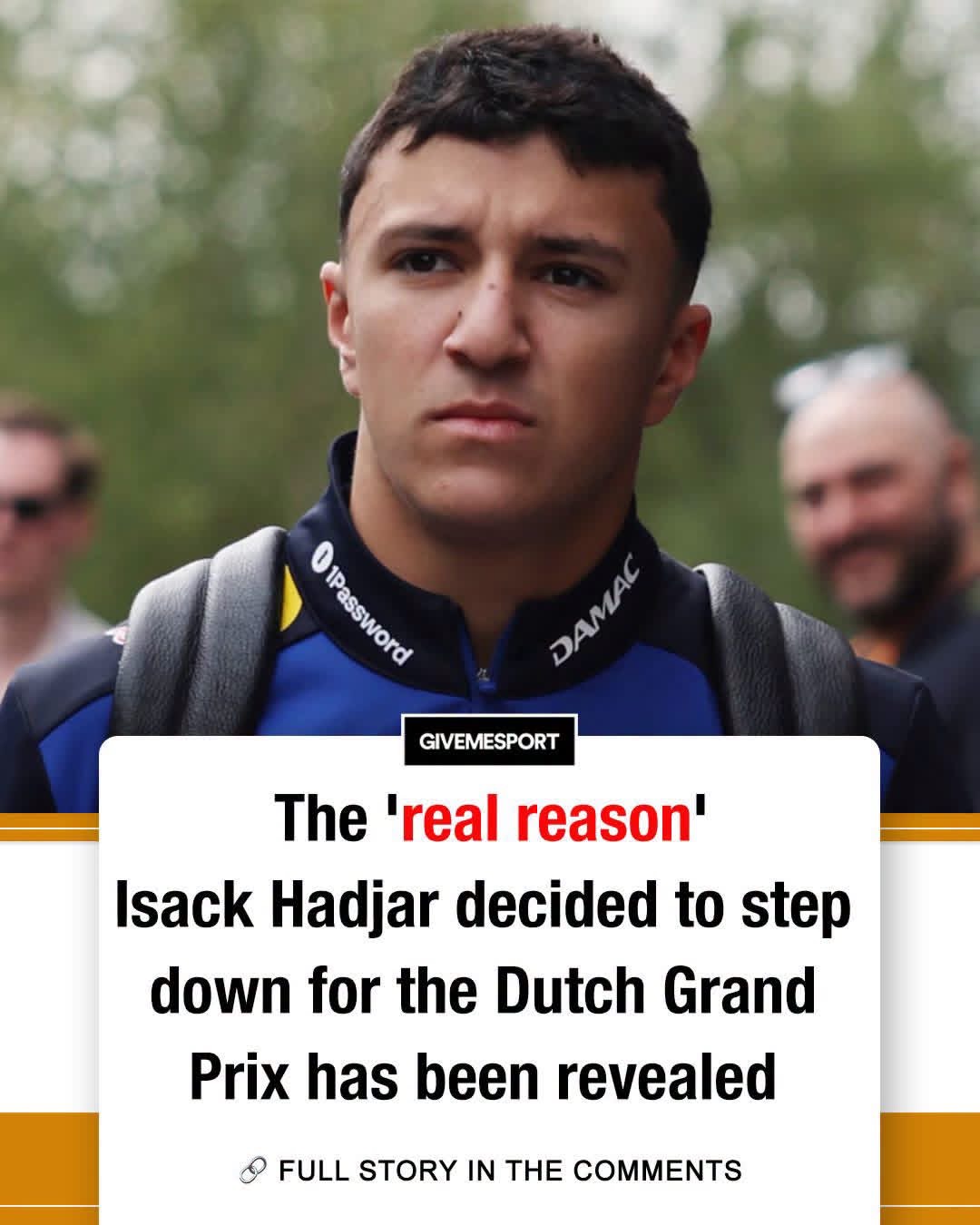
Isack Hadjar reportedly did not initially want to miss the Dutch Grand Prix despite suffering a wrist injury during Formula 1’s summer break. However, advice from MotoGP legend Marc Marquez appears to have played a major role in convincing the Red Bull driver that sitting out at Zandvoort was the sensible option.
Hadjar sustained a small fracture in his wrist, with reports indicating that the injury occurred while boxing as part of his training routine. The French-Algerian driver was keen to compete, but Red Bull ultimately decided against taking the risk. Liam Lawson was brought back into the senior Red Bull team for the Dutch GP, while Yuki Tsunoda moved into Lawson’s Racing Bulls seat for the weekend.
MARC MARQUEZ GAVE HADJAR A DIFFERENT PERSPECTIVE
Hadjar reportedly contacted seven-time MotoGP world champion Marc Marquez for advice. The two share a physiotherapist, giving Marquez an opportunity to offer insight based on his own extensive experience with serious injuries.
Marquez knows better than most how dangerous it can be for an elite competitor to return before an injury has properly healed. His own career was severely disrupted by the arm injury he suffered during the 2020 Spanish Grand Prix, which required several operations and kept him away from MotoGP competition for an extended period.
Speaking about his conversation with Hadjar, Marquez explained that the Red Bull driver was struggling with the decision because athletes naturally want to compete whenever possible.
The advice was apparently enough to help Hadjar accept that missing one race could ultimately be better than turning a relatively manageable injury into a much more serious problem.
RED BULL FACE A DIFFICULT DECISION OVER HADJAR
Hadjar’s absence from Zandvoort was initially viewed as a one-race precaution, but there are now concerns that his recovery could take longer.
The 2026 season has been particularly important for Hadjar, who has established himself as a genuine points-scoring driver in Red Bull’s second seat. His results have included fourth in Monaco, fifth-place finishes in Canada and Great Britain, and several sixth-place results, demonstrating that he has been capable of extracting strong performances from the car.
That makes his fitness situation even more significant. Red Bull will not want to lose a driver who has been contributing valuable championship points, but the team also has little incentive to gamble with an injury that could become worse.
HADJAR’S CONDITION RAISED QUESTIONS AT ZANDVOORT
Hadjar’s behaviour around the paddock reportedly provided another indication that his wrist was still causing problems.
Reports claimed that the driver was reluctant to use his injured left hand while signing autographs and appeared to favour his right hand whenever possible. Although such observations cannot establish the severity of an injury on their own, they underline why Red Bull was unwilling to rush him back into a high-speed Formula 1 car.
Driving an F1 car places considerable physical demands on a driver’s hands, wrists and arms. The combination of steering forces, rapid direction changes and constant adjustments means even a relatively small injury can become problematic over a full race distance.
For Hadjar, therefore, the decision is not simply about whether he can physically climb into the car. The bigger question is whether he can operate at the required level without compromising his recovery.
LIAM LAWSON HAS A HUGE OPPORTUNITY
Hadjar’s injury has simultaneously created an important opportunity for Liam Lawson.
Lawson returned to the senior Red Bull team at Zandvoort and immediately found himself under intense scrutiny. His performance matters because Red Bull now has valuable evidence about how he compares with its expectations after previously losing his seat.
A prolonged Hadjar absence could give Lawson additional opportunities to prove himself. If he continues producing strong performances, Red Bull would have a difficult decision to make when Hadjar is eventually cleared to return.
Yuki Tsunoda’s temporary move back to Racing Bulls also adds another layer to the situation, particularly because Red Bull’s wider driver programme is constantly assessing which young talents can eventually compete at the highest level.
HADJAR MUST THINK BEYOND ONE RACE
The most important lesson from Marquez’s advice is that Hadjar’s priority should be his long-term career rather than forcing himself into a single Grand Prix.
Missing the Dutch Grand Prix is undoubtedly frustrating, particularly after the progress he has made during the season. But aggravating the wrist could potentially cost him far more races and disrupt his development at a crucial stage of his Formula 1 career.
The Italian Grand Prix at Monza will therefore remain an important fitness checkpoint. Hadjar has not necessarily been ruled out, but Red Bull’s willingness to wait will likely depend on medical assessments and whether he can demonstrate that he is capable of driving without putting the injury at further risk.
For now, Marquez’s message appears to have delivered the reality Hadjar needed to hear: sometimes the strongest decision an elite driver can make is knowing when not to race.
If Hadjar returns fully fit, the temporary setback could ultimately prove insignificant. If he rushes back too soon and suffers another setback, however, the consequences could be much greater.